
For Sluggo Rigor, the stories of war were not something he read in textbooks: They were memories that his father—World War II veteran Col. Conrado Rigor Sr.—shared at home as the children grew up: the hunger, the fear, and the will to stay alive after the fall of Bataan.
Those recollections resurface every April 9—“Araw ng Kagitingan”—the day the United States-led Filipino-American forces surrendered to Japanese troops. It was a defeat that set in motion the Bataan Death March, and the suffering that followed 84 years ago.
Rigor said his father would recount one scene from the march where about 76,000 prisoners of war (POWs) were forced to trek roughly 105 to 137 kilometers with little food or water—an ordeal that left thousands dead from brutality, starvation, disease, and exhaustion.
Through tears, the elder Rigor told his children how he watched comrades collapse along the dusty road in the summer heat. He would then recall spotting an “Amerikano” with a gold piece tucked in his pocket. The man pulled it out, approached a roadside vendor selling “tinapa,” and traded it for a strip of dried fish.
On April 10, the prisoners were forced to march from Bataan towns of Mariveles and Bagac, to San Fernando, Pampanga—a grueling ordeal that could stretch from five to 10 days. They were then packed into trains and made to march again to Camp O’Donnell in Capas, Tarlac, where thousands more died from disease and neglect before the war ended.
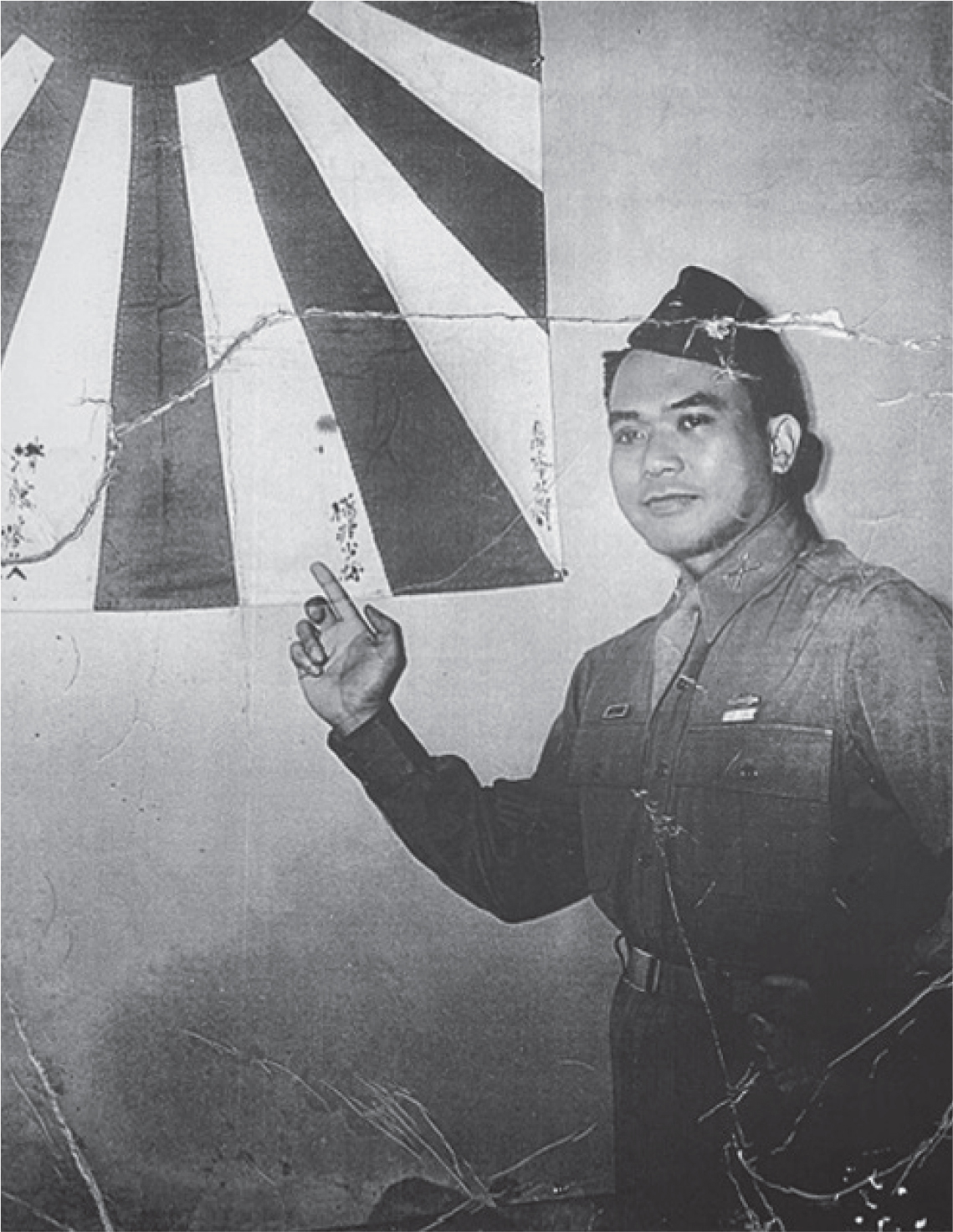
The elder Rigor—then a major—later led the Third Battalion of the 121st Infantry under the United States Army Forces in the Philippines–Northern Luzon or USAFIP-NL in the decisive assault on Bessang Pass—a strategic mountain route in Ilocos Sur that proved crucial in defeating Japanese forces in the north.
The breakthrough at Bessang Pass helped break the final defenses of Gen. Tomoyuki Yamashita—the “Tiger of Malaya”—which hastened the end of the Japanese occupation in the north. After the battle, Japanese Rear Admiral Kyoguro Shimamoto personally surrendered to then-Maj. Rigor, and handed over his Imperial Japanese Navy flag—now a prized Rigor family heirloom and, for them, a symbol of Filipino valor.
POST-WAR ORDEAL
But after the war, President Harry S. Truman signed a congressional bill into law, stripping Filipino veterans of their promised benefits. The Rescission Act of 1946 stated that their wartime service would not be considered active service for purposes of American law.
It was a complete turnaround from the promise of his predecessor, Franklin D. Roosevelt, who assured more than 260,000 Filipino soldiers who answered his call in July 1941 to defend the US and the Philippines—then still a colony of the former—by pledging citizenship to Filipinos who joined the fight against Japan.
In 1990, President George H. W. Bush signed legislation that granted US citizenship to thousands of Filipino World War II veterans. Still, while some rights were recognized over time, their full benefits were never restored.
In 2009, President Barack Obama signed a bill providing a one-time, limited lump-sum payment to some surviving veterans. The law authorized the Filipino Veterans Equity Compensation Fund to provide payments of $15,000 for US citizens and $9,000 for non-citizens. In 2017, Filipino World War II veterans were also awarded the Congressional Gold Medal.
‘SLAP IN THE FACE’
The Seattle-based Sluggo previously worked as the executive director of the International Drop-In Center.
It is a non-profit social services organization and also considered a “virtual repository” of World War II veterans’ files, especially those of Filipinos who migrated to the US to become citizens. He said that most of those who received the long-overdue payments were economically strapped enlisted men.
“There were no officers higher than a lieutenant or captain who came,” he said. “The officers and the more educated enlisted men said it was a slap in the face. They said all the benefits could be given, but you had to go to America, raise your right hand, and become an American citizen—and that’s not fair.”
“Remember, when the war was being fought, we were a Commonwealth and not yet independent. So we were really wards of Uncle Sam. Roosevelt was shocked because of Pearl Harbor, and he promised the moon to US allies—especially the Philippines—[because] we were still partof their country,” said Sluggo, a community leader and advocate for Filipino veterans in the US.
“And yet, we were treated shabbily—especially our soldiers who defended democracy,” he lamented. “Kaya ang sama ng loob nila, especially in the upper echelons [and] among the officers.”
“The Philippines has long been very subservient to Uncle Sam, but [he] never really gave us enough credit for what we’ve done,” Sluggo continued. “Today, nakakaawa ang Armed Forces of the Philippines—the servicemen who were never really recognized properly for all that they have done to defend the motherland.”
The younger Rigor said his father, who studied at Columbia University after the war as a pensionado, chose not to migrate to the US and instead returned home to teach.
A product of the University of the Philippines’ Vanguard Reserve Officers’ Training Corps or ROTC, he helped reconstruct the Philippine Military Academy in Baguio City. He later became secretary general of the Veterans Federation of the Philippines.
Col. Rigor also served as chief of psychological warfare at the Truth and Education Division of the Department of National Defense during Ramon Magsaysay’s presidency, before retiring in 1957. He died in 1960.
An advertising man, Sluggo later left for the US during the diaspora in 1985, when he joined his wife and his father-in-law—a military general who was already a US citizen.
He helped organize, with Alex Esclamado, the National Federation of Filipino American Associations.
A PARALLEL EXPERIENCE
The parallels between the veterans’ experience and the current geopolitical landscape are striking. Once again, our country finds its fate intertwined with the strategic ambitions of global powers.
The Philippines, long shaped by a historical pattern of “dependency,” risks repeating that pattern amid the current Middle East crisis. The 19th century doctrine of “Manifest Destiny” appears to be resurfacing in the Trump administration’s rhetoric against Iran.
Through a highly transactional approach, Washington’s current national defense strategy echoes the “America First” mantra, pressuring allies—including the Philippines—to align strictly with US interests or face economic measures such as tariffs.
Much like in 1941, the Philippine government is being drawn into the fallout, even when the conflict is centered in the Middle East where thousands of overseas Filipino workers are based. This makes the country vulnerable to US-led sanctions and military alignments that prioritize US hegemony over regional neutrality.
Just as Filipinos fought for the US until “liberation” day, millions of Filipino migrant workers in the Middle East again find themselves on the front lines—risking their safety and livelihoods even as their remittances keep the Philippine economy afloat.
With the Strait of Hormuz closed, Brent crude surged past $120 per barrel, prompting President Ferdinand R. Marcos Jr. to declare a state of emergency as diesel prices continued to soar. Transport strikes then paralyzed parts of Metro Manila and Baguio.
This is our economic dependence of the 21st century— when a modern “Manifest Destiny” reaches into Filipino households.
What Filipino veterans and their families endured during WWII reminds us that we are again at a crossroads in defining genuine sovereignty. We can choose diplomacy over aggression—an option that can be elusive for a country like the Philippines, long cast as America’s “little brown brother,” and now pulled once more into the orbit of a US “destiny.”
Written by Joel C. Paredes. Published in the May 2026 Special Issue of the Philippines Graphic.
Started in 1927, the Philippines Graphic is the longest-running printed magazine of national circulation that provides relevant news and features and promotes Philippine literature.