
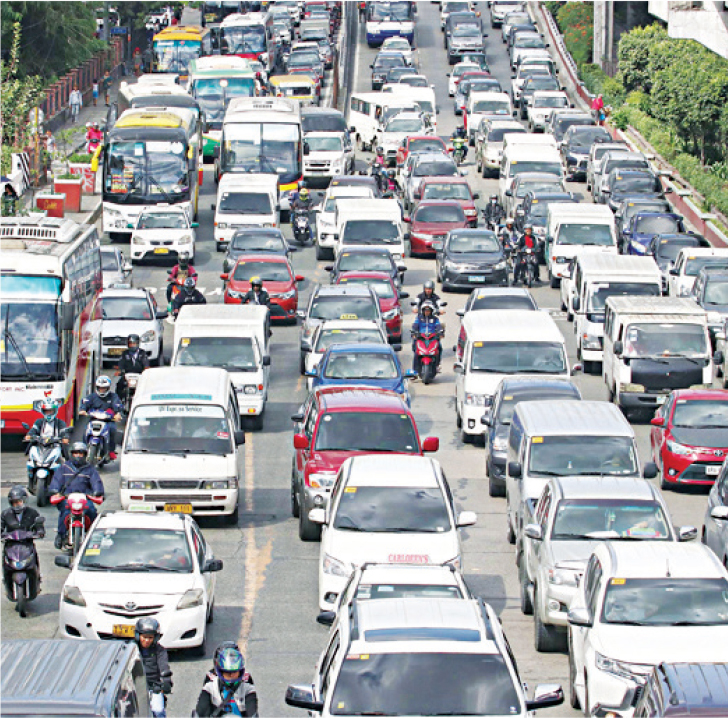
When you ask a foreigner whether they ride a motorcycle in the Philippines, they usually look at you as if you’ve suggested juggling chainsaws and reply: “Are you insane? In this traffic?”
And yes—Manila, the capital of the Philippines, is famous for its traffic. I refuse to translate the word into something civilized like “congestion” or “road traffic,” because whatever happens here belongs to an entirely different category of human experience. It is simply traffic. Just like province is not some neat little “region” or “county.” Unless, of course, your counties also involve harvesting coconuts and surviving on rice fields.
Words absorb climate. Smell. Context. Humidity. Entire civilizations hide inside vocabulary, and no amount of philological gymnastics can fully transfer them into another language.
And Manila traffic is legendary.
You may safely place yourcomplaints about Warsaw’s Dolinka Służewiecka or Zakopianka—a highway in Poland, famous for its traffic jam—onto the shelf labeled First WorldProblems.
Compared to Manila, it’s like complaining that the foam on your latte wasn’t perfectly textured while somebody else lacks even hot water for instant coffee.
Imagine one million cars.
One million.
Spread across Warsaw or Paris and every street it possesses—moving.
Now add 2.6 million—because that many cars—3,6 are currently moving in Metro Manila.
Now add another million scooters.
Then add one hundred thousand jeepneys, another hundred thousand tricycles carrying passengers, gas tanks, or occasionally a live pig—plus fifty thousand tuk-tuks seemingly forged somewhere between India and the underworld itself.
Then add bicycles, ice cream carts, fearless lunatics pushing entire businesses down the shoulder lane, and endless waves of pedestrians.
Then—roughly speaking, though honestly still not enough—you arrive at Manila.
And unfortunately, or perhaps through the dark magic of urban planning, Manila’s problem does not end at Manila itself. Even when trying to escape toward nearby provinces like Batangas or Antipolo, you remain trapped inside the boiling cauldron while Google Maps cheerfully inform you that forty kilometers will require two hours.
Two hours.
Which, for those who lost their battle with physics in high school, gives us the majestic average speed of twenty kilometers per hour.
Some innocent optimist may imagine there must be a solution.
A faster motorcycle. A smarter maneuver. A better route.
This appeared in the May 2026 Special Issue of the Philippines Graphic.

Piotr Sarmini
Piotr Sarmini (born 1993 in Warsaw, Poland) made his literary debut as editor-in-chief of the student magazine UW/AŻAJ at the University of Warsaw. He studied Polish Philology and a Journalism at the University of Warsaw as well as at Adam Mickiewicz University. He completed his degree with a thesis devoted to the editorial study of a memoir manuscript written by a Siberian exile and soldier of Anders’ Army. In 2018, he published his debut hip-hop novel, Bez przekazu (“No Statement”). During this period, he regularly published poetry, short stories, and journalistic as well as industry-related articles. In 2023, he released his second novel, Uchodząc (“Borderless”), portraying the journey of Syrian refugees through Europe. Since February 2024, he has been living in the Philippines, where he works in IT industry, while remaining a keen observer of everyday life and contemporary reality.