
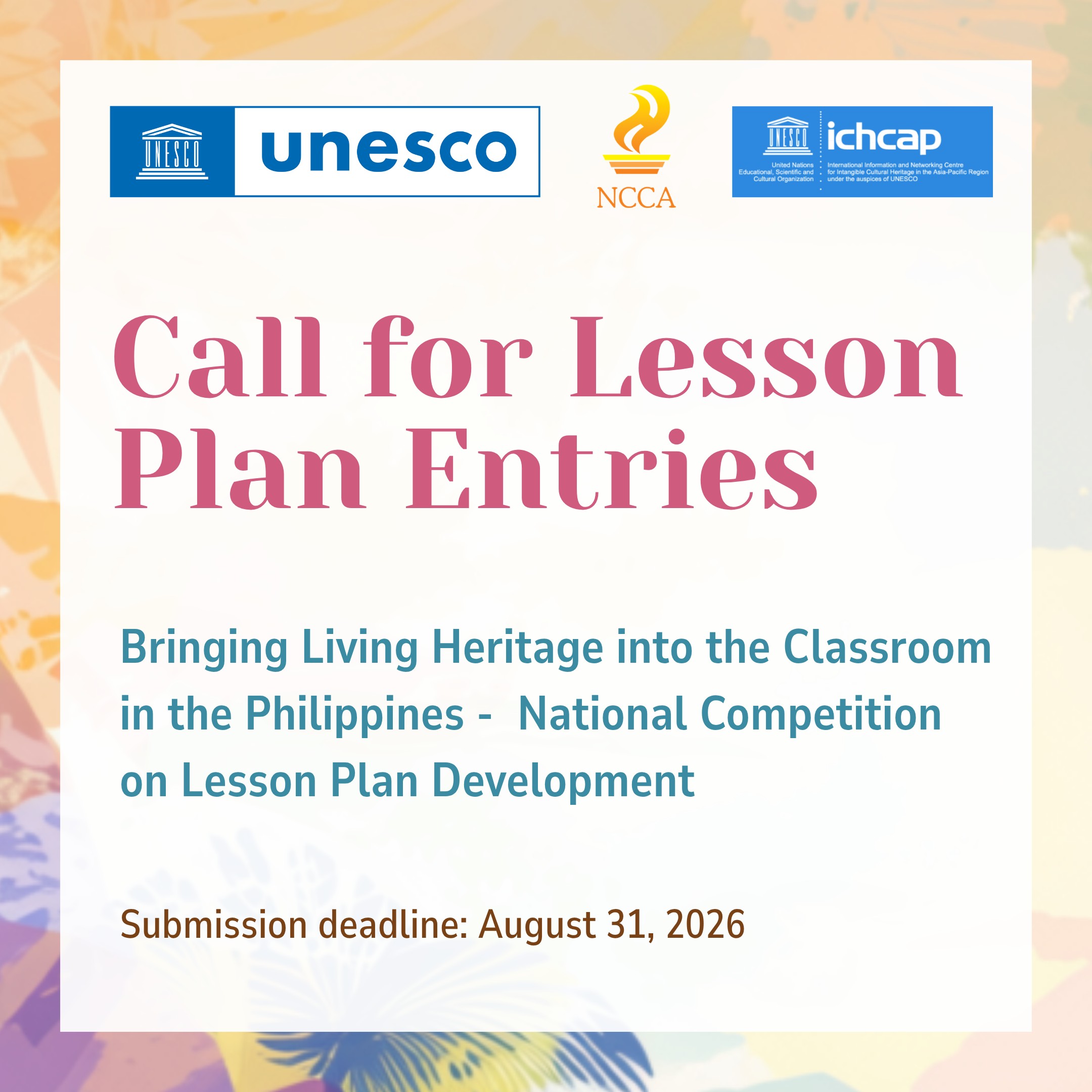
The National Commission for Culture and the Arts (NCCA), in partnership with the United Nations Educational, Scientific and Cultural Organization (UNESCO), is inviting Grade 7 to 12 teachers across the Philippines to participate in the Bringing Living Heritage into the Classroom (BLHC) in the Philippines: National Competition on Lesson Plan Development with submissions accepted until August 31, 2026.
The competition encourages secondary school teachers to develop lesson plans that integrate living heritage, also known as intangible cultural heritage (ICH), into regular school subjects.
Through the BLHC methodology, educators are encouraged to explore how traditional knowledge, skills, and practices can enrich classroom learning while helping students meet curriculum-based competencies.
Teachers from different disciplines are also encouraged to collaborate in developing multidisciplinary and cross-subject lessons—wherein traditional plant-based textile dyeing, for example, may be used to teach chemistry; traditional textile names and meanings may support language lessons; while pattern-making can provide a context for teaching geometry. These approaches allow students to develop subject competencies while engaging with heritage practices from their own communities.
The competition places community participation at the center of heritage-based education. Applicants are expected to work meaningfully with heritage bearers, cultural practitioners, community elders, and other local partners from lesson development through classroom implementation. Their knowledge, perspectives, and participation should be reflected in the proposed learning activities, ensuring that living heritage is represented respectfully and remains connected to the communities that practice and transmit it.
Ten (10) selected lesson plans will receive USD 1,000 each to support classroom implementation during Term 2 of School Year 2026–2027, from September to December 2026. Selected teachers and their schools will also receive certificates of recognition from UNESCO and the NCCA, expert mentorship during the pilot period, and an opportunity for their lesson plans to be published in a UNESCO open-access compilation with full attribution.
The competition is open to individual Grade 7 to 12 teachers or teams of up to five members. Each teacher may participate in only one submission, while schools may submit multiple entries as long as each is developed by a different teacher or teaching team.
Applicants must submit a lesson plan in English that applies the BLHC methodology to a standard subject aligned with DepEd curriculum standards for public schools or school-approved curriculum standards for private schools. A formal school endorsement and a brief description of collaboration with community members, cultural practitioners, elders, or local partners must also be included.
Entries will be assessed by an independent jury of experts in education and living heritage based on their contribution to heritage safeguarding and community engagement; pedagogical quality, creativity, and application of the BLHC methodology; and feasibility, sustainability, and adaptability.
Selected teachers will pilot their lesson plans in their classrooms and document the implementation, results, and lessons learned. Reports will be submitted in January 2027, with insights from the pilots contributing to a growing pool of practical resources for educators, cultural institutions, and heritage practitioners.
Interested teachers and schools may join the online briefing session on August 19, 2026, from 7:30 to 8:30 p.m., which will provide an overview of the competition and submission process. Lesson plans must be submitted by August 31, 2026, while the 10 selected lesson plans will be announced on September 10, 2026.
The selected teachers will then pilot their lesson plans in their classrooms from mid-September to mid-December 2026, during Term 2 of School Year 2026–2027, with online consultations and progress sessions to be conducted throughout the implementation period. Implementation reports from the selected schools will be due in January 2027.
Through the BLHC National Competition on Lesson Plan Development, the NCCA and UNESCO aim to bring living heritage closer to Filipino learners by empowering teachers to connect classroom instruction with the knowledge, practices, and traditions that continue to thrive in communities across the country. The initiative seeks not only to enrich the learning experience but also to help ensure that living heritage remains relevant, practiced, and passed on to future generations.
Started in 1927, the Philippines Graphic is the longest-running printed magazine of national circulation that provides relevant news and features and promotes Philippine literature.
, into regular school subjects.)