I have always been interested in where modern Philippine culture began, how it spread, and what images were used to represent the nation.
Print media is central to that history. Before television and the internet, magazines helped Filipinos imagine the country. As an art historian who studies Philippine art, I have integrated research in print archives as part of the methods to study the culture of Muslim Mindanao.
Readers of recent issues may also know me through the art history essays I write for the Philippines Graphic, a magazine I have long admired for its rich history, though parts of that history remain little known.
Until recently, almost no one knew what its first cover looked like, even though it matters deeply to Philippine print culture and to the history of how Mindanao was pictured as part of the nation.
Originally known as Graphic, the publication debuted during the week of June 26, 1927, and released its maiden issue on July 2. Its cover depicts a man on horseback holding a spear and accompanied by a dog. The rider appears to wear the traditional regalia associated with the Sulu archipelago.
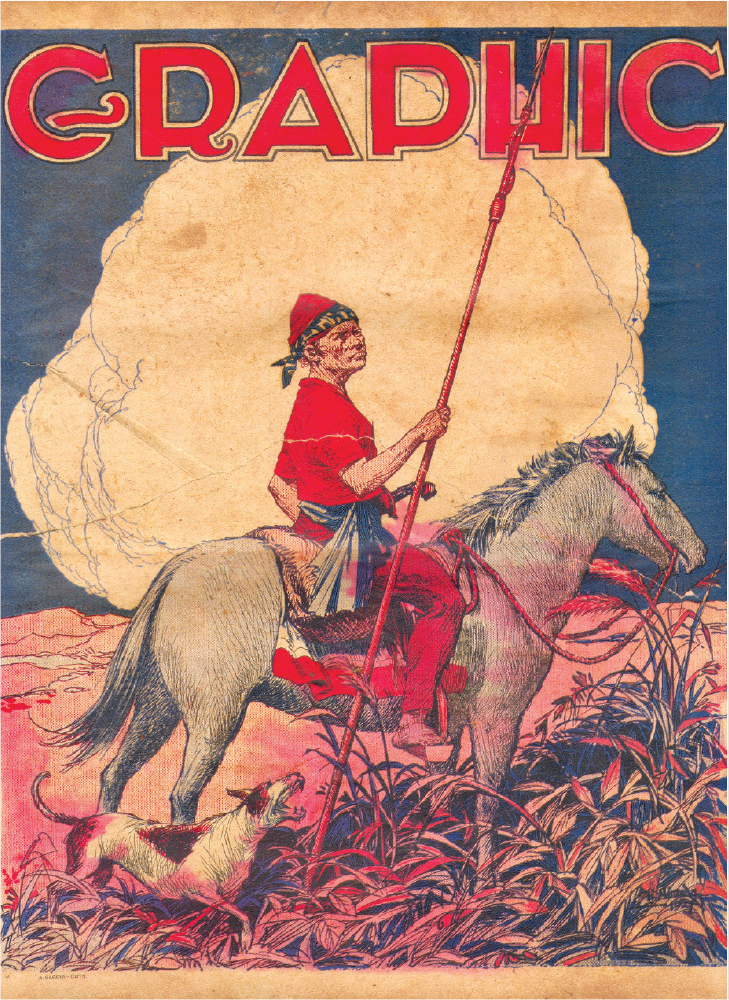
The cover was designed by illustrator and cartoonist Irineo Miranda. The surviving copy comes from the archives of the Lopez Museum and Library, which preserved the document for nearly a century. It was found last year by Graphic writer Von Zyron Alimorong.
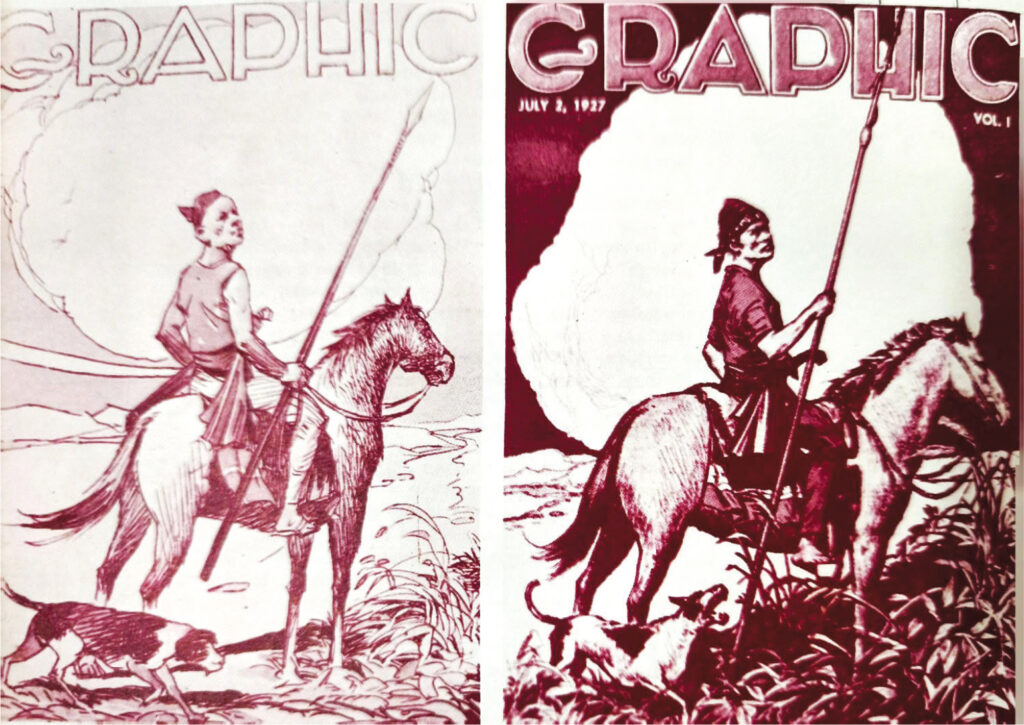
Years before this discovery, I encountered preparatory studies for the same cover in the catalogue of Miranda’s final exhibition. Those studies reveal the development of the composition. The rider, horse, spear, dog, and cloud formation were already present before the final version was printed.
In the published cover, however, the image acquires greater visual force. The contrasts are stronger, the figure darker, and the spear extends upward into the magazine’s masthead.
COVER ARTIST
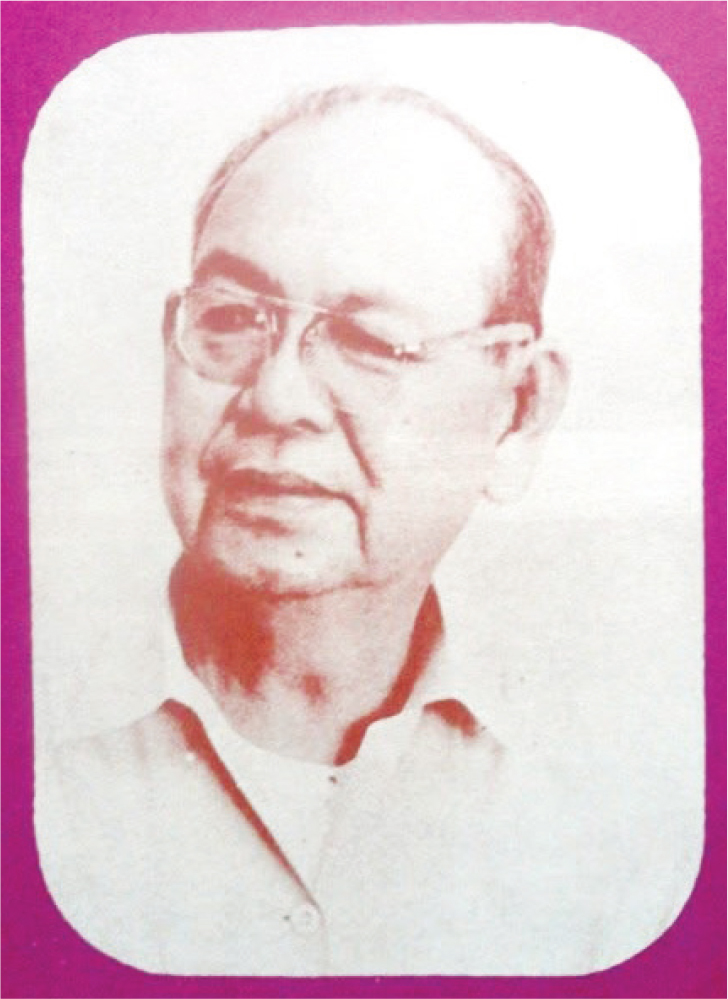
Miranda was born in 1896 and died in 1964. He grew up in San Fernando, Pampanga, during the American colonial period. He studied at the University of the Philippines School of Fine Arts and completed his degree in 1916. While still a student, he was hired by the Bureau of Printing Services.
In 1920, the painter Fabian de la Rosa invited him to join the faculty of the UP School of Fine Arts. A 1932 university catalogue listed Miranda as Assistant Instructor in Illustration, Cartooning, Commercial Designing, and Elementary Decorative Painting.
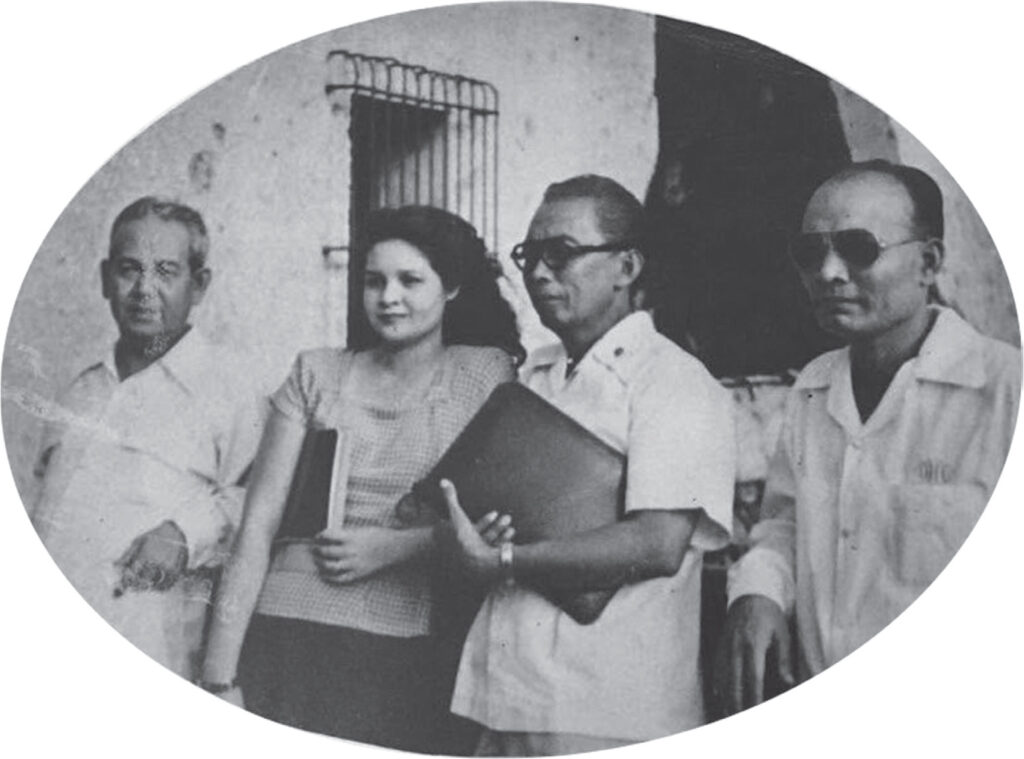
Like many artists of his generation, Miranda moved comfortably between academic art and commercial illustration. He produced magazine illustrations, satirical cartoons, advertisements, product labels, and commercial designs. He contributed cartoons to Liwayway, El Debate, and both the Tagalog and English editions of Graphic. His students recalled that he would pass the time near Plaza Miranda or Quiapo Church, practicing sketches of gestures and facial expressions.
COMMISSIONED WORK
The circumstances that produced the cover can be traced to Ramon Roces, the founder and publisher of Graphic. Roces commissioned the image after returning from a trip to Mindanao.
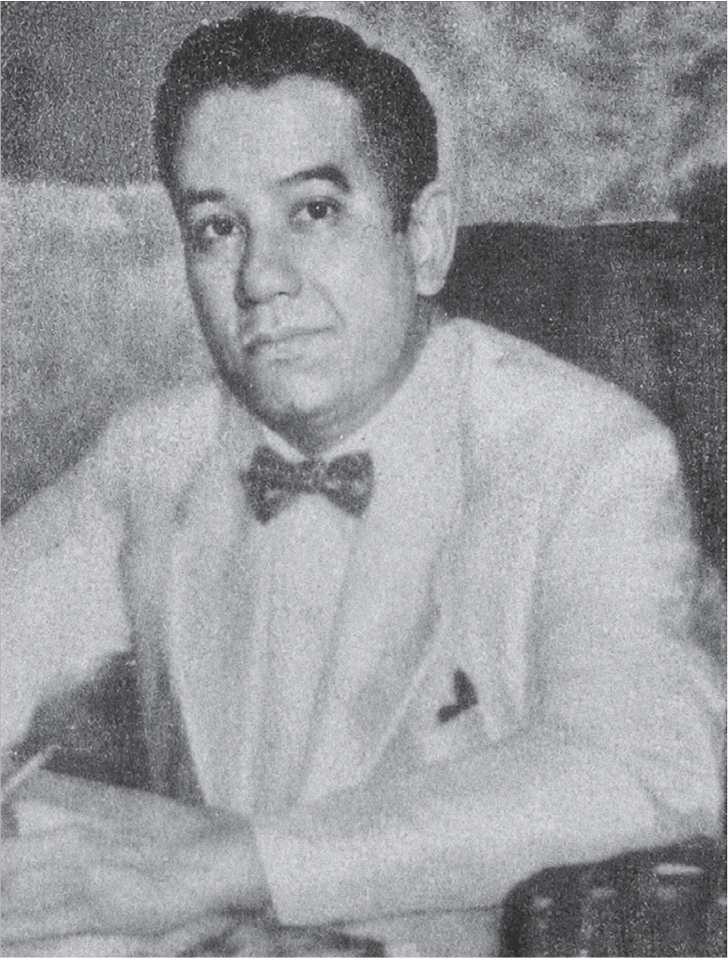
The details of that journey remain unclear, but archival evidence confirms that he had visited Marawi, Zamboanga, and Sulu. Roces was also closely associated with President Manuel Quezon, making it possible that the trip was connected to broader political networks operating at the time.
Although Miranda had not yet visited Mindanao himself, he transformed Roces’s experience into the first visual statement of the magazine.
VISUAL COMPARISON
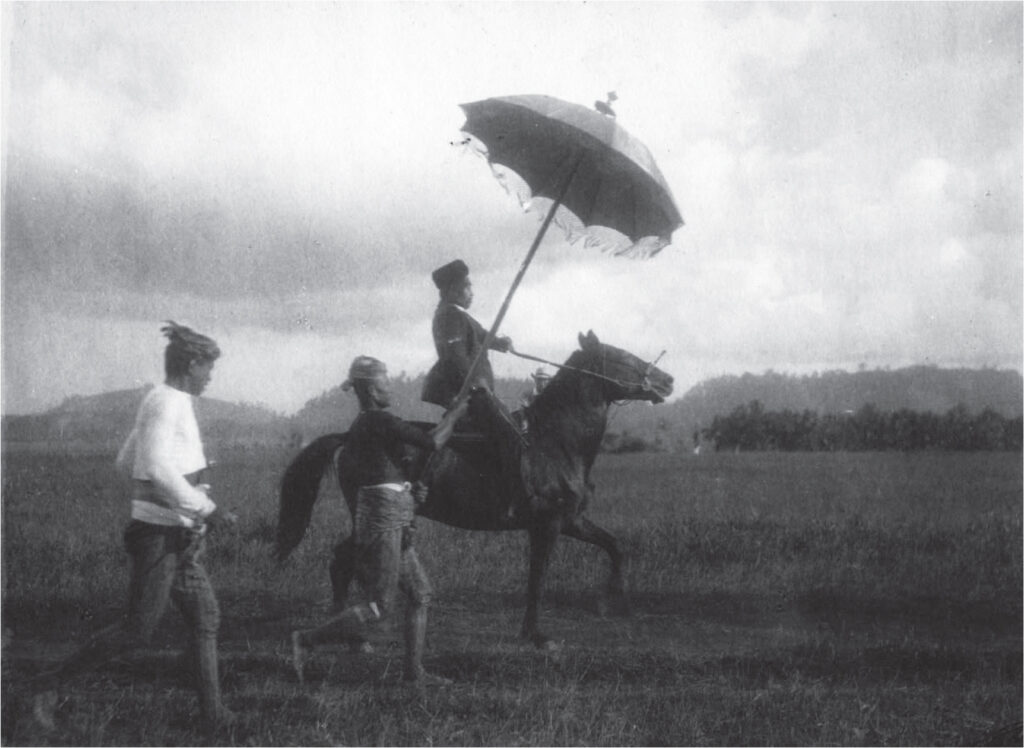
The cover bears a notable resemblance to a widely circulated 1905 photograph showing Sultan Jamalul Kiram II of Sulu arriving on horseback to greet the delegation led by War Secretary William Howard Taft.
The visual similarities are striking, although there is currently no definitive evidence that Miranda directly copied the photograph.
Both images depict a Muslim rider on horseback. The differences are equally important. The 1905 photograph presents a reigning sultan engaged in a formal political encounter.
Miranda’s cover removes the ceremonial entourage and presents the rider as a solitary warrior. The figure is no longer identifiable as a ruler but instead functions as a generalized representation of Sulu.
Miranda’s interest in Muslim Mindanao extended well beyond the 1927 cover. In 1950, he traveled to Marawi, then known as Dansalan, where he produced a series of ethnographic portraits. Viewed today, these works acquire additional significance because they document a city that was profoundly altered by the battle that devastated Marawi in 2017.
His visit inspired many later paintings and drawings depicting Islamic and Indigenous subjects from Mindanao. Among these works, the most famous is Tausug Princess (1951), a portrait of the future senator Santanina “Nina” Rasul. The painting is now in the National Museum of Fine Arts.
Miranda’s influence also extended through teaching. His students included Anita Magsaysay-Ho (who made covers for the Graphic), José Joya, Nena Saguil, Cesar Legaspi, and Abdulmari Imao, who later became the first Muslim National Artist of the Philippines.
Through both his art and his teaching, Miranda occupied an important position in the development of 20th century Philippine visual culture.
MEANING TO BE MODERN
From its early years, Graphic looked toward a modern Philippines. It was an interwar magazine, shaped by new printing technologies, faster circulation, and a public hungry for images of national life. Its covers make this ambition visible.
Some of the late 1920s covers were designed by Abe Birnbaum, an American illustrator and cartoonist who would later on create more than 150 covers for The New Yorker.
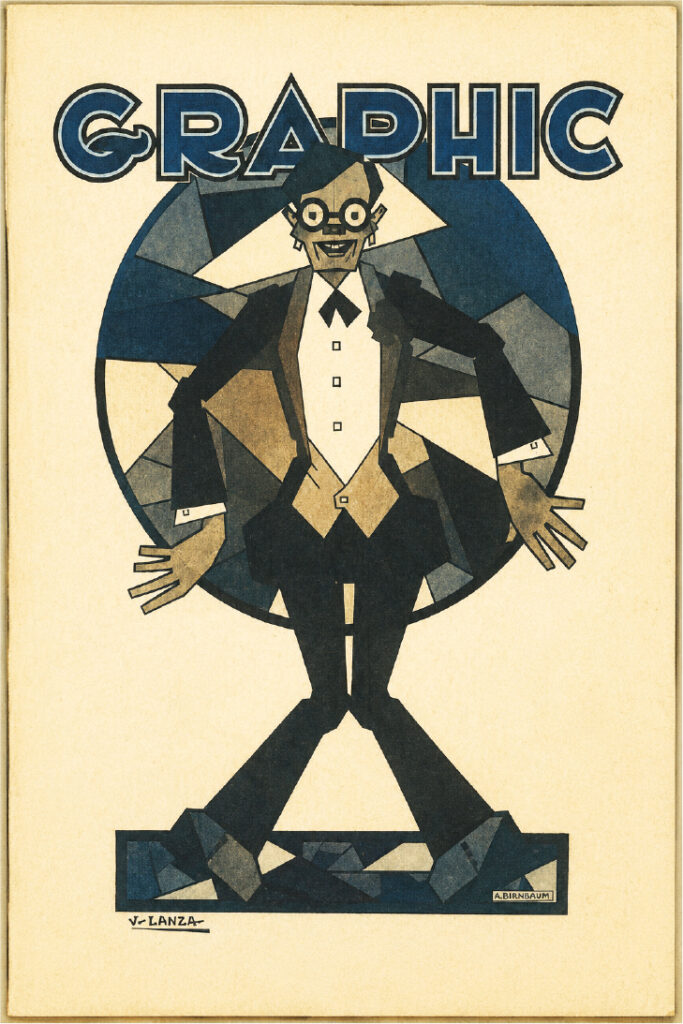
Birnbaum’s early work for Graphic already showed his command of modern magazine design: heavy-outlined lettering, flat geometric forms, and a machine-age clarity that recalled Art Deco.
One of his covers turns the word Graphic into a bold typographic emblem above a strange, almost mechanical figure in a tuxedo, composed of sharp angles, circles, and theatrical shadow.
This may have been a play on The New Yorker’s iconic first cover, published on February 21, 1925, which introduced the dandyish figure of Eustace Tilley.
Other covers use a dark, poster-like composition of fashionable figures, reducing the scene to a drama of light and shadow. These covers made the magazine look urban, witty, and unmistakably up to date.
By the 1930s, as the prospect of Philippine independence became more concrete, Graphic also turned to familiar Philippine subjects. The March 23, 1933 cover by Fernando Amorsolo framed old Manila through a church, a calesa, a flowering tree, and a street scene arranged like a painting or postcard.
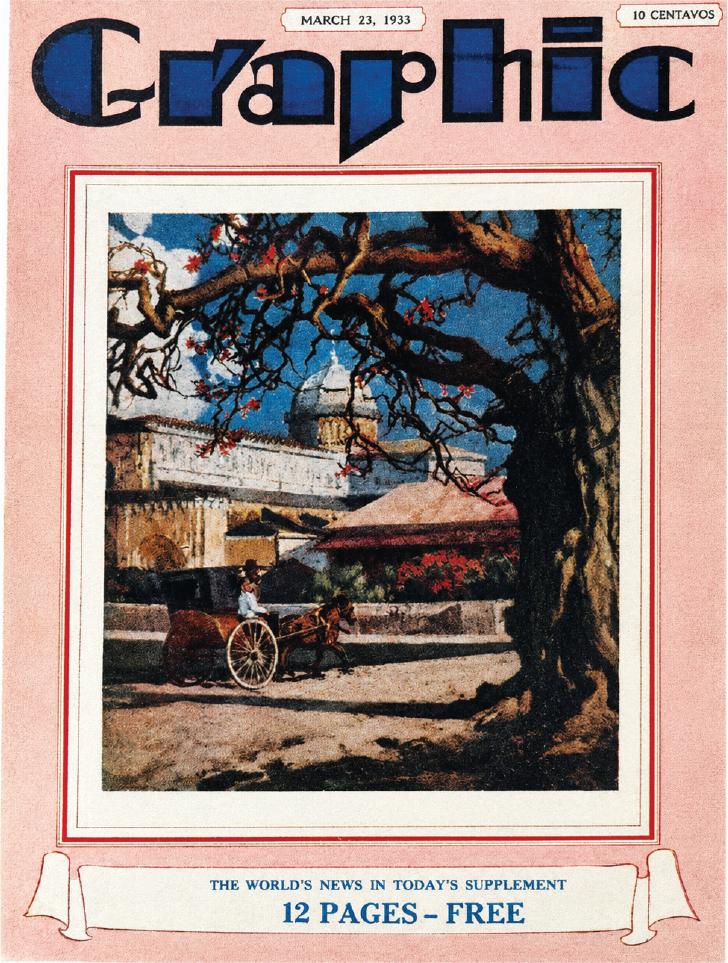
The contrast between modern typography and a view of Intramuros shows that the magazine did not reject the past but it recast it for the modern printed page.
By the March 5, 1936 cover, Graphic had turned even more deliberately to Filipino art, featuring a painting by Anita Magsaysay within a red ornamental frame and a dramatic three-dimensional masthead. Alongside Irineo Miranda, her mentor, and artists such as Fernando Amorsolo and Pablo Amorsolo, Magsaysay represented the movement of Filipino art into a broader public culture.
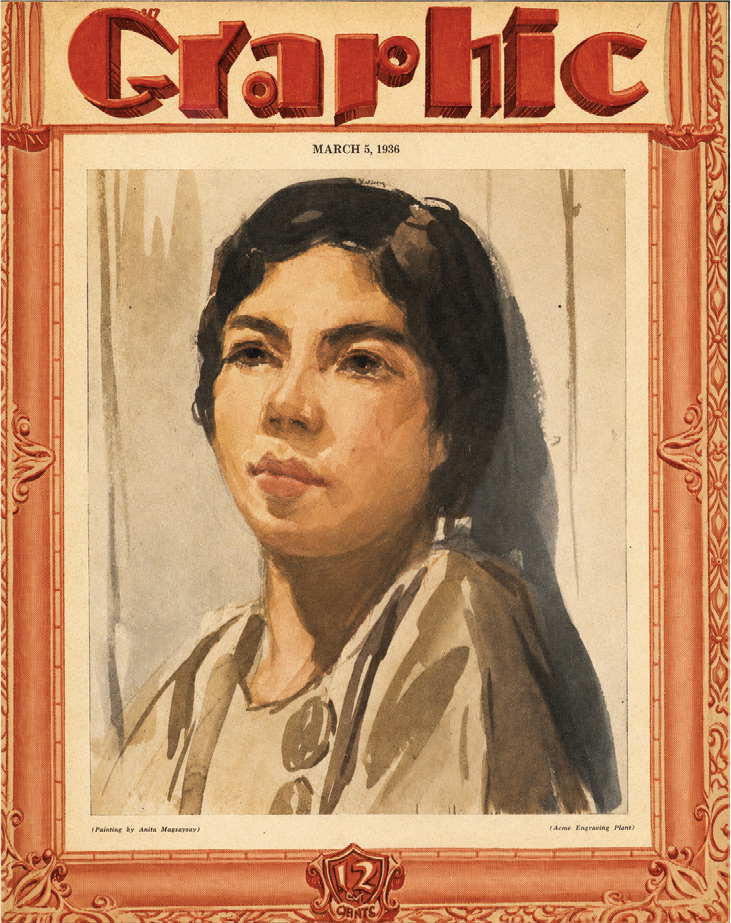
Kroch Asia Library, Cornell University
By the 1930s, Graphic h a d embraced a distinctly Filipino modern identity through its dynamic branding.
Its editors treated the magazine cover as a public surface for the circulation of remarkable Filipino art and cultural memory.
Irineo Miranda’s first cover for Graphic heralded a new kind of publication, one addressed to a culture-minded Filipino public, and it set the tone for the magazine’s early years.
From the beginning, Graphic presented itself as a magazine concerned with the image of the nation, and it did so by placing Mindanao and Sulu within that visual field.
The first cover offers a useful reminder of Mindanao’s place within the history of Philippine print culture.
Discussions of national identity have often treated Mindanao and Sulu as peripheral regions. Yet one of the country’s oldest and most influential magazines chose a figure associated with Sulu for its inaugural image.
As Graphic approaches its centennial, the rediscovery of this cover allows us to revisit both the history of the magazine and the career of Irineo Miranda. It also reminds us that representations of Mindanao were present at the very beginning of modern Philippine mass media.
The first image that greeted readers of Graphic in 1927 was not a politician, a businessman, or a Manila landmark. It was a modernist painting of a rider from Sulu.
Geronimo Cristóbal
Geronimo Cristóbal is a lecturer in Art History at Ateneo de Manila University, and a PhD candidate in the History of Art and Archaeology at Cornell University. He serves as an international correspondent for the Philippines Graphic. He can be reached at gc448@cornell.edu.