


It could qualify as foresight. He saw the power it held 99 years ago. Technology—which in the time of Graphic founder Ramon Roces materialized as photography—was the ticket to news publishing that appealed to a mass audience more effectively and with speed.
Photos dominated page spreads, highlighting the urban life of the period. Roces harnessed the creative talent of visual artists, made evident in the numerous illustrations and illustrated covers that characterized the Graphic before World War II broke out.
The next 50 years after the Second World War would see the march of technology to claim the world. In the Philippines the advent of desktop computers from the late 1970s to the early 1980s radically changed the printing industry, giving rise to desktop publishing The advent of the internet in the mid-1990s saw the country achieving its first permanent connection, with news publications setting up their own news websites.
By the mid-2000s, the introduction of Facebook, YouTube, and blogging, transformed the Philippines into becoming the Social Media capital of the world. Media outfits in the country utilized social media platforms to increase their visibility and audience engagement.
More and more print and broadcast media establishments developed a digital presence through their websites and social media accounts. This made the delivery of the news even more instantaneous and accessible.
THE GRAPHIC EXPERIENCE
The Graphic, like all other media publications, registered its digital presence by establishing a website and social media accounts on Facebook and Instagram.
Both the editorial and advertising side of the magazine benefited from Graphic’s involvement in cyberspace.
By 2025, the Graphic collectively employed various strategies to boost its social media presence. This resulted in millions of views and engagement in the magazine’s website and Facebook page.
The Instagram page saw one of the biggest boosts, amassing hundreds of new followers within a span of months, and millions of interactions, compared to the previous years. Within the same year, the magazine established its presence in LinkedIn and Substack, further expanding the reach of the publication.
ARCHIVING THE OLD
Grounding its legacy in history has been a long-standing philosophy of the Philippines Graphic.
History lives on the pages of the magazine, with almost a century of experience in covering national and local news and events.
Developing access to past issues of the Graphic became a collective concern. This led to the conceptualization of the Philippines Graphic Digitization project.
Under the guidance of the magazine’s Publisher, T. Anthony C. Cabangon, and its Editor-in-Chief, Psyche Roxas-Mendoza, the Graphic’s Social Media Point-Person, Von Zyron Alimorong, and Researcher-Archivist, Carlos Miguel Concepcion, began the careful process of archiving almost a hundred years of the Graphic.
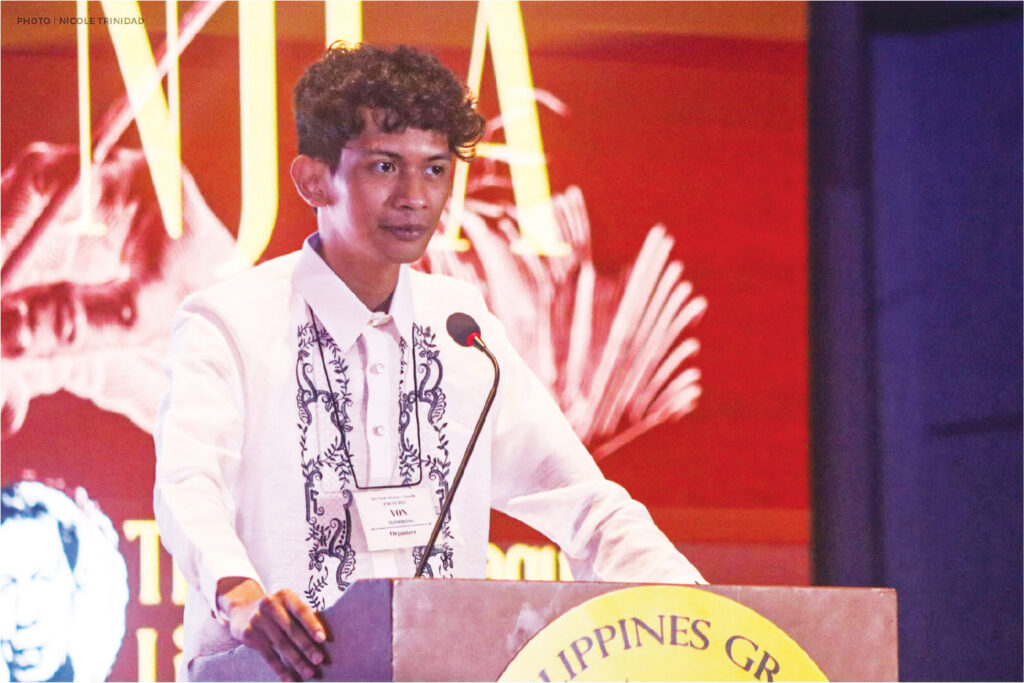

(L-R) Philippines Graphic’s Social Media Point-Person Von Alimorong and Researcher-Archivist Carlos Miguel Concepcion
The archiving process involved logging, photographing, and cataloguing each issue of the publication from 1927 to the present.
Five months into the Digitization project, the team has made considerable progress in making the history of Graphic more concrete. They have also begun securing both digital and hard copies of past issues.
The Graphic is now in the early stage of collaborating with the Ateneo Library to further systematize its Digitization project.
PUSHING 100
As the Graphic pushes past its hundredth year, it begins by embracing the demands of the time.
Technology is rapidly growing, especially with the rise of artificial intelligence, and the public grows even more attached to digital platforms.
Readers have expressed their appreciation for the Graphic’s approach of treating history as an active tool in dissecting current problems and concerns. In many instances, the approach proves that a current issue is not an isolated incident, but a predictable, recurring event.
With every issue, the Graphic presents to its readers snatches of the distant past—captured in reprints of Graphic stories, editorials, columns, illustrations, and photos published in decades past.
Following the rediscovery of the old issues, the Graphic began republishing them in print and uploading them online, with Alimorong transcribing some articles on his trusty smart typewriter “Evergarden,” as he calls it.
The move to republish old articles guarantees that these pieces of literature—and Philippine history—are introduced to a new generation of audience. —Graphic Research

Started in 1927, the Philippines Graphic is the longest-running printed magazine of national circulation that provides relevant news and features and promotes Philippine literature.