

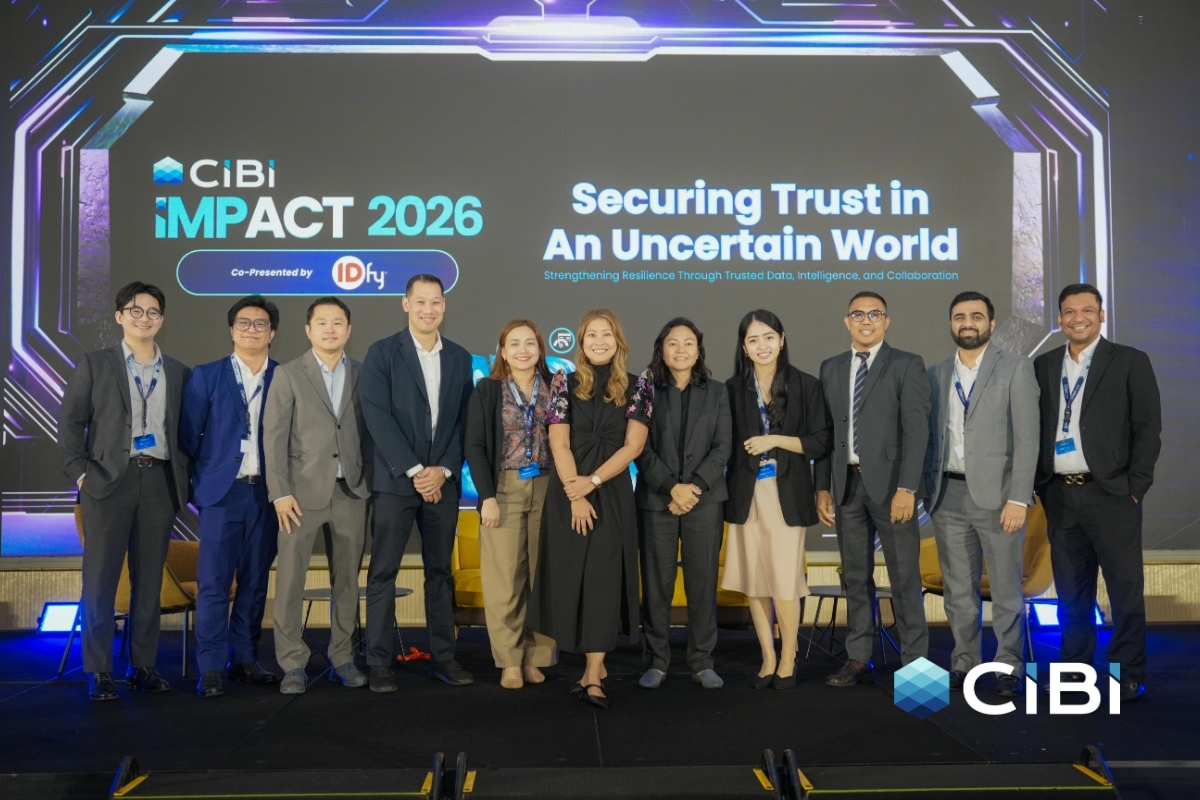
Discussions at CIBI Impact 2026 highlighted a growing challenge for business leaders: turning an abundance of data into trusted information and sound decisions.
VIA GRAPHIC PLUS — Philippines, Manila (August 26, 2026) – Philippine businesses have more data than ever before. Yet as economic pressures, geopolitical shifts, rapid technological change, and recurring disruptions make the business environment harder to predict, having more information does not necessarily make decisions easier.
For business leaders, the challenge is knowing which information they can trust, understanding it in context, and turning it into sound decisions, even when the full picture is not always visible. This becomes especially important when decisions involve significant financial, operational, or reputational consequences.
“Simply having more data isn’t the answer. What matters is having the right data, with enough depth, breadth, and context to see the whole picture. Because when the picture is incomplete, then the decision will also be incomplete,” said Pia Arellano, President and CEO of CIBI Information Inc.
This matters across high-stakes decisions, from evaluating investments and business partners to hiring employees and deploying artificial intelligence (AI). Organizations may have access to vast amounts of information across fragmented systems and increasingly complex networks. For leaders, the challenge is to recognize how decisions in one area can affect the wider organization.
For leaders, the challenge is to recognize how decisions in one area can affect the wider organization as risk, customer experience, operations and commercial priorities become increasingly interconnected.
This perspective, shared during a panel discussion, underscores the need to consider the broader context and implications of every decision. Trusted information, therefore, becomes part of an organization’s ability to adapt.

“Resilience is not simply the ability to survive disruption; it is the ability to adapt, make sound decisions, and continue moving forward despite uncertainty,” said former Trade Secretary and BSP Monetary Board Member Peter Favila.
Leaders will not always have complete or perfect data, particularly when conditions are changing quickly. The ability to distinguish what is known from what remains unclear, interpret the information available,and make accountable decisions based on the best available information is becoming increasingly important.
The stakes become even higher as AI allows organizations to process information and automate decision-making at greater speed and scale.
“Technology without sound judgment can amplify our mistakes just as easily as it can amplify our capabilities,” said Rene Buenaventura, President of Pin An Holdings Corporation and Cliveden Management Corporation. “Speed must be accompanied by accountability, automation must be accompanied by oversight, and intelligence must be accompanied by judgment,” he added.
AI can identify patterns, process information and accelerate action, but it cannot remove responsibility for the decisions that follow. As Francis Estrada, Chairman of CIBI, put it: “Algorithms process data, but people exercise judgment. Systems can flag risk, but leaders must decide how to respond.”
Speed, after all, does not automatically create resilience. Decisions made faster on incomplete or unreliable information can simply allow organizations to make mistakes more quickly.
The broader implication is that businesses may need to rethink what infrastructure means in an increasingly uncertain economy. Technology, capital and physical assets remain essential. So does the information that helps leaders decide where to invest, who to work with, how to respond to emerging risks and where opportunities may lie.
“Trust is not a soft concept. It is a fundamental piece of economic infrastructure,” Estrada said.
For organizations navigating uncertainty, the priority is to strengthen the foundations behind decision-making: access to credible information, the ability to understand that information in context, and the systems and accountability needed to turn it into action.
The businesses best positioned to navigate uncertainty will not necessarily be those with the most data or the fastest technology. They will be those that know what information to trust, understand the bigger picture and have the people, systems and judgment to turn it into sound decisions.

Started in 1927, the Philippines Graphic is the longest-running printed magazine of national circulation that provides relevant news and features and promotes Philippine literature.