

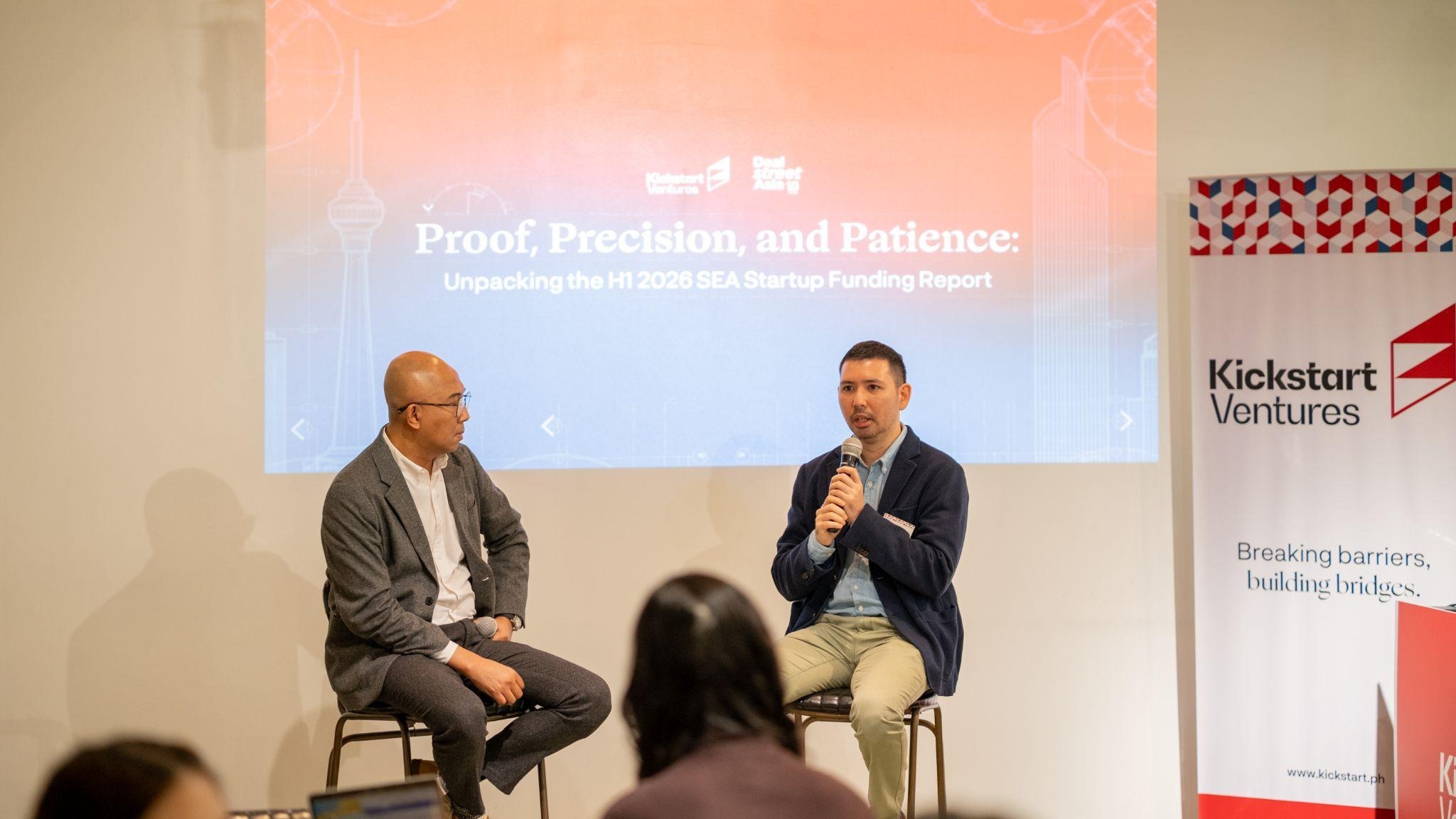
VIA GRAPHIC PLUS | MANILA, PHILIPPINES (October 14, 2026) — Philippine startup funding more than doubled to US$81 million in H1 2026, even as deal volume fell to seven, the lowest in the report’s 2019-2026 series. According to Kickstart Ventures, the corporate venture capital (CVC) firm of one of Southeast Asia’s leading telecom companies, helping more startups progress to growth-stage funding may depend as much on strategic partners that open access to customers as on access to funding.
“We’re seeing this as a commercial opportunity as much as a capital one. One of the reasons startups stall is that they can’t reach the customers that would prove the business, and those doors open through relationships they haven’t had time to build,” said Jecky Pelaez, Partner at Kickstart Ventures.
Capital stack diversifies as sovereign funds, PE, corporates step in
According to the H1 2026 Southeast Asian Startup Funding Report by Kickstart Ventures and DealStreetAsia, sovereign funds, corporates, and private equity are playing a larger role alongside traditional VC, both regionally and in the Philippines, where deal activity this half drew both venture and private-equity participation. Beyond capital, corporates and other strategic investors can bring customers, distribution, and credibility, which are often what startups need to reach their next round.
For investors, the opportunity is to engage earlier, at the seed-to-Series A stage, rather than waiting for later-stage proof. For the country’s corporates and conglomerates, it is an opening to play a bigger role in the innovation ecosystem by offering startups pilots and early commercial opportunities. For founders, it means treating these relationships as part of the fundraising process itself and prioritizing partners who can open doors to scale.
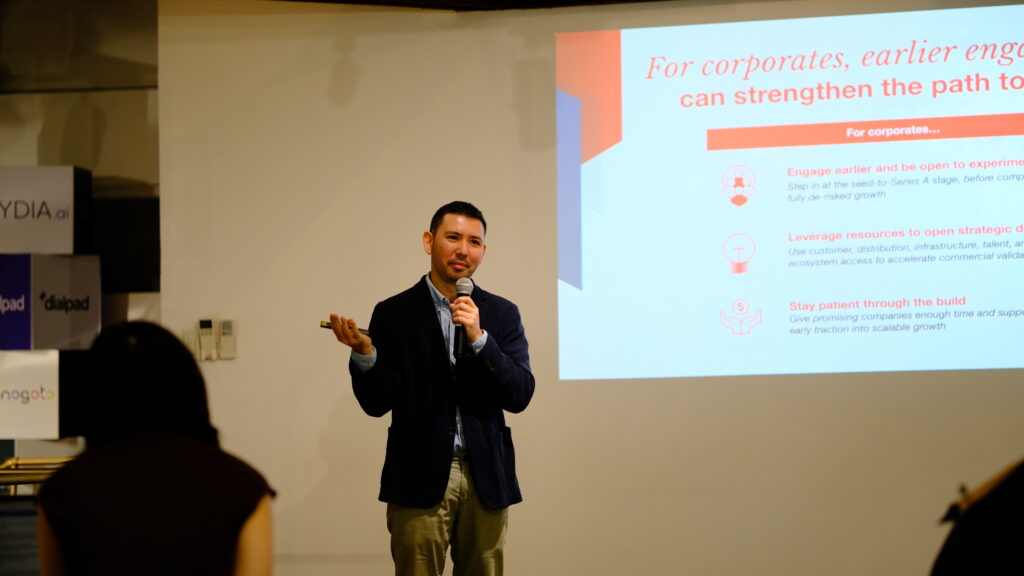
“When an enterprise pilots a startup’s product against a real business problem, a number of positive outcomes occur. The startup is able to test product-market fit, prove out its business model, and hopefully, gain a paying customer. On the flipside, the enterprise gains early and immediate access to technology that addresses genuine business gaps or initiatives that may have otherwise been difficult and/or time consuming to build on its own,” Pelaez said.
The Philippines follows the region’s lead
Across the region, equity funding reached US$7.25 billion across 217 deals, the strongest total since H1 2022; the Philippines accounted for 3.2% of regional deal volume and 1.1% of funding value.
Andi Haswidi, Head of Research at DealStreetAsia, said the deal count, not the headline total, is the better read on the Southeast Asian market: “The US$7.25 billion will get the attention, but the number that matters is 217. Deal volume has held in a narrow band across three semesters, which is a market that has found its floor rather than one recovering. Every market outside Singapore depended on one or two transactions to make its total. That is characteristic of what a market without depth looks like in any conditions. What has changed is who is supplying the capital. Sovereign funds, corporates and private credit are now stepping in alongside venture capital. They price risk differently and they are here to stay.”
Deal count fell from nine in H2 2025 to seven this half, while funding value rose from US$33 million, meaning fewer companies funded but larger checks for those that were. Fintech again led the country by both volume and value, accounting for US$61 million, roughly three-quarters of disclosed funding, consistent with fintech’s dominance across Southeast Asia.
Late-stage activity also returned after a year-long absence: a private-equity round in healthcare, the Philippines’ first late-stage deal since H2 2024, a modest signal that capital is still willing to back Philippine companies beyond the early stage.
Fintech’s dominance, while a genuine strength, also means the country’s funding story currently rests on one vertical, a concentration that mirrors the region’s pattern, where a small number of large rounds account for most of the funding.
For the Philippines, progress will depend on more startups securing the partnerships needed to move from early traction to proven scale.

Started in 1927, the Philippines Graphic is the longest-running printed magazine of national circulation that provides relevant news and features and promotes Philippine literature.

 firm of one of Southeast Asia’s leading telecom companies, helping more startups progress to growth-stage funding may depend as much on strategic partners that open access to customers as on access to funding.)