

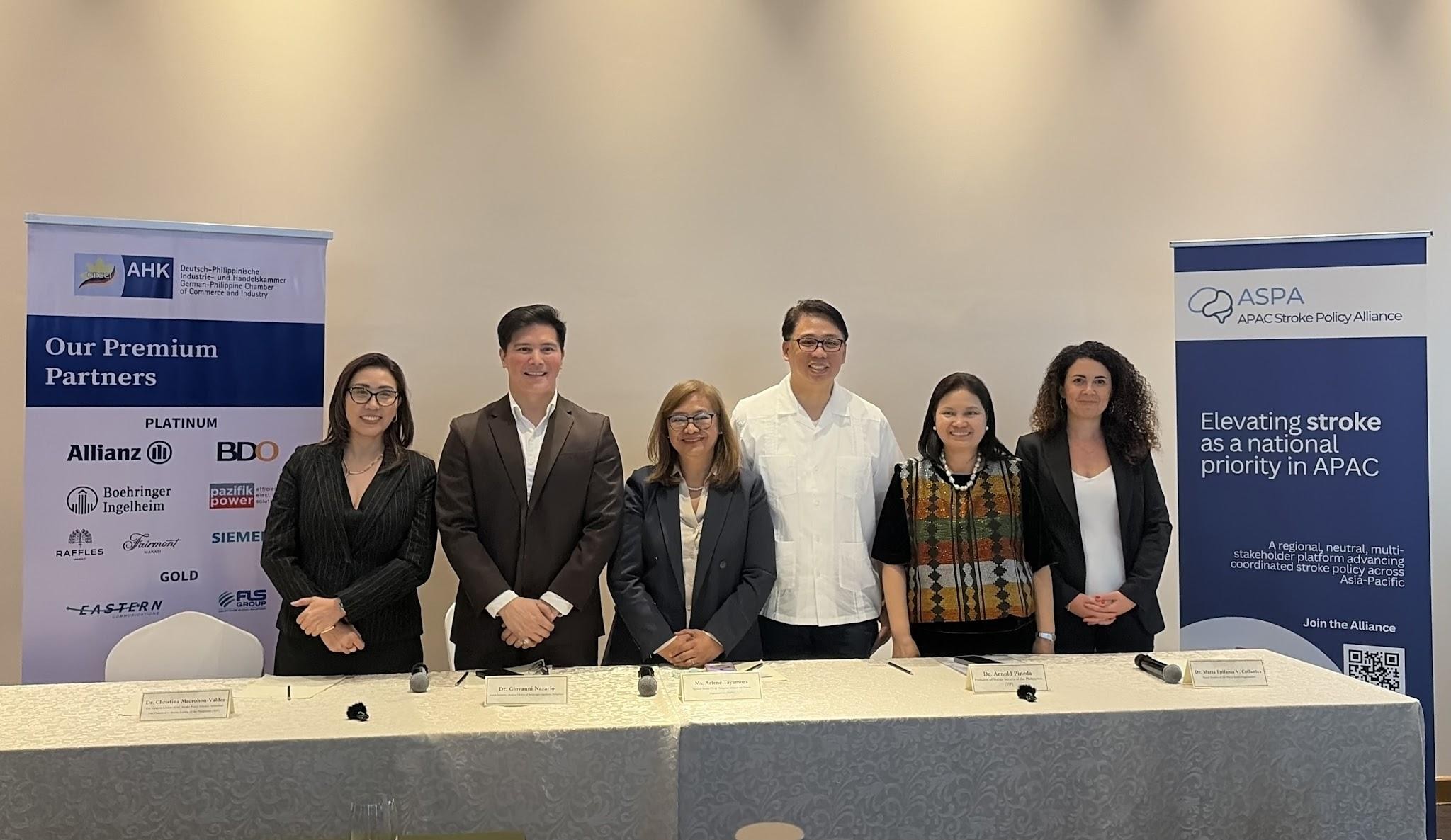
VIA GRAPHIC PLUS — Ahead of World Stroke Day, the APAC Stroke Policy Alliance (ASPA) and the German-Philippine Chamber of Commerce and Industry (GPCCI), with the support of Boehringer Ingelheim Philippines, conducted a press briefing to highlight the real-life impact of stroke on Filipino patients, families, and livelihoods.
Joining the conversation are representatives from the World Stroke Organization (WSO), Stroke Society of the Philippines (SSP), and Beyond Stroke PH of the Philippine Alliance of Patient Organizations (PAPO), and ANGELS Initiative of Boehringer Ingelheim, bringing perspectives from the global stroke community, healthcare professionals, patient advocates, and health system partners working to strengthen stroke care.
Understanding Stroke: Know the Signs, Act Fast
A stroke occurs when blood flow to part of the brain is interrupted, either by a blocked blood vessel (ischemic stroke) or a bleed in the brain (hemorrhagic stroke). When this happens, brain cells can become damaged, making a stroke a medical emergency that requires immediate attention.[1]
Stroke can cause sudden changes in how a person moves, speaks, sees, or maintains balance. Recognizing the warning signs and seeking emergency care quickly can make a critical difference.[2]
Know the Signs: B.E. F.A.S.T.[3]
| B (Balance) | E (Eyes) | F (Face) | A (Arm) | S (Speech) | T (Time) |
| Sudden loss of balance or coordination | Sudden changes in vision | One side of the face may droop or feel numb | Sudden Weakness or numbness, especially on one side | Sudden slurred speech or difficulty speaking/understanding | Every minute counts. Seek emergency medical care immediately |
The Burden of Stroke in the Philippines
Stroke remains a significant health burden in the Philippines, affecting thousands of patients and families each year.
- #3 leading causes of death in the Philippines. Cerebrovascular diseases ranked third among the country’s leading causes of death in both 2024 and 2025.[4]
- 156,000+ new stroke cases in the Philippines each year[5]
- 1.2 million+ Filipinos living with the effects of stroke[6]
- 72,000+ stroke-related deaths in 2023, based on Global Burden of Disease estimates[7]
But the burden of stroke does not end with the number of cases or deaths. Its effects can continue long after a patient leaves the hospital.
Beyond the hospital: the real-life cost of stroke
Stroke can create a financial burden that extends well beyond the initial hospital stay. An unpublished study on the cost of illness analysis of acute ischemic stroke (AIS) in the Philippines estimates the disease’s 15-year economic burden at approximately ₱416.52 billion.[8]
The burden can continue to grow when stroke results in disability. The annual management cost of stroke is estimated at approximately ₱240,400 for independent survivors and ₱739,000 for dependent survivors requiring caregiver support, with both estimates inclusive of rehabilitation costs. These costs reflect not only healthcare needs, but also the time and income that patients and families may lose as they adapt to life after stroke.[9]
For some patients with acute ischemic stroke, a treatment called thrombolysis can help restore blood flow by breaking up a blood clot blocking blood flow to the brain. Because it must be given within a limited time window, timely access is critical. The analysis estimated that expanding timely access to thrombolysis among eligible patients could generate around ₱687.58 million in potential savings over 15 years, largely by reducing long-term disability and productivity losses.[10]
This highlights how timely treatment can affect not only health outcomes, but also the long-term financial burden on patients, families, and society.
What does the National Stroke Policy mean for Filipinos?
The National Policy Framework on the Prevention, Control and Management of Acute Stroke in the Philippines, established through Department of Health Administrative Order No. 2020-0059, provides a national framework for strengthening stroke prevention, diagnosis, treatment, and care. It calls for standardized stroke protocols, stronger referral pathways, trained healthcare workers, Acute Stroke Ready Hospitals (ASRH), and collaboration across sectors.[11]
Its priorities can be understood in practical terms:
- Stronger stroke systems of care = A more coordinated journey from stroke onset to treatment and recovery
- Timely access to care = Less time lost between recognizing symptoms and receiving appropriate treatment
- Stronger referral pathways = Faster transfer to facilities equipped to provide appropriate stroke care
- Stroke-ready hospitals = Greater capacity to assess and manage stroke, including access to appropriate emergency treatment
- Multisector collaboration = Government, healthcare professionals, hospitals, communities, and other partners working together to strengthen stroke care
Ultimately, the policy becomes meaningful when it helps more patients reach appropriate stroke care faster and supports better outcomes for patients and families.
Every minute counts: Why timely stroke care matters
Stroke is a medical emergency. The longer blood flow to the brain is disrupted, the greater the risk of brain damage and lasting disability. From recognizing the warning signs and seeking emergency care to reaching an appropriate facility and receiving treatment, every step can affect outcomes.
Strengthening stroke care requires coordination across government, healthcare professionals and medical societies, patient and civil society organizations, hospitals, communities, and the private sector. Together, these stakeholders can help strengthen early recognition, emergency response, referral pathways, stroke-ready hospitals, and continuity of care.
Every minute matters in stroke care because every patient has a life beyond emergency. Timely access to appropriate care can help more Filipinos achieve better outcomes and reduce the lasting impact on patients, families, and livelihoods.
[1] CDC. About Stroke. https://www.cdc.gov/stroke/about/index.html. Accessed October 2, 2026.
[2] CDC. Signs and Symptoms of Stroke. https://www.cdc.gov/stroke/signs-symptoms/index.html. Accessed October 2, 2026.
[3] American Stroke Association. The B.E. F.A.S.T. Experience. https://www.stroke.org/en/be-fast-experience. Accessed October 2, 2026.
[4] Philippine Statistics Authority. 2025 Causes of Death in the Philippines (Provisional as of 28 February 2026). https://psa.gov.ph/content/2025-causes-death-philippines-provisional-28-february-2026. Accessed October 2, 2026.
[5] Philippine Academy of Vascular and Intervention Neurology. Current Status of Stroke Data in the Philippines: Where Are We Now? https://www.pavin.org/current-status-of-stroke-data-in-the-philippines-where-are-we-now. Accessed October 2, 2026.
[6] Philippine Academy of Vascular and Intervention Neurology. Current Status of Stroke Data in the Philippines: Where Are We Now? https://www.pavin.org/current-status-of-stroke-data-in-the-philippines-where-are-we-now. Accessed October 2, 2026.
[7] Philippine Academy of Vascular and Intervention Neurology. Current Status of Stroke Data in the Philippines: Where Are We Now? https://www.pavin.org/current-status-of-stroke-data-in-the-philippines-where-are-we-now. Accessed October 2, 2026.
[8] Macrohon-Valdez, M. C., Collantes, M. E. V., Encarnacion, P. J. C., Cañete, M. T. A., Manuel, M. V. G., San Jose, M. C. Z., Perez-Santiago, C., Florendo-Sarfati, M. S., Surdilla, A. F., Tiongson, J. J. A., Oraño, J., Beratio, N. A., III, Bonifacio, R. L. V., & Montilla, P. J. S. Cost of thrombolyzed acute ischemic stroke: A cost-of-illness analysis.
[9] Macrohon-Valdez, M. C., Collantes, M. E. V., Encarnacion, P. J. C., Cañete, M. T. A., Manuel, M. V. G., San Jose, M. C. Z., Perez-Santiago, C., Florendo-Sarfati, M. S., Surdilla, A. F., Tiongson, J. J. A., Oraño, J., Beratio, N. A., III, Bonifacio, R. L. V., & Montilla, P. J. S.. Cost of thrombolyzed acute ischemic stroke: A cost-of-illness analysis.
[10] Macrohon-Valdez, M. C., Collantes, M. E. V., Encarnacion, P. J. C., Cañete, M. T. A., Manuel, M. V. G., San Jose, M. C. Z., Perez-Santiago, C., Florendo-Sarfati, M. S., Surdilla, A. F., Tiongson, J. J. A., Oraño, J., Beratio, N. A., III, Bonifacio, R. L. V., & Montilla, P. J. S. Cost of thrombolyzed acute ischemic stroke: A cost-of-illness analysis.
[11] Department of Health. The National Policy Framework on the Prevention, Control and
Management of Acute Stroke in the Philippines. https://law.upd.edu.ph/wp-content/uploads/2021/04/DOH-Administrative-Order-No-2020-0059.pdf. October 5, 2026.

Started in 1927, the Philippines Graphic is the longest-running printed magazine of national circulation that provides relevant news and features and promotes Philippine literature.

 and the German-Philippine Chamber of Commerce and Industry (GPCCI), with the support of Boehringer Ingelheim Philippines, conducted a press briefing to highlight the real-life impact of stroke on Filipino patients, families, and livelihoods.)