

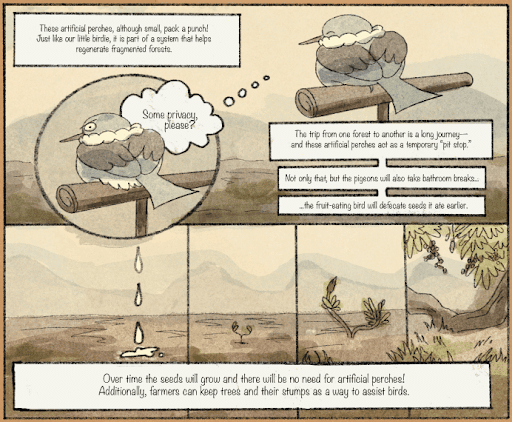
Reforestation activities typically involve planting trees in degraded areas. However, tree planting is resource-intensive, requiring labor for the planting and more importantly nurturing of the seedlings, and may be expensive and limited by seedling supply. Moreover, there is always a question of whether the right plant species (i.e., native rather than non-native economically important species) are being planted to benefit biodiversity.
Thankfully, forests have built-in processes to regenerate or heal if we let them be. Reforestation activities can work with natural systems to accelerate natural forest recovery through Assisted Natural Regeneration (ANR). One strategy under the ANR approach targets the increase of the seed supply to the degraded areas.
The idea is simple: add bird perches to degraded areas near the forest and attract the fruit-eating birds. While on the perch, they poop out seeds and plant the future forest! Easy, but is it really effective?
Previous studies found varying results on the effectiveness of perches to increase seed arrival and seedling establishment. Some say it is, some say not. To resolve this, our international team of scientists, led by Dr. Jelaine Gan from the Institute of Biology – University of the Philippines, with researchers from UK Universities (Newcastle University, University of St Andrews) and Norwegian Institute for Nature Research, conducted a systematic review of the literature and combined the data from different studies to find a consensus through a method called meta-analysis.
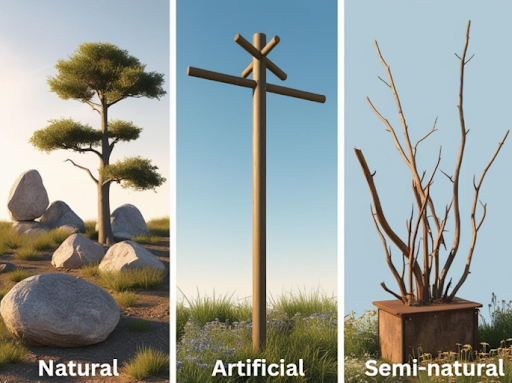
After months of searching and carefully screening studies, we found 396 relevant publications to review. We noted different types of artificial, semi-natural, and natural perches (Figure 1 below). Artificial perches (i.e., man-made) were mainly straight poles made from wood or PVC pipes with horizontal bars and crossbars, while some examined live fences (i.e., living trees tied with wire), and wood piles. Meanwhile, natural perches were also examined, which came in a variety of types from shrubs to trees to tree islands, as well as rock. The scattered trees in agricultural fields are also considered natural perches. We have also noted semi-natural perches, which are those made from dead branches/snags propped up with support.
The verdict
All three types (natural, artificial, semi-natural perches) had a significant positive effect of increasing the number of seeds that arrive in the degraded areas. More seeds from more species were found under perches than the control sites (i.e., areas without perch), signifying their effectiveness.
However, it is not enough that seeds arrive in the area. We need them to germinate and grow into seedlings. When we examine the effect of perches on seedling establishment, only natural perch was found to have a significant effect on seedling density and richness. Hence, the presence of natural perches increases not only the number of seedlings in the area, but also the diversity of seedling species.
We recommend that natural perches be preserved, such as those shrubs and scattered trees in the agricultural farms, but in areas lacking these natural features, to explore the use of artificial and semi-natural perches to increase seed rain and follow it up with additional treatments, such as soil amelioration and weeding, to improve seedling establishment. — By Dr. Jelaine L. Gan
For interview requests and other concerns, please contact media@science.upd.edu.ph.
References:
Comics – We partnered with the Massachusetts College of Art and Design to develop a comic book entitled How Birds Can Help Farms and Forests in Northern Philippines. Art beautifully designed by Jessica Stutman and co-developed with Dr. Caroline Hu. Check out the full comic here: https://blogs.ncl.ac.uk/marionpfeifer/2024/07/19/how-birds-can-help-farms-and-forests-in-the-philippines/
Journal article – https://environmentalevidencejournal.biomedcentral.com/articles/10.1186/s13750-025-00363-8
Blog post – https://about.conservationevidence.com/2025/07/23/can-we-use-perches-to-attract-birds-and-increase-seed-dispersal-in-degraded-areas/

Started in 1927, the Philippines Graphic is the longest-running printed magazine of national circulation that provides relevant news and features and promotes Philippine literature.

 are being planted to benefit biodiversity.)