

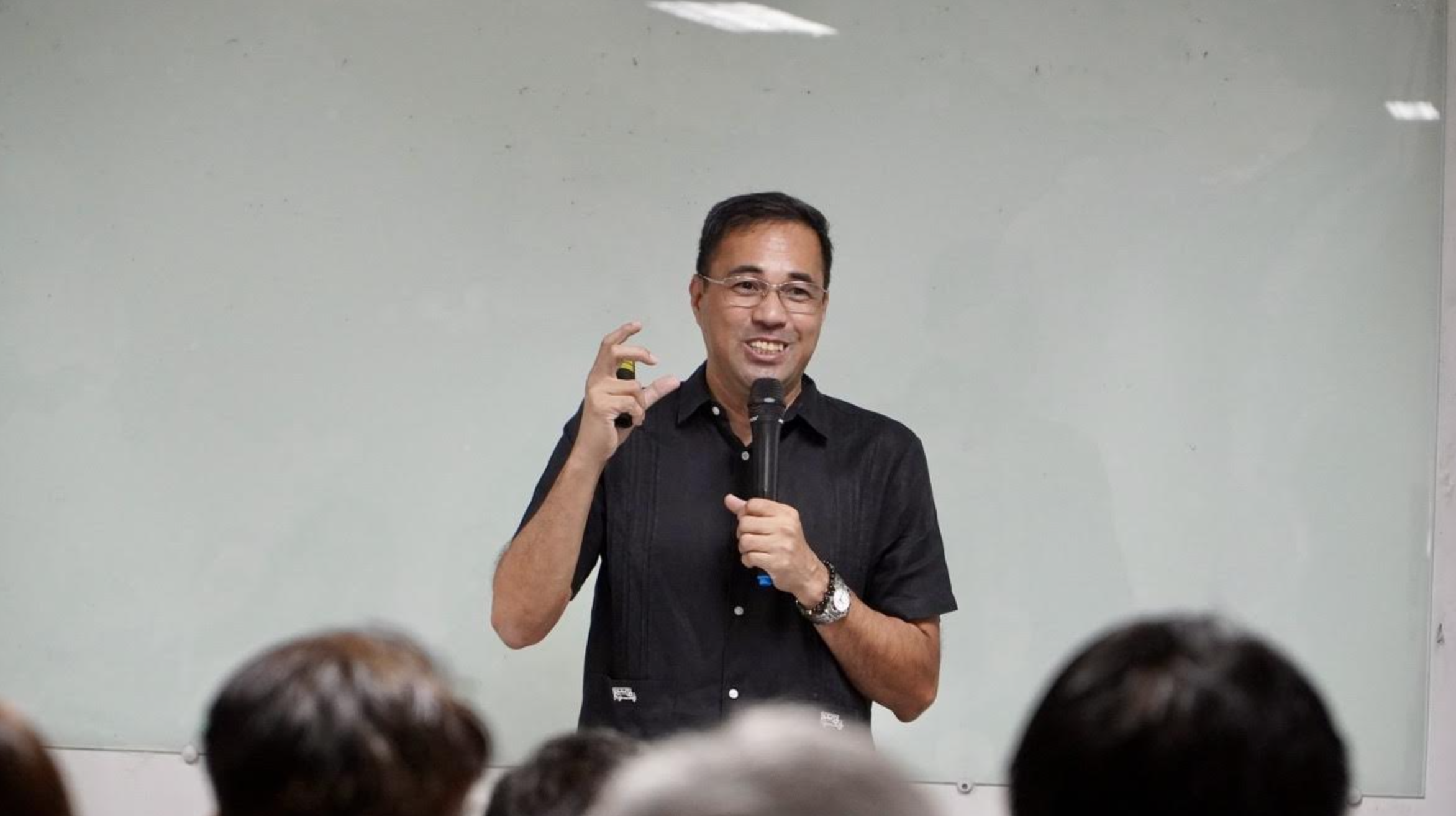
Jerry Ilao’s 4A Blueprint™ urges companies to maximize AI assistants before moving to automation and AI agents.
VIA GRAPHIC PLUS | MANILA, Philippines (September 2026) — Participants in AI workshops for Philippine companies have reported cutting hours-long reporting and analysis tasks to minutes using commonly available AI tools, according to Jerry Ilao, creator of The 4A Blueprint™, a practical AI adoption framework for Philippine businesses.
In Ilao’s in-house workshops, participants have reported redoing an inventory aging analysis in 3 minutes instead of 4 hours, a sales and collection report in 5 minutes instead of 5 hours, and a network sales report in 10 minutes instead of 6 hours. The examples are participant-reported, the AI-assisted times include review and corrections, and results vary by task.

“None of these people built an agent or automated anything,” Ilao said. “They took a report they already knew well, gave the same data to ChatGPT, Claude, Gemini, or Copilot, and compared the result with the version they built by hand. The benchmark is what made it meaningful.”
The 4A Blueprint maps AI adoption in four levels: Assistants, where people use AI to do their own work faster; Automation, where AI runs a set workflow on its own; Agents, where AI takes on a defined job within limits people set; and AI-First, where the business is built around AI.
Ilao’s principle is to meet the business where it is and start there. While many promote AI agents because they are exciting, he advises companies to start at Level 1, which he describes as the cheapest and easiest level to implement.
“At Level 1, companies can start by training employees to use AI effectively, giving them access to approved tools, and putting a clear AI policy in place,” Ilao said. “That is one of the fastest and lowest-cost ways to start improving productivity. Once the company is ready, it can move to automation and AI agents. But it does not have to start there.”
In one company workshop, 87% of participants said they were already using AI multiple times a week — the highest rate Ilao had seen across his workshops. Even so, many still discovered significant room to improve how they used AI assistants. For Ilao, the lesson is clear: frequent AI use does not necessarily mean employees are maximizing the AI tools they already have.
As companies move from assistants to automation and agents, implementation complexity, governance requirements and operational risk generally increase. Ilao cautions companies against rushing into AI agents simply because they represent a more advanced level.
In the framework, a higher level is not automatically better. A business may be exactly where it should be at Level 2 if automation already delivers the needed business value without the added complexity of AI agents.
“Level 1 gets underestimated because it sounds basic,” Ilao said. “But the judgment your people build there is what every level above runs on.”
Across selected workshop sessions, participants’ average self-reported confidence in using AI at work moved from 3.22 to 4.26 out of 5, based on matched before-and-after responses. Eighty-nine percent rated their AI-assisted output better than their usual work and 94 percent said they would use the approach again. These are self-reports, not measured productivity gains.
Ilao recommends four steps: pick one analysis the team has already completed manually; give AI the same data and question; include review time when measuring the result; and compare the AI-assisted output with the original. Employees should use company-approved tools and must not upload confidential, sensitive, or personal information unless their organization’s policies and data protections allow it.
If the approach works, the company can then turn the prompt into a shared assistant on approved company accounts, with clear rules on what employees must not upload.
The best prompts, Ilao adds, should be shared within the company. “A good prompt is not disposable,” he said. “Treat it as intellectual property, like an SOP. Later, the same logic can become a reusable AI skill or form part of an automated workflow or agent.”
The 4A Blueprint and its free five-minute assessment are available at jerryilao.com/4a-blueprint.
About Jerry Ilao. Jerry Ilao is a Filipino AI Business Strategist and creator of The 4A Blueprint™, a practical AI adoption framework for Philippine businesses. He is Founding President and Co-Founder of the Philippine AI Business Association (PAIBA), co-founder of field-work automation platform Tarkie, and has led more than 200 digital transformation projects since 2014.

Started in 1927, the Philippines Graphic is the longest-running printed magazine of national circulation that provides relevant news and features and promotes Philippine literature.