

In places where paved roads give way to dirt, service is not an idea—it is a decision, made repeatedly, often without witnesses. It is measured in who stays when help becomes inconvenient, and who returns when gratitude has faded.
Long before awards and ceremonies, these were the conditions that shaped Dr. Dely Po Go’s understanding of responsibility.
The woman known widely and affectionately as “Tita Dely” was raised in Cadiz, Negros Occidental—a provincial city shaped by agricultural wealth alongside persistent inequality.
In Filipino communities, “tita” is not a title of age, but of trust, earned through consistency, care, and an absence of pretense. Cadiz is a place where survival has long depended not only on institutions, but on neighbors, kin, and informal networks of care.
Responsibility there is not theoretical. It is learned early, and it is shared.
Nursing was her way into public life. It was never the edge of it.
For decades, Tita Dely has moved between systems, healthcare, education, philanthropy, and diaspora institutions—not chasing visibility, but building continuity. Her work crosses borders quietly, linking immigrant communities in the United States with underserved regions in the Philippines, guided by a belief that service is not an event, not a performance, but something closer to infrastructure. If it works, one barely notices it. If it fails, everything collapses.
‘HERO OF THE WORLD’
That philosophy gives weight to her recognition as a “Bayani ng Mundo:” an honor bestowed by the Philippine Nurses Association of America Foundation (PNAAF). The phrase translates loosely as “hero of the world,” but its power lies in how it is given.
This is not a state decoration: It is peer recognition, conferred by people who understand the cost of the work.
The distinction occupies a particular moral space within Filipino professional life. It is not an award designed to elevate celebrity or singular achievement, but one meant to recognize sustained service that crosses borders, disciplines, and generations. “Bayani,” or “hero,” in this context, is defined less by sacrifice than by continuity, the quiet endurance required to keep communities functioning when formal systems falter.
The award was conferred by the PNAAF—the philanthropic and civic arm of the Philippine Nurses Association of America which is one of the largest and most influential professional organizations representing Filipino nurses in the US. For decades, the association has served not only as an advocate for professional advancement, but as a stabilizing force within the Filipino diaspora, responding to labor inequities, immigration challenges, public health crises, and humanitarian emergencies both there and in the Philippines.
The foundation’s honors are shaped by that history. They emerge from a profession that understands service at its most intimate and exhausting scale: bedside care, crisis response, moral injury, and long recovery.
Within the nursing culture, recognition is not lightly given. It is grounded in collective memory, shared hardship, and a deep awareness of what it costs to remain present over time.
That is what gives Bayani ng Mundo its authority. It is an honor that comes not from political power or national symbolism, but from peers who have lived inside the same demands, who know the difference between episodic charity and sustained responsibility. To be recognized by PNAAF is to be acknowledged not only for what one has done, but for how consistently, and with whom.
NOT A CAPSTONE
When Dr. Go accepted the honor during PNAAF’s Gabi ng Pagpupugay in Manila, the evening carried the polish of ceremony without the suggestion of finality.
This was not a capstone. It was a placement. A way of saying: We see what you have carried, and for how long. Peer recognition operates differently from state
honor. Government awards tend to declare meaning. Peer honors evaluate it. They emerge from shared labor, shared risk, shared exhaustion. They do not turn work into myth—they measure whether it held up over time.
In naming Dr. Go a “Bayani ng Mundo,” her community did not lift her into abstraction. It placed her inside a lineage, one that understands service as something sustained, repeated, and often unseen.
To understand why, one has to look beyond nursing.
To describe Tita Dely solely as a nurse, or even as a nursing leader, is to miss the architecture of her public life. Nursing was the discipline that opened the door. It was never the room. Over decades, she has functioned as a civic anchor, operating across healthcare, education, labor policy, diaspora governance, culture, and faith- based community life.
Her influence is not attached to a single title: It resides in her ability to hold systems steady while others move through them.
NURSING AS A FOUNDATION
Her professional formation began in healthcare, shaped by her studies at Silliman University and later Fairleigh Dickinson University, where she earned her Doctor of Nursing Practice. Like many Filipino professionals who migrate, nursing offered entry into complex systems, licensure, regulation, institutional hierarchies that determine who advances and who is left behind. She learned those systems thoroughly not simply to navigate them herself, but to translate them for others.
From her base in New Jersey, she built Nursing Network, LLC, guiding hundreds of nurses through licensure, leadership, and professional survival.
Yet, even at the height of her influence, she resisted being contained by a single field. Nursing was a foundation, not an identity.
Beyond clinical practice, she became an educator and mentor, teaching at graduate and doctoral levels, advising students, mentoring candidates without compensation.
Education, in her practice, was not about prestige or branding: It was about continuity, making sure knowledge and responsibility did not stop with one generation.
Her long service in institutional governance followed the same logic. Across boards and advisory councils, she acted less as a figurehead than as a custodian. For her governance was quiet work, maintaining ethical standards, institutional memory, and accountability so organizations could survive leadership changes and political cycles.
That same ethic extends across the diaspora. Tita Dely has been entrusted with civic and cultural leadership roles repeatedly, not by appointment, but by consensus. Being selected both as “Grand Marshal” and “Hermana Mayor” in multiple international settings reflect a rare form of legitimacy, trust granted only to people who can move resources and people without fracturing communities.
CHARITY AS RELATIONAL
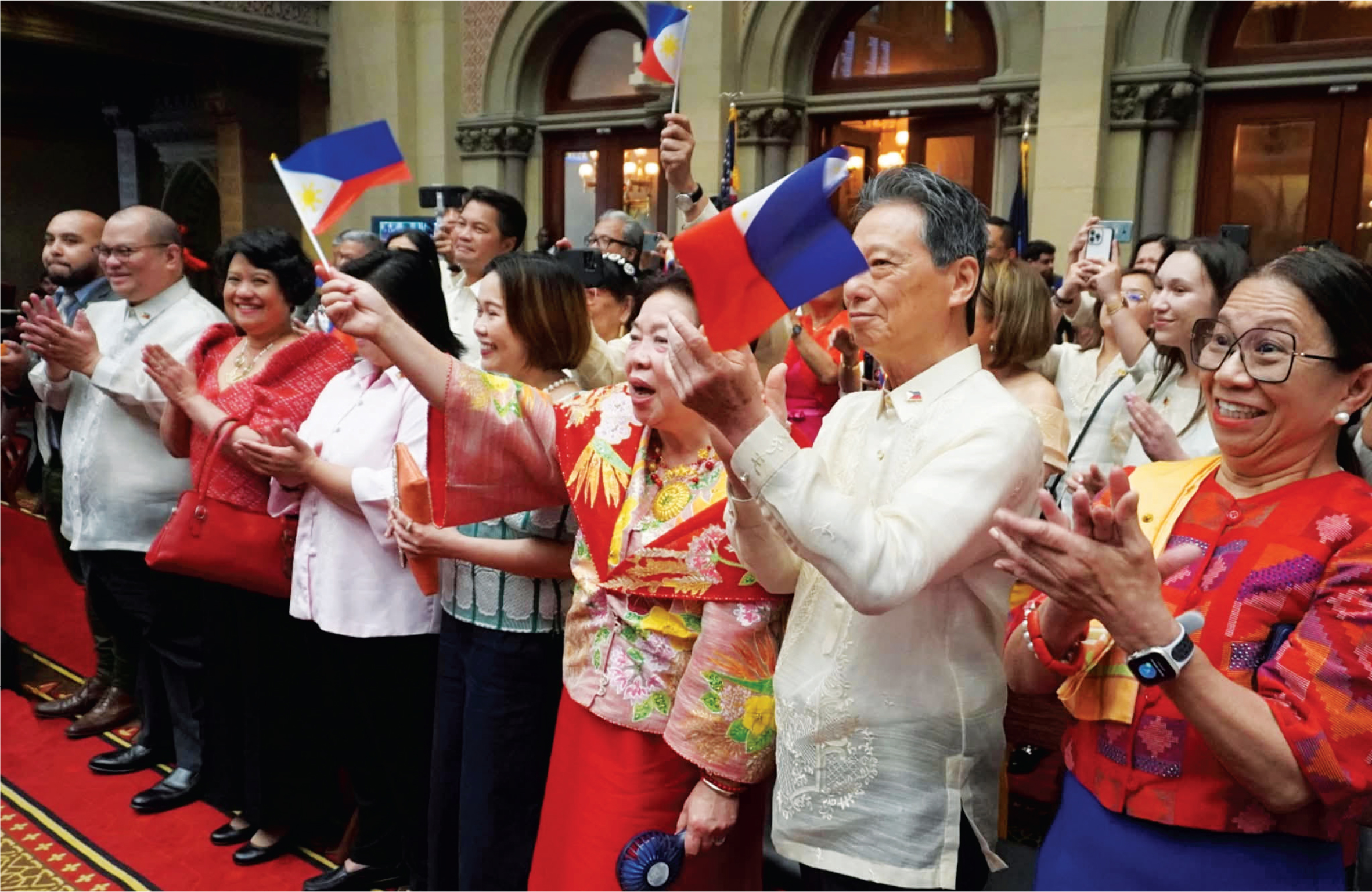
I covered Tita Dely closely throughout 2023—not from a distance, but by following her across places and moments. I documented her Grand Marshalship during New York City’s 125th Philippine Independence Day Parade, traveled with her to Milan for the Philippine Independence Day celebrations there and the PAFCOM Grand Marshalship, and witnessed her presence at more than 30 other community events throughout the year.
These were not exclusively Filipino spaces. They included faith communities, civic organizations, cultural groups, and humanitarian gatherings marked by real diversity. What stayed with me was not how much she gave, but how often she stayed. She did not delegate compassion. She showed up. She listened. She remained. Charity, for her, was not transactional. It was relational.
Presence, she understands, is the rarest form of generosity.
Her cultural work in Milan reflected the same instinct. As a steward of Filipino music and heritage, she helped sustain choirs and foundations not through spectacle, but through structure. Culture, in her hands, became something durable rather than decorative.
Her engagement with faith-based communities followed a similar rhythm. In these spaces, legitimacy cannot be claimed; it has to be earned slowly: through discretion, through consistency, and through presence. Her support of large religious and humanitarian gatherings functioned less as ceremony than as cohesion, holding communities together far from home.
Together with her husband Harry Go, she has supported livelihood development in underserved Philippine communities, places often described plainly as areas where the road ends and the mud begins.
There, philanthropy was not about relief alone: It was about reintegration. Skills training, education support, and livelihood projects were designed so people could remain participants in their own lives.
What distinguishes these efforts is not scale, but method. When crises appeared, she responded directly. When systems failed, she filled the gap: Whether arranging the safe return of a Filipino nurse abandoned during a mental health crisis, or financing education for families displaced by sudden tragedy, her instinct was always restoration—not recognition.
To date, she continues to support communities in need, especially during times of calamity in the Philippines.
SERVICE PHILOSOPHY
Taken together, these acts form a philosophy of service grounded in continuity. Tita Dely does not replace institutions. She steadies lives long enough for institutions to catch up, or quietly compensates when they do not.
For decades, she has occupied a rare place in civic life, service no longer driven by urgency or ambition, but sustained by habit, memory, and accountability. Authority here does not come from visibility. It comes from staying.
Honors have followed, though they rarely seem to interest her. What matters more is that communities keep calling, and she keeps answering.
That is why the Bayani ng Mundo recognition carries weight. It did not arrive from the state; It came from peers who understand the cost of showing up year after year.
The “Gabi ng Pagpupugay” exists for this reason. Not to manufacture heroes, but to recognize lives that have already been lived in service.
What ultimately distinguishes Tita Dely is restraint. She does not confuse leadership with command, or charity with display. Her work insists that care must extend beyond profession, beyond geography, beyond crisis.
As the ceremony in Manila ended, what lingered was clarity. Bayani ng Mundo is a grand phrase. She wears it lightly.
The real measure of her work lives elsewhere, in livelihoods restored, in families steadied, in institutions held together quietly. In a time drawn to visibility, her life offers a calmer truth: that the most consequential acts of service are often the ones that do not ask to be seen, only sustained.
Long after the parade routes are cleared and the stages dismantled, Tita Dely is still there, answering calls, holding hands, and staying when it would be easier to leave.
Written by Troi Santos. Published in the February 2026 Special Issue of the Philippines Graphic.

Started in 1927, the Philippines Graphic is the longest-running printed magazine of national circulation that provides relevant news and features and promotes Philippine literature.