

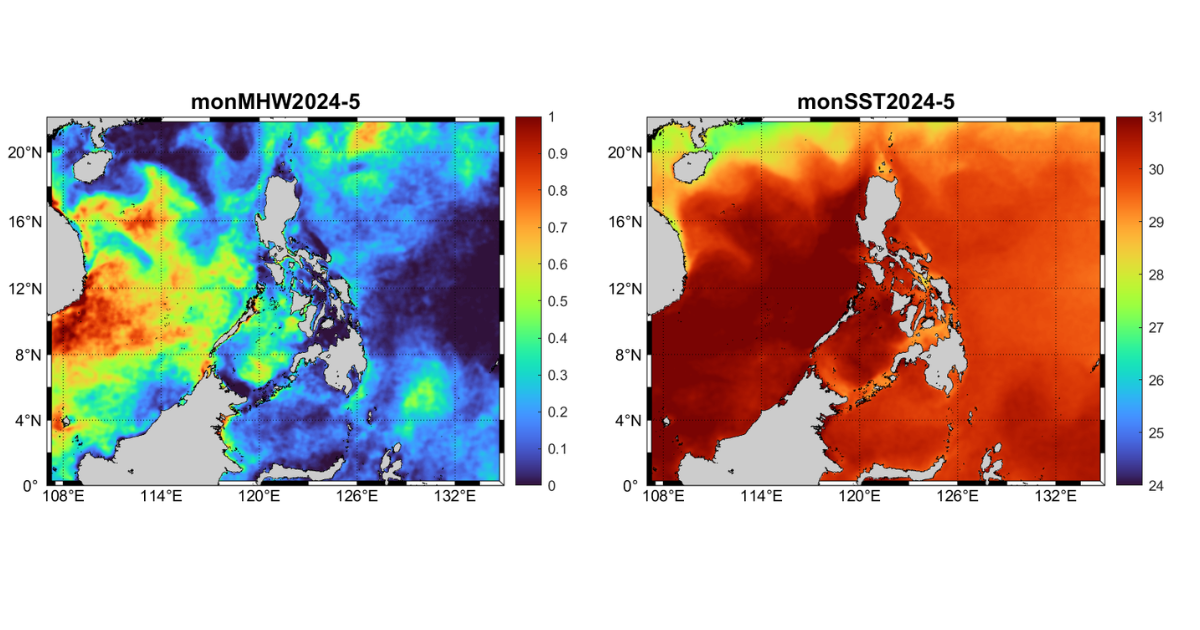
RECORD-BREAKING HEAT. Sea surface temperatures (left) and marine heatwave anomaly (right) around the Philippines in May 2024, at the tail end of the El Niño event. The bar graphs show sea surface temperature values (in °C) and the severity of marine heatwave anomalies (in °C), respectively. Figures courtesy of Rachel Francisco.
The 2023–2024 El Niño resulted in record-high sea surface temperatures (SST) in the Philippines, with daily SST peaking at 30.45°C in June 2024. These temperatures surpassed previous El Niño events, including the 2015–2016 El Niño.
A new study by UP MSI has found that these elevated SSTs persisted for 3 months even after the official end of the El Niño in May 2024, especially through June to August 2024.
Rachel Francisco, Dr. Charina Lyn Amedo-Repollo, and Chloie Ann Libatog of the Physical Oceanography and Observation Laboratory worked with Dr. Maria Vanessa Baria-Rodriguez of the Interactions of Marine Bionts and Benthic Ecosystems Laboratory to investigate marine heatwaves in the Philippines. The study, Evolution of Marine Heatwave in the Philippines During and After the 2023/24 El Niño, was recently published in the journal IOP Conference Series: Earth and Environmental Science.
Data from the Global OSTIA NRT dataset was used to examine the spatiotemporal evolution of sea surface temperatures from March 2023 to August 2024.
Two groups of marine heatwaves were identified. The first group of marine heatwaves occurred from November 2023-January 2024 in northwest Philippines. Although cooler waters are normally expected from the cold winds brought by the northeast monsoon (amihan), these were not enough to overcome the heat of El Niño.
The second, more intense group of marine heatwaves occurred from April-August 2024 in both northwest and northeast Philippines. As El Niño was ending, warm winds brought by the southwest monsoon (habagat) intensified the heat. This led to prolonged marine heatwaves in the Philippines that persisted even after the El Niño event was over.
In both groups, the marine heatwaves first appeared in the north and progressed southward over time.
With marine ecosystems already under stress, understanding how these extreme events evolve in a warming world is crucial.

Started in 1927, the Philippines Graphic is the longest-running printed magazine of national circulation that provides relevant news and features and promotes Philippine literature.