

The world of social media has become an increasingly important source of data for biodiversity and conservation, especially for rare or little-known species such as the Philippine tarsier. However, despite its popularity, there is still limited information about where it lives and how it behaves in the wild.
Maria Sabrina Tabeta and Simeon Gabriel Bejar of the University of the Philippines – Diliman College of Science’s Institute of Biology (UPD-CS IB) explored public posts and group posts on Facebook that mentioned Philippine tarsiers.
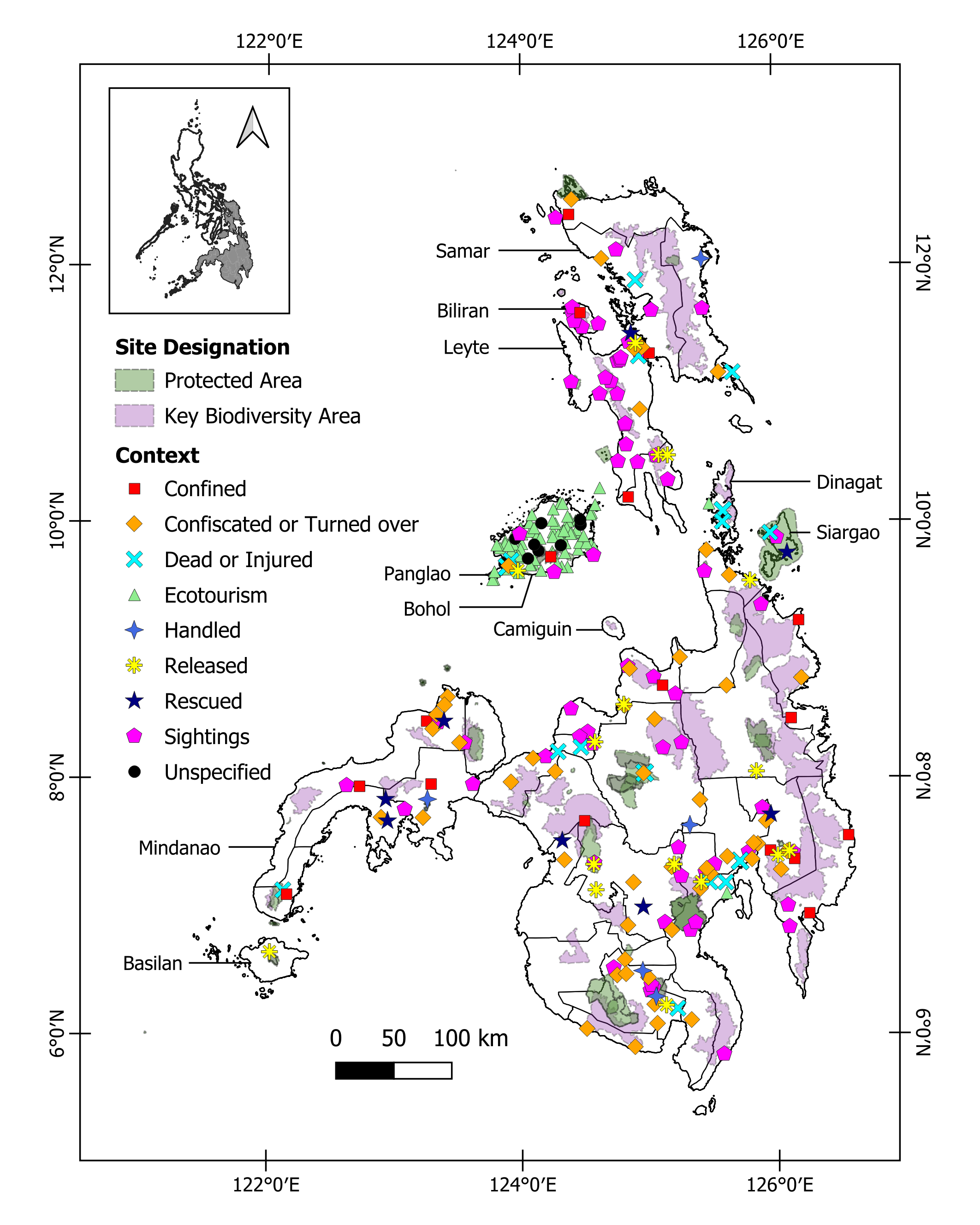
After gathering a total of 1,125 posts published between 2006 and 2024, the researchers mapped out the locations where people encountered tarsiers and identified whether these places were within Protected Areas or Key Biodiversity Areas.
“What we found was astonishing—people reported encountering tarsiers in 29 provinces, which is more than twice the number listed in official conservation records like the International Union for Conservation of Nature (IUCN) Red List or even the citizen science platform iNaturalist,” the biologists shared in an email interview.
Many of the encounters between humans and tarsiers took place outside protected areas, often in environments altered by human activity. The results of the study suggest that tarsiers may be more adaptable to human-altered environments than what was initially thought.
“While most posts showed tarsiers in the context of ecotourism, others featured wild sightings of the primate, individuals kept in captivity, handovers to authorities, rescues, and even cases involving injury or death,” they added.
Through some of the Facebook posts they analyzed, the biologists also identified emerging threats to tarsiers, such as attacks by pet dogs and cats, forest fires, and infrastructure projects. These trends point to increasing contact between people and tarsiers, which could put the species at risk.
“This study shows how social media posts can offer meaningful insights about elusive species like the Philippine tarsier and help fill in gaps left by traditional research,” the biologists explained. “Furthermore, it highlights how everyone can play a part in conservation just by sharing their observations of wildlife.”
To keep the momentum going, the biologists launched the Philippine Tarsier Conservation and Research Initiative on Facebook—a platform for sharing knowledge, raising awareness, and sparking action to protect tarsiers.
Their study, titled “Improving Our Understanding of a Cryptic Primate, the Philippine Tarsier (Carlito syrichta), Through Social Media,” is published in the International Journal of Primatology, a multidisciplinary forum devoted to current research in fundamental primatology. — Eunice Jean C. Patron / UP College of Science
For interview requests and other concerns, please contact media@science.upd.edu.ph.
References:
Tabeta, M. S. G., & Bejar, S. G. F. (2025). Improving Our Understanding of a Cryptic Primate, the Philippine Tarsier (Carlito syrichta), Through Social Media. International Journal of Primatology. https://doi.org/10.1007/s10764-025-00495-1

Started in 1927, the Philippines Graphic is the longest-running printed magazine of national circulation that provides relevant news and features and promotes Philippine literature.