

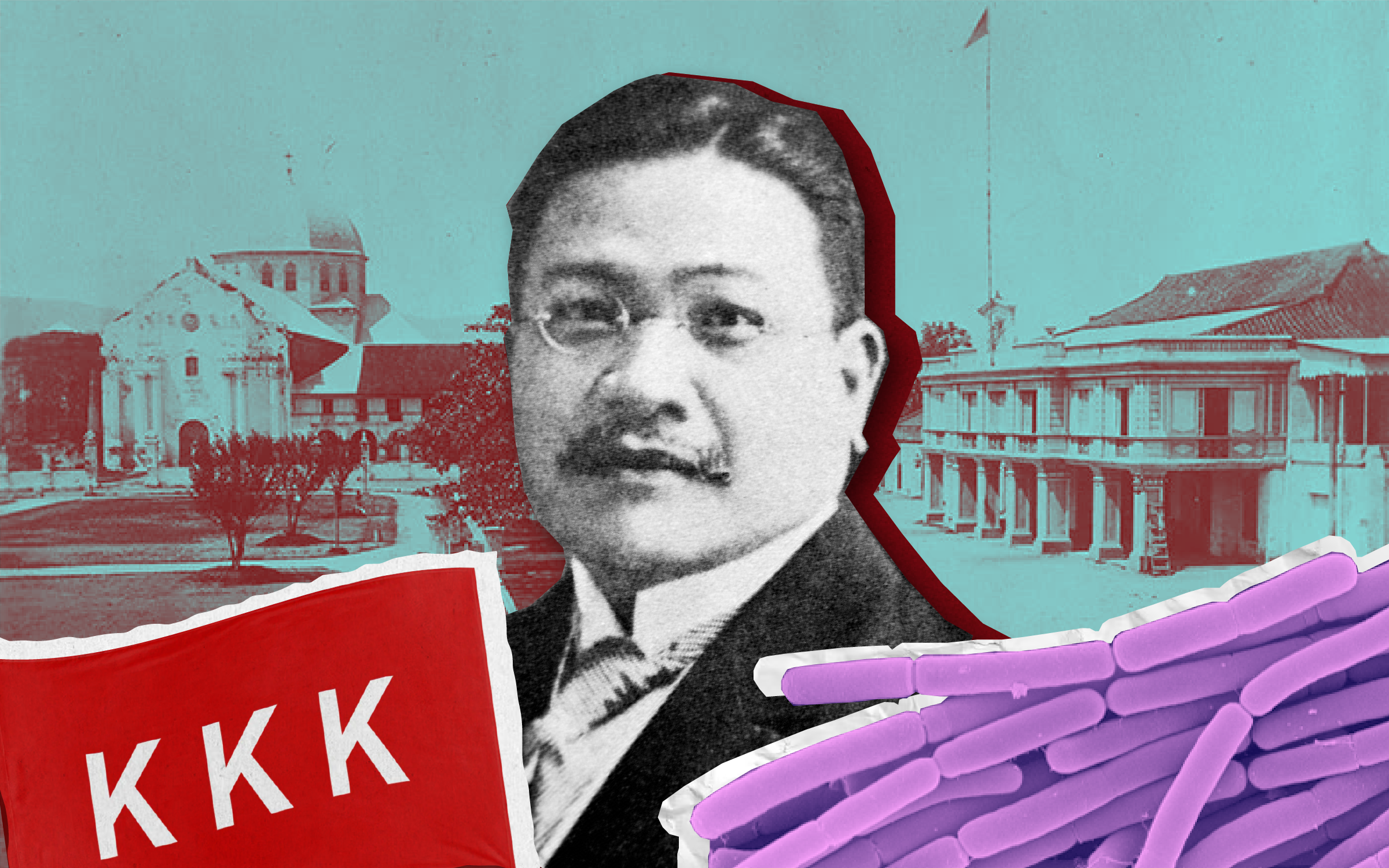
The lives and careers of the Filipino Ilustrados in Madrid in the last two decades of the 19th century are well known. Figures such as Dr José Rizal, General Antonio Luna, Juan Luna, and Marcelo H. del Pilar are familiar to many Filipinos. However, the career of Dr. Francisco Tongio Liongson is less so. Like General Luna, Liongson trained as a scientist at the Universidad Central de Madrid, where he earned his doctorate, and pursued postdoctoral training at the Institut Pasteur in Paris. As with many Filipino scientists who studied overseas, he returned home with the intention of establishing laboratories and teaching future medical students, had the revolution not occurred and Philippine independence been secured.
Dr. Francisco Tongio Liongson was one such scientist who, after completing his doctoral studies, joined the Katipunan and fought in the Philippine Revolution. Scientists from the UP Diliman College of Science (UPD-CS)—Dr. Benjamin M. Vallejo Jr. of the Institute of Environmental Science and Meteorology, and co-authors Dr. Rodrigo Angelo C. Ong and Raymundo Pascual Addun—recently published a paper on the career of Dr. Liongson.
Their paper, which was based on Liongson’s doctoral thesis and clinical notes, reviewed how Liongson conceptualized his understanding of immunology—which was an emerging field in the early 1890s. Using the primary scientific research material which Liongson consulted—such as those of Metchnikoff, Toussaint, von Behring, Pasteur, Roux, and Héricourt—the researchers were able to describe the development of Dr. Liongson’s medical and clinical theories, particularly in developing an anthrax vaccine.
Dr Liongson came out with hypotheses and conclusions that anticipated many of immunology’s major advances in the 20th century, such as the humoral theory. Through his scientific work, he strongly advocated vaccination as a means to combat infectious diseases and save millions of lives. In the first 15 years of the 20th century, 18 million Filipinos were vaccinated. As a result, deaths from vaccine-preventable diseases dropped—from 40,000 in 1902 to just 823 by 1913.
Dr. Liongson served as General Luna’s military doctor during the Philippine Revolution. After the American occupation in 1902, he became the provincial doctor of Pampanga, later entering politics and being elected as Senator of Pampanga in 1916, where he authored bills on public health and vaccination. He died in 1919 at the age of 49 due to anthrax—which ironically, was the subject of his doctoral vaccine research. Liongson’s contribution to immunology led to the first successful clinical trial of an anthrax vaccine in 1935.
The paper by Vallejo, Ong, and Addun, titled “A Filipino Doctor at the Birth of Immunology and National Revolution: The Career of Francisco Tongio Liongson, MD,” was published in the Journal of Research in the History of Medicine of the Shiraz University of Medical Sciences in Iran. — by Dr. Benjamin Vallejo Jr.
For interview requests and other concerns, please contact media@science.upd.edu.ph.
References:
Vallejo Jr., B., Ong, R.A.C., Addun, R.P., 2025. A Filipino Doctor at the Birth of Immunology and National Revolution: The Career of Francisco Tongio Liongson, MD. Res Hist Med, 14(3), pp. 239-252. doi: 10.30476/ rhm.2024.103717.1239.
Started in 1927, the Philippines Graphic is the longest-running printed magazine of national circulation that provides relevant news and features and promotes Philippine literature.