

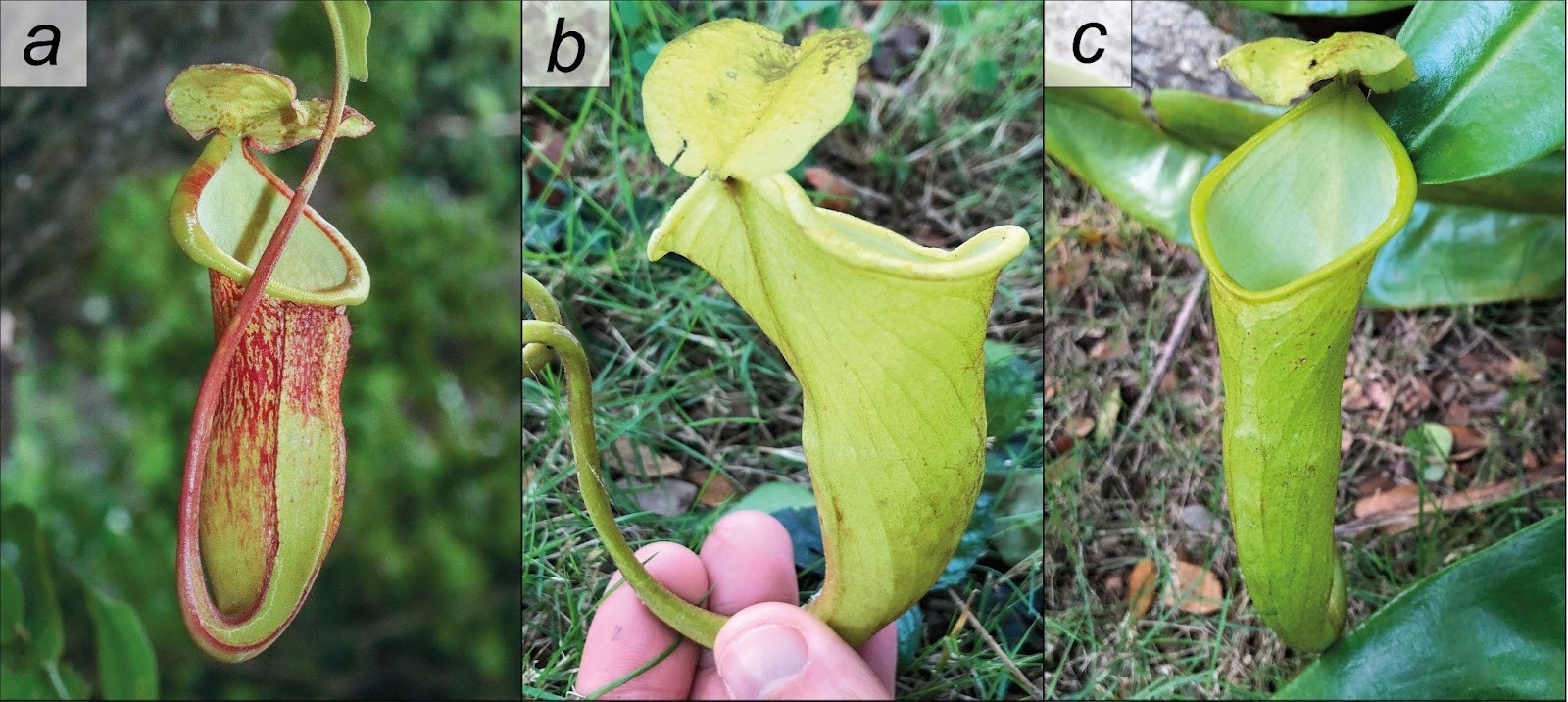
Philippine scientists and an Australian expert have just confirmed a new species of pitcher plant found only on Palawan Island, but warn that it is already at risk of extinction due to frequent severe weather conditions and human encroachment.
A carnivorous vine that uses cup-shaped pitchers to trap insects, Nepenthes megastoma—from the Greek for “large mouth”—is found in only three locations in the steep and rocky karst terrain of the Puerto Princesa Subterranean River National Park.
“It’s amazing that these plants have evolved to survive in such difficult and inaccessible conditions. And yet, despite their hardiness, their existence is threatened by human activity—directly by way of encroachment and poaching, and indirectly through the effects of anthropogenic climate change,” said researcher John Charles Altomonte.
Well adapted to steep cliffs
The few areas where N. megastoma grows are so difficult to reach that the plant could only be properly documented using drones and long-range cameras. Ecologists first spotted them in 2013, but initially thought they were an already known species, N. campanulata, from nearby Borneo. Only after detailed fieldwork, drone surveys, and close study were the researchers able to confirm the plant to be a previously unknown Philippine species.
N. megastoma is well adapted to surviving on steep cliff sides, with upward-pointing female flowers that facilitate vertical pollination and a fuzzy coating that helps collect rainwater. The shape of the plant’s pitchers also seems to vary based on the seasons, transitioning between a wider, flared form and a slimmer, elongated form—an adaptation that may help with water retention, according to the researchers.
Precarious survival, dwindling numbers
Yet despite these remarkable adaptations, the researchers estimate that there are only some 19 mature clumps with about 12 non-flowering plants, making the species’ survival highly precarious. They warn that this already extremely limited population is highly vulnerable to threats like typhoons, drought, poaching, and deforestation in surrounding areas due to human activities and settlements.
With fewer than 50 individual mature specimens known, the plant is classified as Critically Endangered per International Union for Conservation of Nature (IUCN) guidelines. This number is likely to decline even further, owing to “increasing frequency and severity of extreme weather events, particularly droughts and typhoons, as well as poaching,” the scientists warn in their paper. Illegally harvested specimens are already being sold in Metro Manila.
The imminent danger to N. megastoma’s survival despite its ability to adapt to a harsh cliffside environment underscores anew both the richness and fragility of Philippine biodiversity.
John Charles A. Altomonte, John Paul R. Collantes, Vernaluz Mangussad, Rene Alfred Anton Bustamante, and Alastair S. Robinson published their study, Nepenthes megastoma (Nepenthaceae), a micro-endemic pitcher plant from Puerto Princesa Subterranean River National Park, Palawan, Philippines, in November 2025 in the international journal, Phytotaxa. — Danika Geronimo, Ateneo de Manila University Research Communications
SOURCE: https://archium.ateneo.edu/es-faculty-pubs/132/
For interviews, please contact the paper’s corresponding author, John Charles Altomonte, at jaltomonte@ateneo.edu

Started in 1927, the Philippines Graphic is the longest-running printed magazine of national circulation that provides relevant news and features and promotes Philippine literature.