

QUEZON CITY, Philippines – A new cohort of researchers, government professionals, and local policymakers from across the Philippines will soon convene under the Kalalawdan Fellowship Program as Project NEXUS 2.0 expands efforts to strengthen the connection between marine science and policymaking in the country.
As an archipelagic and maritime nation, pursuing and strengthening science-based development is not only needed but necessary. However, attaining this will require policy reforms that are both science-enabling and science-enabled. These are the challenges faced by the Lawod Fellows as they embark on a seven-month training under the Fellowship program.
Building on the gains of the first phase of Project NEXUS and the inaugural Kalalawdan Fellowship, the program’s second batch brings together participants from national government agencies, local government units, and academic institutions.
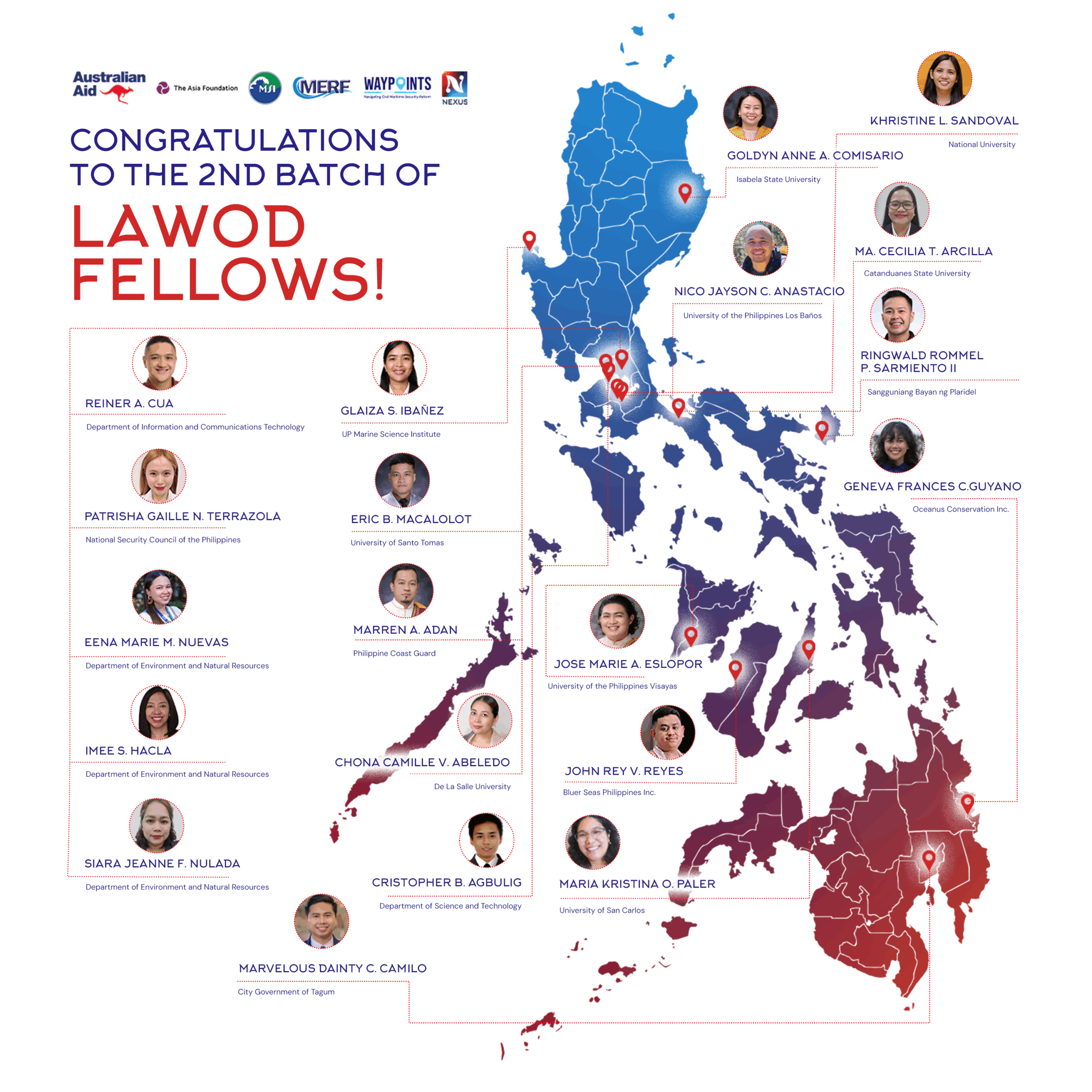
The current cohort of 20 Lawod Fellows reflects a range of perspectives and expertise, with participants representing Luzon, Visayas, and Mindanao, and coming from government, academe, and the private sector. In a celebration of interdisciplinarity, diversity, and culture, the fellowship seeks to equip participants with the knowledge, networks, and practical tools needed to translate scientific evidence into actionable policy reforms for the country’s marine and maritime sector within their respective contexts.
The list of accepted fellows are:
- Goldyn Anne A. Comisario – Isabela State University – Institute of Fisheries, Isabela, Cagayan
- Nico Jayson C. Anastacio – University of the Philippines Los Baños – Center for Strategic Planning and Policy Studies, Los Baños, Laguna
- Chona Camille V. Abeledo – De La Salle University – Br. Alfred Shields FSC Marine Station (SHORE Center), Manila City, Metro Manila
- Marvelous Dainty C. Camilo – City Government of Tagum, Tagum City, Davao del Norte
- Ma. Cecilia T. Arcilla – Catanduanes State University, Virac, Catanduanes
- Glaiza S. Ibañez – UP Marine Science Institute – Bolinao – Marine Invertebrate Ecology Laboratory, Bolinao, Pangasinan
- Jose Marie A. Eslopor – University of the Philippines Visayas – Regional Research Center, Miagao, Ilo-Ilo
- Eric B. Macalolot – University of Santo Tomas – Faculty of Engineering, Manila City, Metro Manila
- Maria Kristina O. Paler – University of San Carlos, Talamban, Cebu City
- Marren A. Adan – Philippine Coast Guard – Coast Guard Strategic Studies and International Affairs Center (CGSSIAC), Manila City, Metro Manila
- Reiner A. Cua – Department of Information and Communications Technology – Procurement and Communications Oversight, Quezon City, Metro Manila
- Cristopher B. Agbulig – Department of Science and Technology – Department Legislative Liaison Office (DOST-DLLO), Taguig City, Metro Manila
- Patrisha Gaille N. Terrazola – National Security Council of the Philippines – Partnership and Engagement, Quezon City, Metro Manila
- John Rey V. Reyes – Bluer Seas Philippines Inc., Negros Occidental, Marinduque, Mindoro
- Geneva Frances C.Guyano – Oceanus Conservation Inc., Bislig City, Surigao del Sur; Lobo, Batangas
- Ringwald Rommel P. Sarmiento II – Sangguniang Bayan ng Plaridel, Plaridel, Quezon Province
- Eena Marie M. Nuevas – Department of Environment and Natural Resources- Ocean Environments Task Force (OETF), Quezon City, Metro Manila
- Imee S. Hacla – Department of Environment and Natural Resources- Ocean Environments Task Force (OETF), Quezon City, Metro Manila
- Siara Jeanne F. Nulada – Department of Environment and Natural Resources- Ocean Environments Task Force (OETF), Quezon City, Metro Manila
- Khristine L. Sandoval – National University – Mall of Asia (NU MOA) Research Center, Pasay City, Metro Manila
The Kalalawdan Fellowship Program Batch 2 is implemented as part of Project NEXUS 2.0 under the WAYPOINTS Project, led by Dr. Deo Florence Onda of the Microbial Oceanography Laboratory at the University of the Philippines Marine Science Institute (UP MSI), in partnership with the Marine Environment and Resources Foundation, Inc. (MERF) and The Asia Foundation, with support from the Australian Government. Project NEXUS 2.0 aims to advance science-informed maritime governance and promote regional cooperation in marine scientific research (MSR).
Turning science into policy
The first Kalalawdan Fellowship gathered marine scientists and mid-career government professionals who collaborated on policy briefs addressing key marine and maritime governance issues. The fellows also produced Charting New Waters: Strengthening the Philippines’ Path Towards a Stronger and Prosperous Archipelagic Nation, a compendium reviewing the state of marine science-supported policies in the country.
Through workshops, mentorship sessions, policy discussions, and community engagements, the second batch of fellows will develop policy proposals that respond to local and national governance challenges while supporting a more enabling environment for marine scientific research. The fellowship also seeks to foster sustained collaboration between scientists and policymakers and support fellows in advancing reforms within their respective institutions and communities.
The fellowship provides a space for scientists and government professionals to engage in dialogue, learn from one another, and collaboratively develop policy recommendations that support evidence-based marine and maritime governance. These initiatives emerged as priority reforms because of their strategic importance, feasibility, and potential to strengthen the country’s marine scientific research capacity and maritime governance systems.
Advancing maritime policy reforms
In addition to the fellowship, Project NEXUS 2.0 will establish a dedicated policy reforms track to support alumni from the first fellowship cohort in advancing priority policy proposals, including the adoption of a National Marine Scientific Research Agenda and Framework and the institutionalization of the National Academic Research Fleet (NARFleet).
The proposed National Marine Scientific Research Agenda and Framework seeks to provide a unified national strategy for marine scientific research, addressing longstanding challenges related to fragmented research efforts, coordination gaps, and administrative barriers. By aligning research priorities with emerging maritime legislation and national development goals, the framework aims to strengthen evidence-based policymaking and support the sustainable management of the Philippines’ marine resources.
Complementing this effort is the push to institutionalize the National Academic Research Fleet (NARFleet), a consortium led by the University of the Philippines Marine Science Institute together with partner institutions including UP Visayas, Bicol University, and Mindanao State University-Iligan Institute of Technology. NARFleet currently operates six research vessels that support scientific expeditions and oceanographic research across Philippine waters.
By bringing together stakeholders from government, academe, and local communities, the Kalalawdan Fellowship contributes to strengthening science-based and data-driven policymaking, enhancing research-policy collaboration, and building a growing network of science-policy champions across the Philippines.
Project NEXUS 2.0 reflects a shared commitment among its partners to support sustainable marine governance and strengthen the role of science in shaping policies that protect and responsibly manage the country’s marine resources. ——Sofia Guanzon, Microbial Oceanography Laboratory, UP MSI

Started in 1927, the Philippines Graphic is the longest-running printed magazine of national circulation that provides relevant news and features and promotes Philippine literature.