

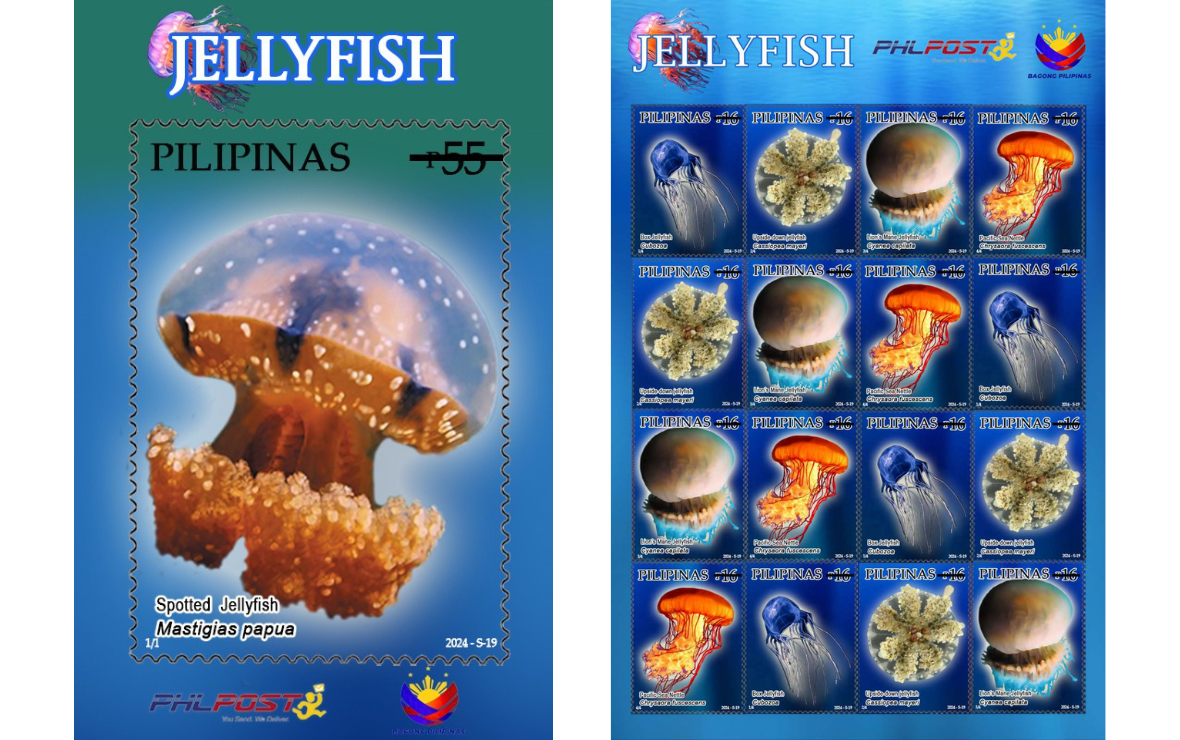
The Philippine Postal Corporation (PHLPost) issued stamps featuring different species of Jellyfish found in the Indo-Pacific and the Philippines, which is considered the epicenter of marine biodiversity.
The regular stamps illustrate four (4) of these wonders of the ocean presented in the “16 on sheet” containing 16 individual stamps. The Philippines is the home of diverse jellyfish species, which are a part of the country’s natural heritage, with some species potentially being unique in the country.
Highlighted in the stamps are: The Box Jellyfish (Cubozoa Box) that lives in warm waters, but the most dangerous of this kind is found near the coasts of northern Australia and the Indo-Pacific region. It has a box-like body with lots of tentacles covered in venom-filled stingers. The different species of box jellyfish are divided into two types: cubozoans and carybdeids.
Another is the Upside-down Jellyfish (Cassiopea mayeri Scyphozoans), notable for their unusual benthic habit of lying upside-down with tentacles facing upwards, resulting in their common name, “upside-down jellyfish”.
Called the Lion’s Mane Jellyfish (Cyanea capilata), this type of marine species is considered one of the largest jelly species in the world, growing to an average length of 1.5 feet (40 cm), but can reach lengths of 6.5 feet (200 cm). The lion’s mane jellyfish is named after its “mane” of long, hair-like tentacles hanging from its bell.
The fourth stamp feature the Pacific Sea Nettle (Chrysaora fuscescens) which exhibited a vibrant red, gold, and brown bell that may grow up to 3 ft (1 m) in diameter as well as white oral arms and 24 tentacles that may be as long as 15 ft (4.6 m).
In addition to the four regular stamps issued by PHLPost, a special souvenir stamp was released featuring the Spotted Jellyfish (Mastiagas papua). The spotted jelly is one of seven lagoon jelly species in the genus Mastigias that also have the species name papua. This species, which is sometimes called the Papua jelly.
Meanwhile, the Official First Day Cover design features the Jellyfish Cassiopea culionensi which was discovered by an international team of scientists that includes Filipino marine biologists and taxonomists. The new endemic species of jellyfish was named after Culion Bay, Palawan where it was originally found.
As living beings, they have implications in the cycle of nutrients and energy and their relationships to other organisms–as prey, predator or symbiotic interactor–in marine ecosystems.
PHLPost has printed 10,000 copies of the “16 on sheet” containing 16 individual stamps, and 2000 pieces of the souvenir sheet.

Started in 1927, the Philippines Graphic is the longest-running printed magazine of national circulation that provides relevant news and features and promotes Philippine literature.