
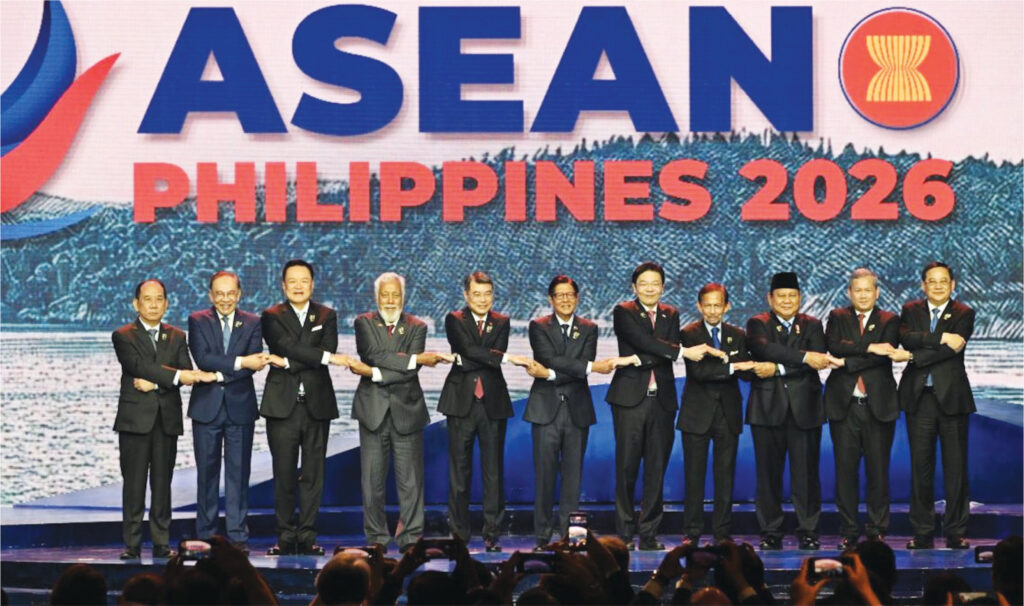
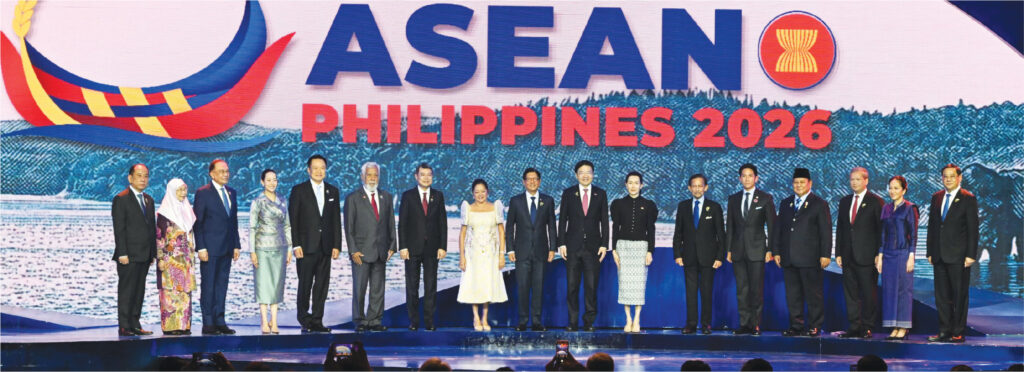
This year, the Philippines assumes the ASEAN chairship. For one calendar year—from Jan.1 to Dec. 31, 2026—the country will be leading an 11-nation regional bloc that is home to 700 million people and ranks as having the 5th largest economy in the world.
The chairship of the ASEAN has been regarded as a banner year for Philippine diplomacy.
As mentioned on its online information sheet, “guided by the theme, ‘Navigating Our Future Together,’ the 2026 chairship reflects the Philippines’ commitment to leading ASEAN with unity, clarity, and purpose. It is a call to steer our region toward greater resilience, deeper connection, and meaningful change that places our people at the center of progress.”
But the chairship came with disturbing developments: the South China Sea dispute, border clashes between Cambodia and Thailand, Myanmar’s defiant junta, and U.S. tariffs.
Then came the joint strike by the U.S. and Israel on Iran.
Tehran launched counterattacks against Washington’s Middle Eastern allies—the UAE, Saudi Arabia, Qatar, and Kuwait. Iran seized control of the Strait of Hormuz, a crucial oil artery for Asia. Suddenly, the war that had once seemed distant finally hit home.
For the Philippines, still reeling from the pandemic and a corruption-tainted flood control program, a question loomed: Could we still afford to host one of the year’s biggest diplomatic gatherings—bringing 11 ASEAN leaders to Cebu?
President Marcos Jr. had to weigh the odds, concluding that in this chaotic world, diplomacy—however dull or unglamorous—was a political imperative.
If I had my way, I wouldn’t cover the Cebu summit after what happened at the foreign ministers’ meeting in January. A Presidential Communications Office (PCO) contractual staffer pulled me back while I tried to ambush Foreign Secretary Ma. Theresa Lazaro.
STRICTER, ‘BARE BONES’ ASEAN
Unlike past ASEAN summits, the Cebu hosting was stricter.
Reporters were barred from side interviews with ministers and senior officials. Perhaps the situation demanded it.
With today’s uncertainties, anything can happen. And this is the Philippines, where Murphy’s Law seems to have been born—an earthquake, Kanlaon’s eruption, a summer super typhoon, or another Black Swan event. That’s why my editor- in-chief Lourdes Molina-Fernandez decided that I fly to Cebu, even if livestreams and press releases made the stories equally accessible. Off I went to cover my third ASEAN Summit.
From the Mactan-Cebu International Airport (MCIA), I and other reporters from the Cebu Pacific flight boarded the van arranged by the ASEAN National Organizing Council—the inter-agency group in charge of the administrative and logistical aspect of the hosting.
We were initially brought to the Waterfront Airport Hotel to get our media IDs. Organizers then briefed reporters on the hotels assigned to the media.
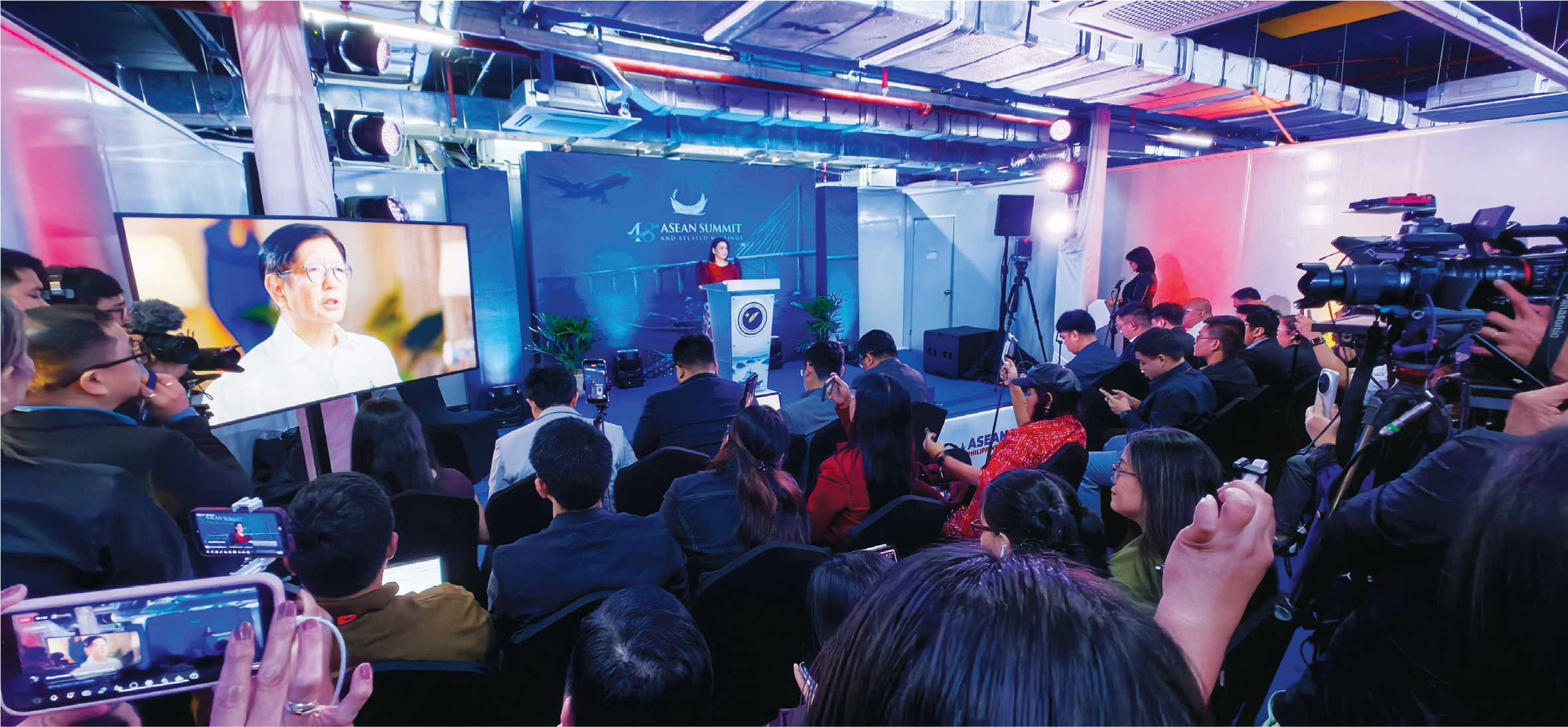
Some of us went straight to the International Media Center (IMC) in Mactan Newtown to catch the 10 a.m. press conference of the Department of Foreign Affairs and Department of Trade and Industry spokespersons.
In the past, security agencies blocked cellphone signals to prevent mobile phone-triggered bomb attacks during high profile visits. Surprisingly, the signals during the summit were not blocked.
Still, I found it hard to connect to my Globe mobile line.
Some Cebuanos told me, however, that Globe data signal is at times intermittent in some areas in Cebu. Fortunately, the internet at the IMC was quite fast so that solved the data issue for Globe user journalists like me.
The PCO rented the Mactan Global Museum to be the venue of the IMC. Aside from showing the orange media card to the guards, the entrance at the ground floor had facial recognition technology. No need to swipe magnetic cards.
The turnstile gate opened when the system recognized that you are indeed accredited media and hence, allowed to enter the building.
The 48th ASEAN in Cebu had a “barebones” ambiance—one lacking in fanfare and the fiesta atmosphere characteristic of past summits.
No less than Pres. Marcos told the media: “It will be a very bare-bones summit. It will be over a period or maybe a day and a half. Hindi ngayon ang panahon na masyadong elaborate [now is not the time to be very elaborate].
ASEAN banners were hung on street lamps or were painted on the wall. I noticed most of these banners were already there during the ASEAN foreign ministers retreat last January.
There was no ASEAN lane dedicated to accredited vehicles and marked “ASEAN” for Very Important Persons (VIPs) and Very, Very Important Persons (VVIPs). Every time an ASEAN leader arrives, the roads were closed and locked down for 30 minutes.
FREEBIES
The press badge came with a bag of freebies courtesy of the Presidential Communications Office—two modular travel backpacks that can be attached to one another and easily placed on big trolley bags, a laptop sleeve, a box of emergency medicines from Unilab, portable fan (which became handy during stakeout in Shangri-La Mactan).
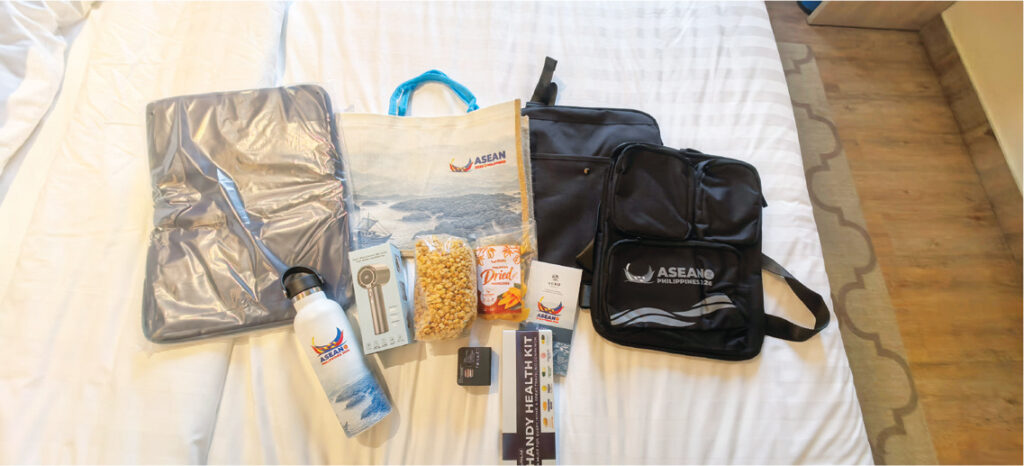
There was also a plastic of cornick (deep-fried crunchy puffed corn nut snack), Auro dark chocolate, dried mango strips, and travel adapter.
Looks like everything was well thought of. Kudos to the PCO team behind this because the backpacks contained all the “essentials” that travelling journalists might need during coverage.
During the ASEAN 2017, some reporters returned their bag of goodies to ASEAN organizers as it came with smart phones, power banks and bamboo speakers. Some reporters thought of them as excessive and returned the bag of freebies to the PCO.
ASEAN LEADERS
Ariel Peñaranda, DFA Assistant Secretary for Protocol, was on hand at the MCIA. This presaged the arrival of a high-ranking arrival.
It turned out to be Hau Khan Sum, Myanmar’s Permanent Secretary to the UN in Geneva. His stature matched that of a senior diplomatic undersecretary.
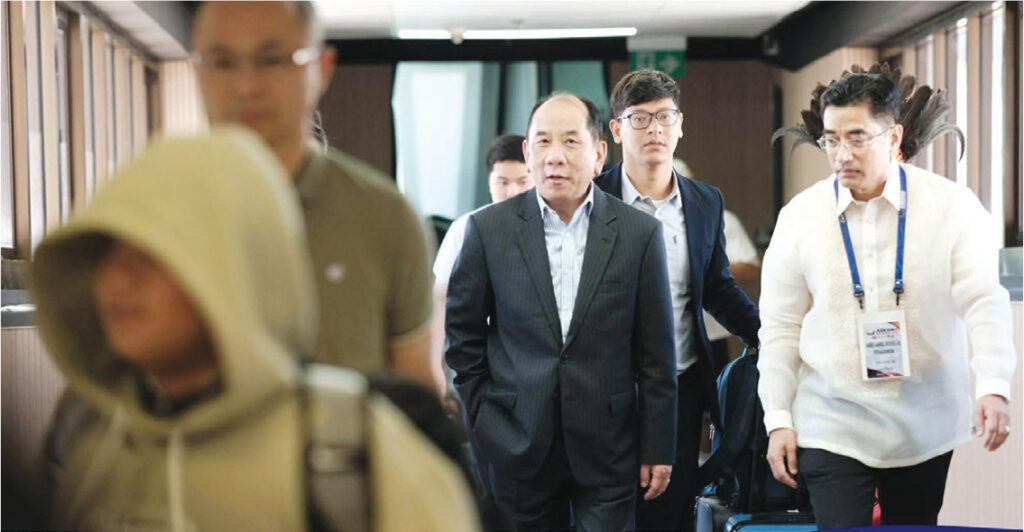
But with ASEAN’s ban on Myanmar ministers and leaders, Hau was not only the head of the delegation for the Senior Officials Meeting. He also doubled as the head of the Foreign Ministers’ Meeting and the Summit.
“Kuracha!” I blurted to Assec Peñaranda. “Ganun na nga [Yeah],” he smiled.
Kuracha, from the film, Kuracha, ang Babaeng Walang Pahinga, is an idiom for someone wearing too many hats— never resting, always multitasking.
While in the lobby area, we were able to get videos of ASEAN leaders arriving, including President Marcos Jr.
We tried to ask him a question about South China Sea, but apparently, he was in a hurry as he had two meetings that day—the BIMP-EAGA Summit and trilateral summit with Thailand and Cambodia.
What was quite surreal was when Timor Leste Prime Minister Xanana Gusmao arrived and he paused when I told him, “Congratulations Prime Minister. You are now a full member of ASEAN. Is this your first time in ASEAN as a full member?” He replied, “No. This is my first time in Cebu.”
Celerina Monte, reporter of NHK, quickly quipped, “Do you have candy? Last year in Kuala Lumpur, you gave us candies.” Gusmao pulled something out of his pocket and it was a small Kitkat chocolate.
He then asked his assistant for candies and he gave Fisherman’s Friend lozenges. I was the first recipient and then everyone also got theirs. My other journalist colleagues started asking him questions about Myanmar, about South China Sea. But he refused to answer. Then, he ran out of candy. He only got the Kitkat chocolate he had from his pocket.
Gusmao broke one bar and asked Straits Times reporter Mara Cepeda to eat it. Mara, who was also filming like I did, initially didn’t take it. Then Gusmao said, “Open your mouth!” Mara didn’t open her mouth and just took the chocolate using her hand. The same thing happened to Agence France Press reporter Martin Abuggao. We didn’t get any soundbites from the 79-year-old, Timor Leste leader.
After that, I jokingly told Martin that had it been GenZ reporters who covered this incident, they would have felt offended by what Gusmao did. But since we covered Gusmao when he was still a rebel, when his comrade in arms Jose Ramos Horta went to Manila and called for independence from Indonesia, probably they were not the usual presidents or prime ministers who are sticklers for protocols.
Also at the lobby, we saw First Lady Liza Araneta-Marcos.
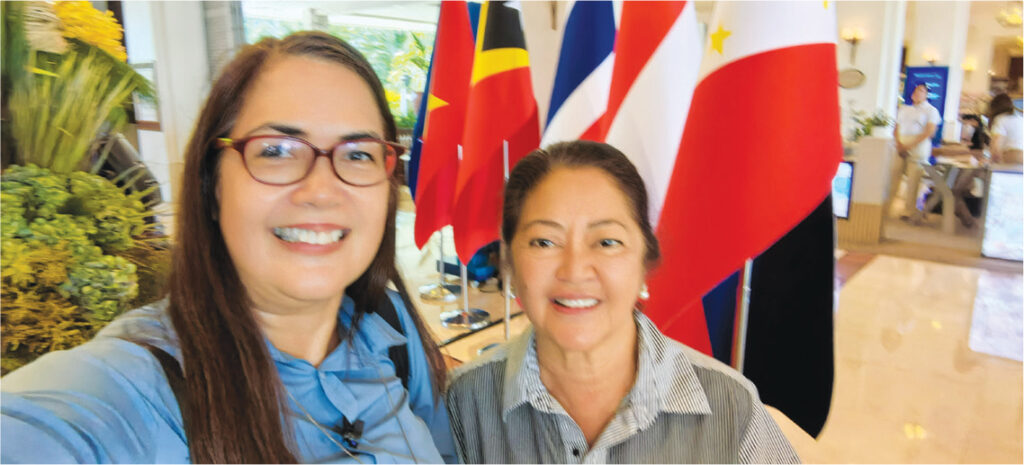
She was in a good mood and went along with our requests for selfies. It turned out she was waiting for Malaysian Prime Minister Anwar Ibrahim.
But the Palace protocol officer told her that she was not dressed formally to receive the Malaysian leader. She said, “No. I just want to wave from behind, not welcome him.” The protocol politely told that it was still not proper. In my view, she was wearing a dress, but perhaps not the way she is required as First Lady. Well, she just succumbed to her protocol officer.
Other Cabinet secretaries were there to entertain her anyway.
IMPRESSIONS
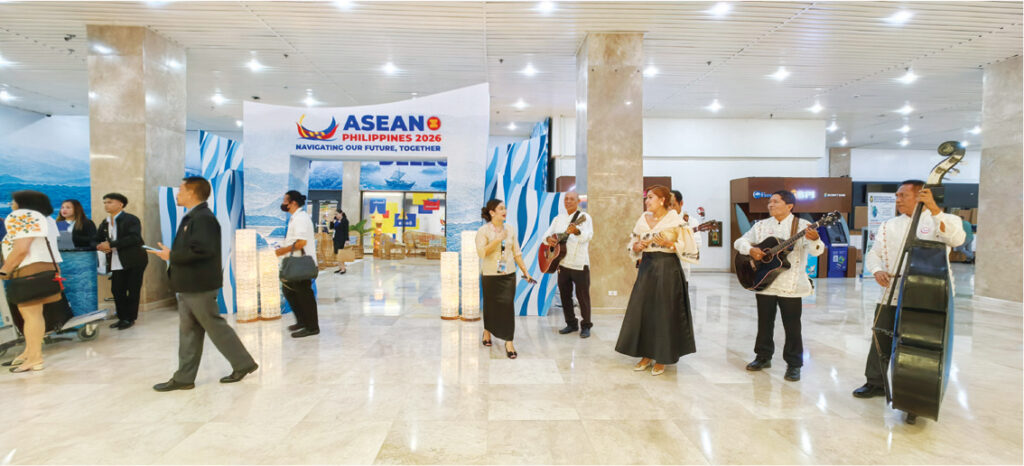
The IMC’s working area for journalists was quite huge. It had a big LED television at the stage. My Cebu partner, BusinessMirror correspondent Carmel Pedroza, was able to secure a seat for me at the left side of the room. There, the air condition was at Arctic-blast and it took me three hours to acclimatize and write my first story (a calendar story!) from Cebu.
Filipino journalists who either work for local media or with foreign media occupied the area. There were a number ofASEAN journalists, including Jay of Bangkok Post (sorry your last name escaped me!) who I met during a media tour in New Delhi last year.
Perhaps, other ASEAN journalists did not see the summit as interesting, or found it too costly to cover a one-day summit.
Out of 2,000 journalists who applied for accreditation, only 500 actually showed up and covered.
Cebuanos I spoke with said that had it not been for the Cebu provincial government’s suspension of classes from May 6-8, they wouldn’t realize that there was going to be an ASEAN Summit in Cebu.
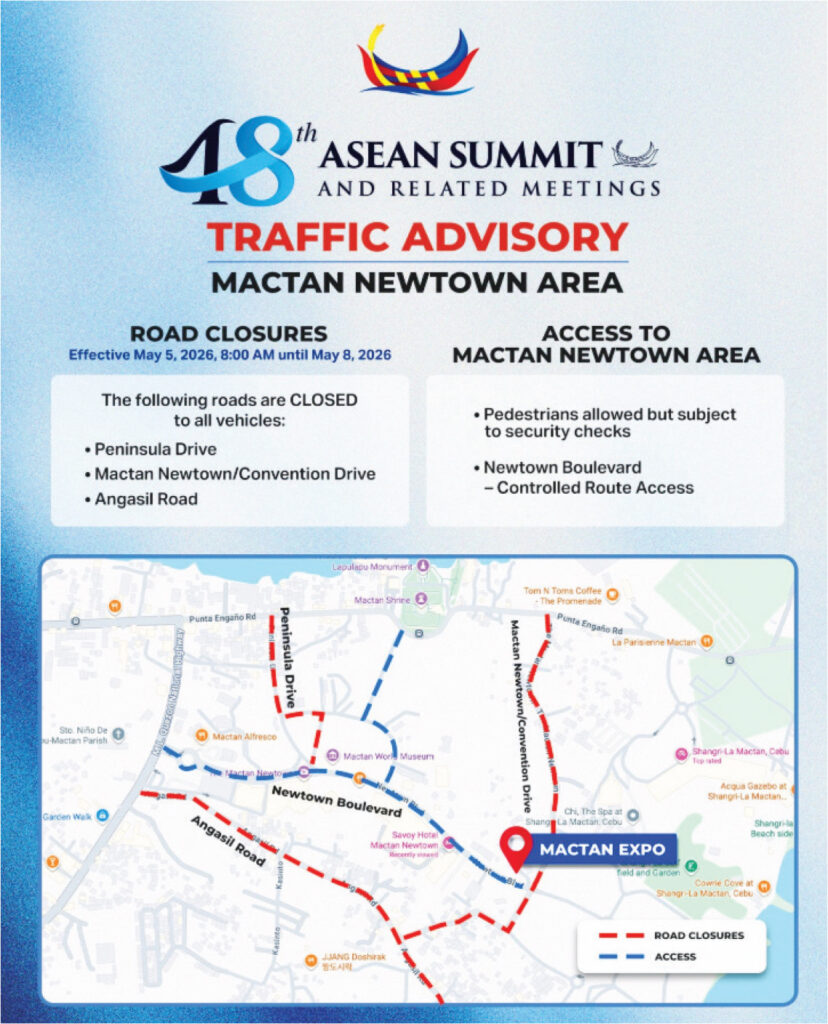
“Di po ba gumaan ang traffic kasi walang pasok [Didn’t traffic ease because classes were suspended]?” I asked one taxi driver.
“Dili man. Lagi namang traffic dito sa Cebu [No, it’s always traffic here in Cebu],” the taxi driver told me.
It seemed many Filipinos—even those in the host province of Cebu—viewed ASEAN as merely a club.
“They have a party here and as host, we need to endure some inconveniences such as traffic. Some, like the informal settlers, are evacuated from their homes so visiting leaders would not have to see their ‘eyesore’ shanties,” they said.
The price of diesel and gasoline in Cebu during the week of ASEAN meetings were around P80+ per liter.
There was no respite from the high cost of fuel even after the summit, when leaders returned to their respective capitals. Of course, it is unfair to expect a miracle after the ASEAN summit, because the real action happens behind the scenes in tandem with the private sector and civil society.
All of the people I met in Cebu—from van drivers to hotel staff, even the Starbucks barista near the IMC building— were all courteous. Good job to the NOC and the Cebu local government for training their people. One particular incident that I’d like to share was when I left my laptop at the Bai Hotel.
In less than an hour after I checked out, the front desk of Bai Hotel called up. The PCO Accreditation Supervisor Lorina Delos Reyes arranged that one of the PCO volunteers stationed at the Bai Hotel picked and brought my laptop to the IMC. It took less than an hour for me to get reunited with my bestie Macbook.
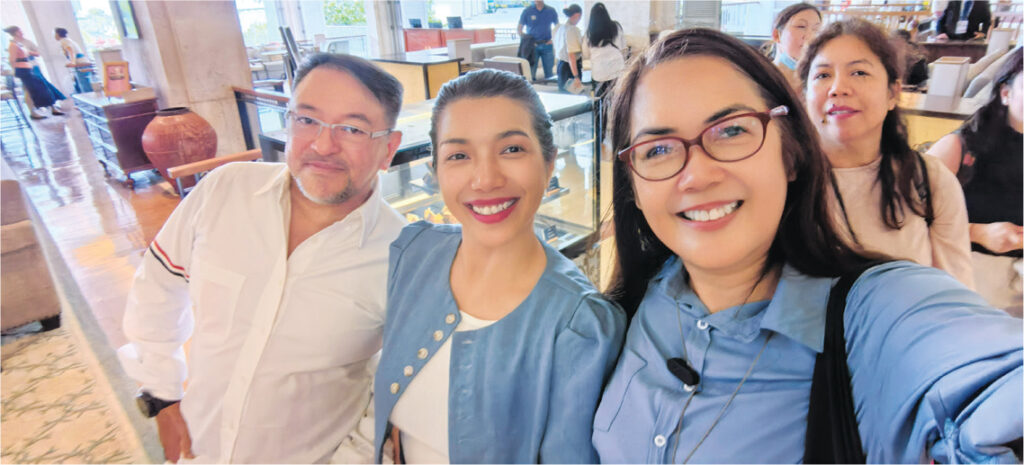
On May 7, the day of ASEAN Foreign Ministers and Economic Ministers’ meetings and start of arrivals of ASEAN leaders. Some members of the Foreign Correspondents Association of the Philippines (FOCAP) invited me to join their stakeout at Shangri-La Hotel at the lobby lounge. It was not my first time at Shangri-La Mactan but I didn’t realize it was so hot and humid! Good thing, Johnna Giolagon of Asahi Shimbun reminded me to bring my portable fan or I wouldn’t have survived the heat.
SOME SUBSTANTIAL POINTS
At the IMC, I met PCO Acting Secretary Dave Gomez and Undersecretary Claire Castro already preparing for their press conference with the Malacanang Press Corps. (MPC) “Ante Kler” requested DFA spokesman Dax Imperial to return to the IMC to answer ASEAN-related queries. Since I’m not a member of the MPC, I was not asked to throw questions.
A Cebu-based reporter inquired about the tangible benefits that Cebuanos would get out of hosting the summit.
Although Imperial is not with the NOC, he gamely answered that what the leaders would discuss would have an impact on the daily lives of the Filipinos, including Cebuanos.
He mentioned that the topics to be covered included the prices of oil and the jobs that would be created from ASEAN investments.
I distinctly remember one ASEAN Summit that I covered in 1997, during the Asian financial crisis. Our media coverage was more exciting then. Malaysia’s Prime Minister, Mahathir Mohammad, blamed hedge funds billionaire George Soros for the financial debacle that the region was facing. ASEAN only had nine members (minus Cambodia, Myanmar and East Timor). Still, getting consensus was a pain.
There was no institutional mechanism back then to provide direct financial bailouts for ASEAN members Thailand and Indonesia whose currencies had been devalued.
There was one distinct plea from ASEAN leaders then to China—please don’t devalue your currency—one thing they can’t do in their own free market economy.
It was in 1997 when ASEAN decided that Japan, South Korea and China are indispensable partners who will later on help in the restructuring of their financial systems and making economies interdependent.
But after 1997, that’s when ASEAN found its relevance, evolving from being a trade bloc into a deeply integrated financial coalition with the ASEAN Surveillance Process (ASP) peer reviews and early-warning economic monitoring among member states.
In 2000, they established the Chiang Mai Initiative (CMI) alongside China, Japan, and South Korea, that created a multi-billion-dollar network of bilateral currency swap arrangements that served as a regional financial safety net.
ENERGY ISSUES
The Cebu ASEAN Summit would have been impactful or at the very least relevant to ordinary Filipinos if ASEAN leaders had provided an action plan that could be done right away, immediately after they left the building.
This would have been achieved through the APSA or the ASEAN Petroleum Security Agreement—a treaty that provides relief to a member state whose oil reserves have reached below 80%. Leaders have thought of this possible energy contingency in 1986 but since then, it has not been invoked.
Last October 2025, energy ministers revised the APSA to include LNG supplies. All 11 ASEAN members need to ratify the revised pact. Analysts said, however, that it would take two years, at the least, to ratify the agreement.
During the press conference at the end of the Summit on May 8, President Marcos Jr. was asked if ASEAN members have a timeline and operations schedule for the APSA and ASEAN Power
Grid. He said there was a general consensus that this supposedly existing contingency should have been done right away. Mara Cepeda, reporter of Singapore-based Straits Times, followed up: “But isn’t it rather frustrating, or were there leaders during the summit that expressed frustration that these mechanisms do exist, but we cannot activate them at the moment when the region needs it most? Is there any way that you could trigger these mechanisms much faster so that we could meet the goals set by the summit?”
Exasperated, Marcos Jr. replied: “Look, we’re open to suggestion. If you have a suggestion to make it faster, please tell us, because we are trying to examine everything that we can do to make it, as I said, immediate.”
ASEAN POWER GRID
The vision of ASEAN having a single grid for electric supplies had been laid out since 1997. Aside from the power grid, the idea also included a gas pipeline that would connect all ASEAN members in 2020. Some 29 years later, that vision remains a vision.
One new idea that President Marcos Jr.—as host of the summit—has floated during the summit was for ASEAN to have a joint oil reserve.
He said, ASEAN leaders—in principle—were in favor of it. Laos, for one, is exporting 75% of its power generated from hydropower and coal to Thailand, Vietnam, Cambodia, China, Singapore, and Myanmar.
Marcos recognizes that many related issues have to be resolved for the idea of a joint oil reserve becomes realizable.
“Is it going to be in one single place? Is it going to be scattered through the whole of ASEAN? Where will it be placed? What is it supposed to do? The reserve, for example, how do we share this?” he said.
So, just like in 1997, ASEAN leaders left the room with so many to-do’s for their ministers. But based on their one-day discussion, Marcos is “very optimistic” that ASEAN nations are committed to bringing these plans into real, tangible cooperation mechanisms.
“Everyone is suffering, and everyone wants to get out of this situation. So, I’m very optimistic that we will not be wasting time with bureaucratic nonsense. We will not be arguing politics… We will be really working very hard to getting it done as quickly as possible, in the best way possible.” Marcos said.
Published in the May 2026 Special ASEAN Issue of the Philippines Graphic.
Malou Talosig-Bartolome
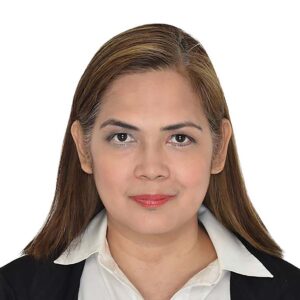
Malou Talosig-Bartolome is a veteran journalist with over 25 years of experience in both print and broadcast industries, specializing in diplomatic reporting. She started as a police and defense reporter in 1994, then became the foreign affairs reporter for Today newspaper until 2002. As a diplomatic beat reporter, she was assigned to cover summits of the Association of Southeast Asian Nations (ASEAN), Asia Pacific Economic Conference (APEC), and Asean-Europe Meeting (Asem) in major capitals. She was also invited to interview heads of states and attend short fellowship journalism and diplomacy programs in the US, Europe, and Asia. She has spent 15 years in the broadcast industry as senior news editor of GMA Network Inc.