

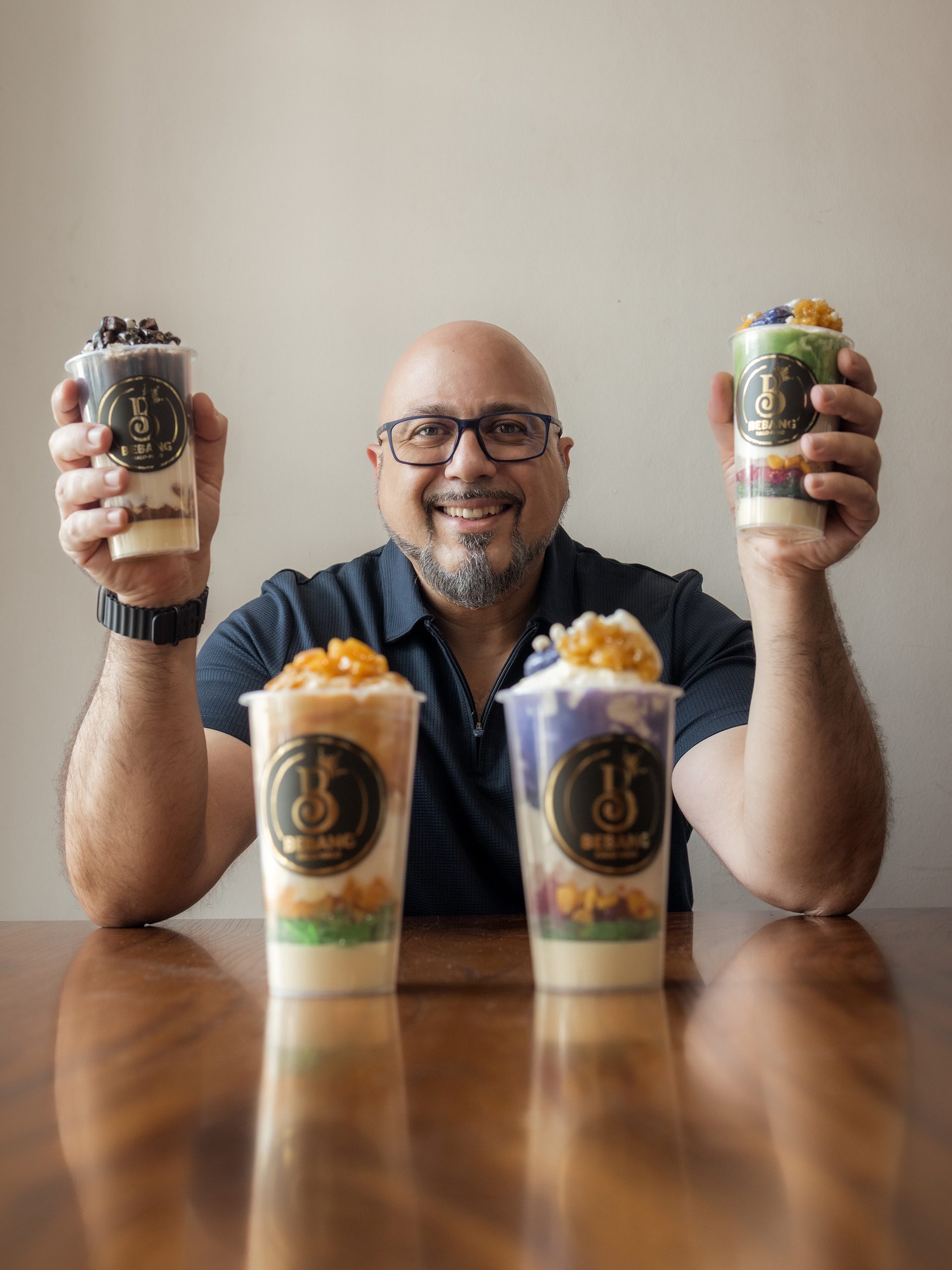
How a Filipino dessert, a family recipe, and an unconventional entrepreneurial partnership are building the Bebang brand.
ON A HOT PHILIPPINE AFTERNOON, few things offer the same satisfaction as a cup of halo-halo. A spoon breaks through a mound of creamy ice, catches a piece of leche flan, and gathers the sweetness of ube, the chewiness of macapuno, and the crunch of pinipig. Each mouthful brings together different flavors and textures, transforming familiar ingredients into something greater than the sum of their parts.
For many Filipinos, halo-halo is inseparable from summer afternoons, family outings, and merienda shared with friends. It is a dessert that welcomes improvisation, with every household, neighborhood stall, and restaurant offering its own interpretation. Yet beneath its colorful layers lies something more enduring: the familiarity of a taste that has accompanied generations of Filipinos through ordinary days and special occasions alike.
It is this familiarity that Bebang Halo-Halo seeks to preserve while reimagining how the dessert can be prepared, presented, and enjoyed. Founded by Maria “Mae” Karazi and her husband, Sam Karazi, the business demonstrates how a traditional Filipino favorite can become the foundation of a modern enterprise without abandoning the qualities that make it meaningful.
MORE THAN A DESSERT: A TASTE OF HOME
Halo-halo’s appeal lies partly in its ability to bring different ingredients together. Ube, sweetened fruits, jellies, beans, milk, and shaved ice may each have their own character, but their combination creates an experience that is distinctly Filipino. There is no single way to enjoy it, either. Some prefer to mix everything before taking the first spoonful, while others work through the layers, discovering different combinations along the way.
Its cultural significance extends beyond the ingredients. Halo-halo belongs to the everyday landscape of Filipino life, from neighborhood eateries to roadside stalls and family gatherings. It offers an affordable indulgence, a respite from the heat, and an excuse to slow down over something sweet.
For entrepreneurs, however, familiarity presents an interesting challenge. How does a business distinguish a product that almost everyone already knows? And how can it introduce something new without making customers feel that the original has been lost?
For Bebang, the answer was not to transform halo-halo into an entirely different dessert. Instead, the company focused on improving the eating experience while retaining the traditional ingredients and flavors customers recognize.
REINVENTING THE FAMILIAR
Bebang began in 2021, when Mae started preparing halo-halo using her family’s recipe in their garage in Teacher’s Village, Quezon City. Working with four of her cousins during the pandemic, she found a productive outlet amid the restrictions and uncertainty of lockdowns.
What began as a small operation soon attracted a steady stream of neighborhood customers. People returned to place orders several times a week, prompting Sam to recognize the business potential behind the modest setup.
“I looked at that garage and thought: this is a serious business hiding in a plastic chair and a few monobloc tables,” he recalled.
The couple had initially agreed to test the business for three months. Within two weeks, however, the repeat orders convinced Sam that the operation needed to move beyond a residential street.
Their partnership brought together complementary skills. Mae, whose childhood nickname inspired the brand’s name, leads product development, drawing on her knowledge of the recipe and her commitment to refining its flavors and textures. Sam, whose background spans marketing and software engineering, focuses on building the business around that product.
Their division of responsibilities comes with an unusual detail: Sam cannot taste Bebang’s halo-halo. A severe dairy allergy developed in 2011 means that even a small amount of milk or leche flan can send him to the hospital.
Rather than treating this limitation as an obstacle, he sees it as a reason to rely on Mae’s expertise and customer feedback instead of his own preferences. “A CEO trusting their own taste buds is a data set of one,” he says.
For Sam, the responsibility is to understand the market and build the systems that allow Mae’s recipe to reach more people. Mae’s role, meanwhile, is to ensure that the product delivers on its promise.
Mae spent three months refining the recipe, addressing common complaints about conventional halo-halo while preserving its familiar flavors. Instead of shaving plain ice and pouring evaporated milk over it, Bebang freezes a milk-and-cream mixture and shaves it directly into each cup. The result is a creamy base that melts into milk rather than bland water.
The dessert also features a generous layer of artisanal leche flan at the bottom, alongside ingredients such as ube halaya, macapuno, nata de coco, sago, langka, banana, corn, gulaman, and pinipig.
Explaining the philosophy behind the recipe, Sam says, “We did not turn halo-halo into a foreign dessert. We just made every component the way it deserves to be made.”
The goal is not to erase tradition but to make each component work better together. For Bebang, innovation begins with understanding what customers already love and identifying where the experience can improve.
UNFORGETTABLE FILIPINO CLASSIC
A distinctive product, however, is only one part of building a successful business. Customers must also recognize it, remember it, and have a reason to choose it among the many dessert options available.
For Sam, that process begins with the name.
Several people advised the couple to replace “Bebang” with something English or foreign-sounding to create a more premium image, particularly as the company prepared to enter shopping malls. Sam disagreed. The name was Mae’s childhood nickname, carrying a personal history that a generic brand name could not replicate.
“Why spend millions of pesos on ads for a generic English name that people forget five minutes later?” he asks.
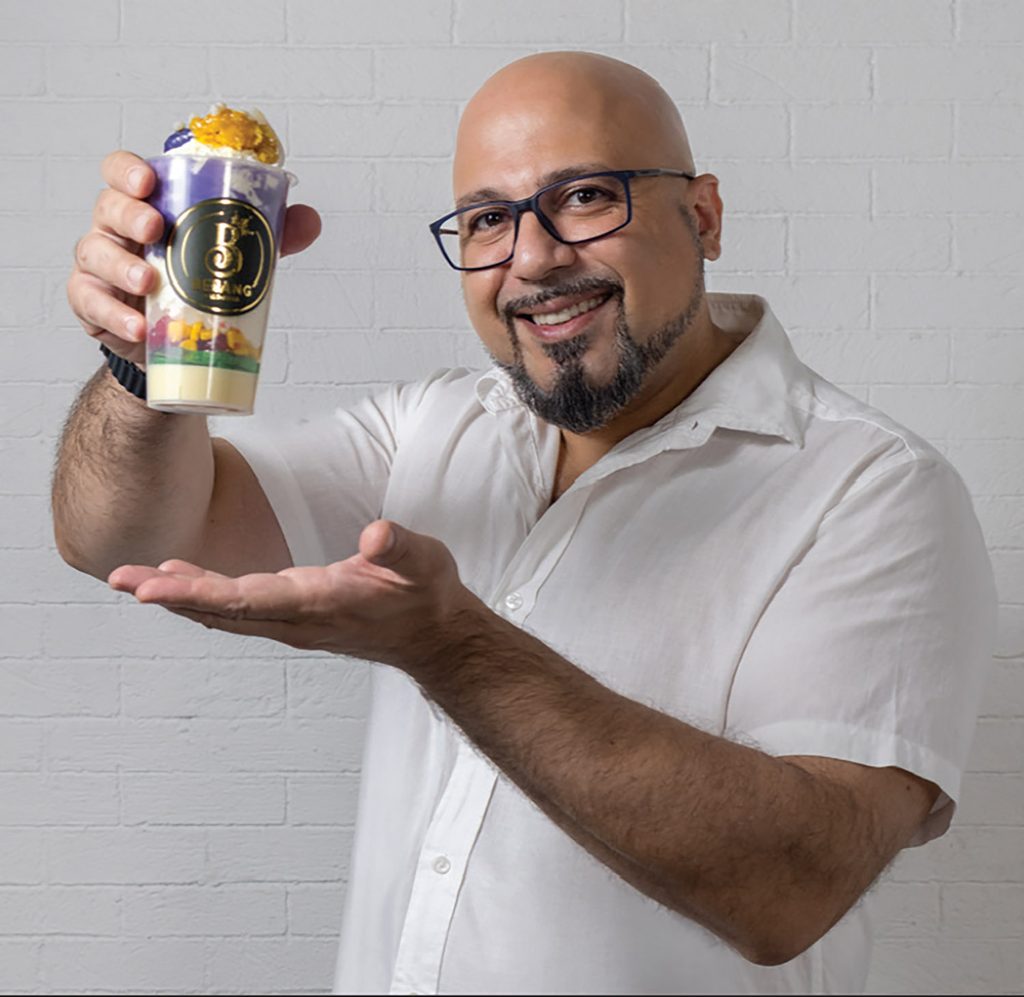
Rather than distancing the product from its Filipino identity, Bebang paired its familiar name with modern visual branding. Its yellow-and-white stores, custom cups, and carefully layered products create a recognizable identity. The company’s tagline, “Nothing Beats Original,” reinforces its emphasis on standing apart in a crowded market.
One of its most recognizable products, the Halo-Halo Presidential, features more than 15 ingredients and 24-karat edible gold leaf. Its presentation is designed to appeal not only to the palate but also to the camera, encouraging customers to photograph and share their dessert on social media.
“We design every cup for both the palate and the camera,” Sam explained. A striking presentation, he added, can encourage customers to post about a product, effectively extending its reach without requiring the company to pay for every recommendation.
Bebang experienced the power of word-of-mouth marketing in 2022, when it sent a cup to content creator Abi Marquez, popularly known as the Lumpia Queen. According to Sam, the company did not pay for the feature or provide a scripted review. Instead, it encouraged her to try the product and share her honest opinion.
Her subsequent video generated more than 4,000 cup orders overnight.
Sam maintained that authenticity matters when working with content creators. “Customers can smell a fake paid script in two seconds,” he said, explaining why the company prefers creators who genuinely try their products and give their own opinions.
The episode demonstrated the value of authentic recommendations, but Sam’s broader approach to branding extends beyond influencer marketing. He argued that entrepreneurs should treat marketing as an investment from the beginning rather than an expense to consider only after the business becomes profitable.
When Bebang was generating monthly sales of PHP 100,000, he says he was already spending PHP 500,000 a month from his savings on Facebook advertising. His immediate objective was to test advertising materials and audiences while building awareness of the brand across Metro Manila.
“I am not testing if the ads are profitable today,” he explains. “I am testing ad creatives and audiences while forcing all of Metro Manila to know the name Bebang.”
The strategy reflects a central lesson for businesses built around traditional products: familiarity alone does not guarantee recognition. A strong product needs an identity that communicates its value, while its branding must be supported by an experience that gives customers a reason to return.
BUSINESS BEYOND VIRAL VIDEOS
The thousands of orders generated by Marquez’s video brought Bebang an extraordinary opportunity. They also exposed the limitations of a business whose production capacity had not yet caught up with its sudden popularity.
The company received more than 4,000 orders before opening its doors that morning, far exceeding what its available freezers could accommodate. Rather than attempting to fulfill every order immediately, Sam and Mae decided to cancel and refund the orders, temporarily close the store, and reorganize production.
They rented additional freezer capacity, rebuilt their production line, and communicated with customers about the reopening.
The decision came at a financial cost, but it reflected a larger principle: marketing can bring people through the door, yet the quality of the product ultimately determines whether they return.
“The temptation to fulfill those orders and pocket the cash was huge,” Sam recalled. Nevertheless, the couple prioritized the product over immediate sales.
He described viral attention as a double-edged sword. Serving thousands of customers a substandard product, he argued, could turn a moment of popularity into lasting damage to the brand. As he put it, “Protecting the product saved the brand.”
That lesson has shaped Bebang’s approach to expansion. With more than 50 stores, consistency requires a system that can deliver the same product across different locations without relying on each branch to prepare everything from scratch.
The company separates manufacturing from assembly. Its central commissary handles the pasteurizing and freezing of the milk base under food-safety controls, while a cold-chain fleet transports the product to stores at temperatures between minus 22 and minus 25 degrees Celsius. Branch employees then shave the frozen milk and assemble the pre-portioned ingredients according to standardized measurements.
Operational improvements have also helped the company increase output. Sam recounts how an operations director reorganized the preparation line and tripled daily production capacity during his first week. The company later invested PHP 1.5 million in kitchen workflow engineering to make assembly faster and more efficient.
Growth also extends beyond the stores themselves. According to Sam, Bebang sources ube halaya from small processors in San Pablo City and Nagcarlan, Laguna, while local family producers supply ingredients such as macapuno, langka, corn, and pandan. The company’s expansion has created opportunities for suppliers to increase their production alongside the business.
The four cousins who helped Mae start the garage operation also remain with the company, which now employs more than 600 Filipinos across its stores and offices.
These relationships reveal another dimension of entrepreneurship: a growing brand does not operate in isolation. Its success depends on the people who prepare its products, deliver its ingredients, serve its customers, and maintain the standards that keep those customers coming back.
FILIPINO CULTURE
Mae and Sam’s partnership offers a practical example of how different forms of expertise can come together to build a business around a culturally familiar product.
Mae brings the recipe knowledge and product development that give Bebang its foundation. Sam applies his experience in marketing, technology, and business development to make that product visible and accessible.

Neither contribution works independently of the other. Reflecting on their partnership, Sam said, “Without Mae’s recipe, I have nothing to market; without my marketing and systems, her recipe stays in that Quezon City garage.”
For aspiring entrepreneurs, Sam gave the folowing recommendations: Start with a manageable operation rather than spending all available capital on rent, renovations, and equipment. Testing a product with strangers offers a more meaningful measure of demand than relying solely on friends and family. Entrepreneurs should also allocate resources for marketing and seek business partners whose skills complement their own.
“You can have the best recipe in the Philippines, and if nobody knows you exist, you have no business,” he says.
These lessons are especially relevant to businesses built around Filipino food, where cultural familiarity can provide a strong starting point but does not automatically translate into commercial success.
In October 2026, Bebang reached more than 50 stores across Luzon, including mall locations, neighborhood outlets, and a branch at Ninoy Aquino International Airport Terminal 3. The company aims to reach 100 stores by the end of 2027 and 300 stores across the Philippines and overseas by 2030.
Success for me is simple: when any Filipino in the world craves halo-halo, the first name that enters their mind is Bebang,” says Sam Karazi, sharing his vision for the brand’s future as it pursues international expansion.
Its international plans begin with Dubai, where Mae and Sam previously lived for a decade. With a substantial Filipino community in the United Arab Emirates, the couple sees an opportunity to introduce halo-halo to overseas Filipinos while reaching customers unfamiliar with the dessert.
Sam drew a comparison with other Asian desserts that have found international audiences, including Taiwanese milk tea and Korean bingsu. He believes halo-halo can also find a place in the global market, with overseas Filipinos helping to introduce it to their friends and communities.
THE TASTE OF SUMMER NEVER LEFT
Return to a cup of halo-halo, and the appeal remains in its layers: the creamy ice, the sweetness of leche flan, the richness of ube, and the contrasting textures that make every spoonful different.
Entrepreneurship, through Bebang Halo-halo’s product development, does not have to mean leaving tradition behind. Sometimes, it means recognizing the value of something already beloved and finding new ways to share it.
The taste of summer may take on new forms, but the memories it carries can travel with every spoonful.

Hjadoeya Calica
Hjadoeya Calica is a cinephile, reader, and a content writer for Philippines Graphic whose roots trace back to La Union and Aurora. She studied AB Literature at the University of Santo Tomas where she served as the Literary Editor for The Flame. Currently based at the heart of Makati, she finds inspiration in stories of every kind, spaces, and places.