

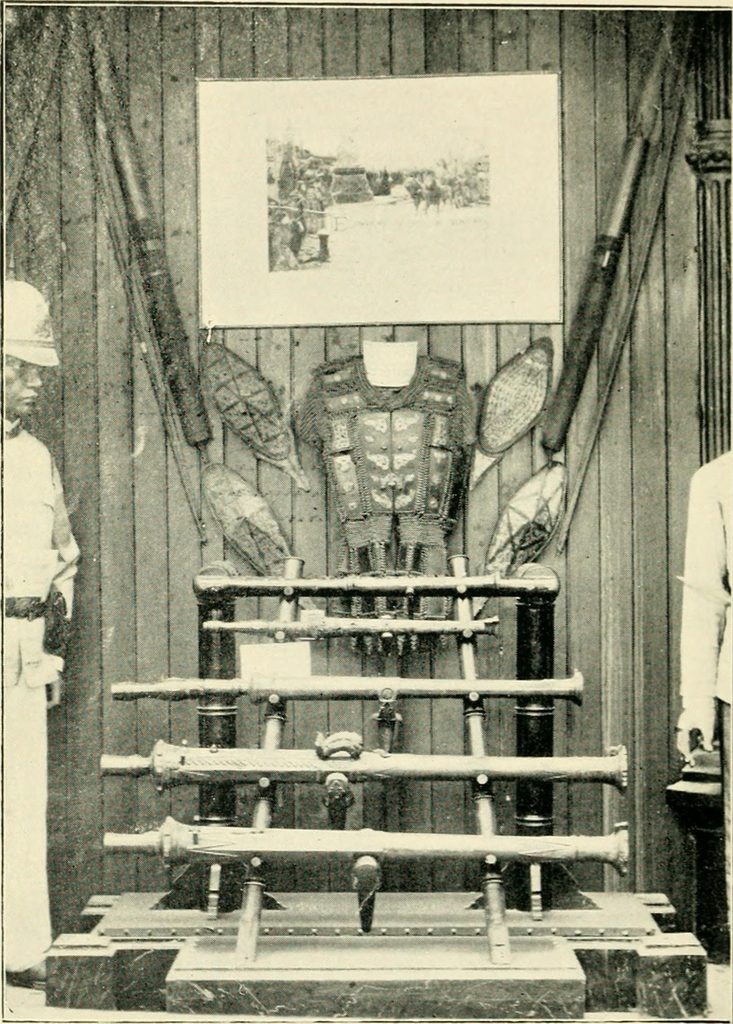
The title of Patricia Perez Eustaquio’s newest exhibit “Pearls for Knives,” which opened on November 21 at Silverlens in Makati, takes its title from the historical trade in Sulu, where natural pearls were exchanged for knives and other metal goods. Eustaquio uses materials familiar from rope and basketry to make sculptures, including fountain forms woven from abacá and a piece resembling chain mail made from interlocking rattan rings.
On a recent visit to the School of Oriental and African Studies (SOAS), where I consulted the T. H. Haynes Collection, I was struck by how easy it is to follow a pearl from Sulu to a London jeweler’s bench and overlook what the seller received in return.
Eustaquio starts with the other half of the exchange where steel blades are prized tools for shaping timber.
Once you picture the boatbuilder at work, it’s not hard to imagine why someone might exchange a pearl for a knife. The entangled themes of beauty, utility, and value run through the exhibition, from the length of mail Eustaquio makes from rattan to her freestanding court parasol.
ABACÁ FOR THE SHIPYARD
In Soft Industry, thick lengths of abacá hang from a timber crossbar. The stitches stretch where they hang and bunch where they land. Follow the rope across the floor and you can see where the falling water becomes the rim of the basin.
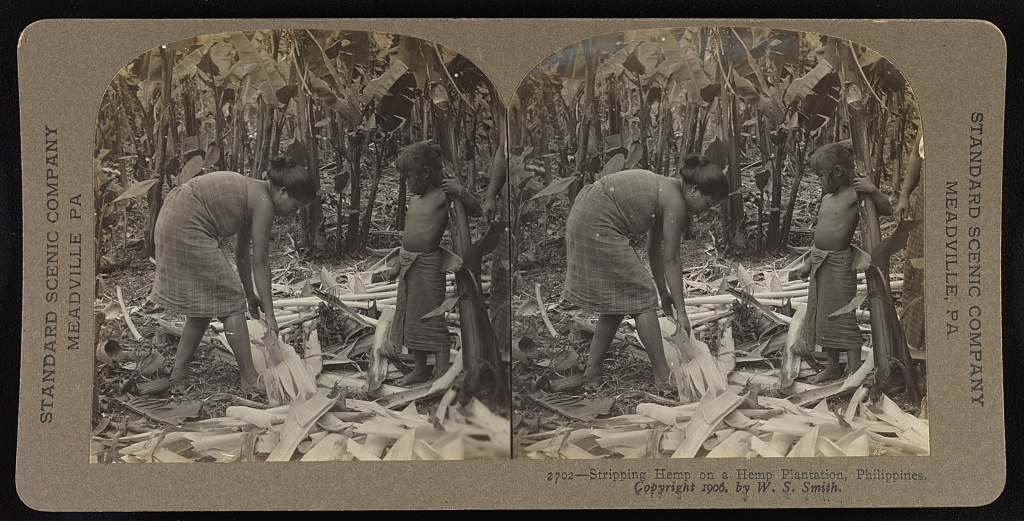
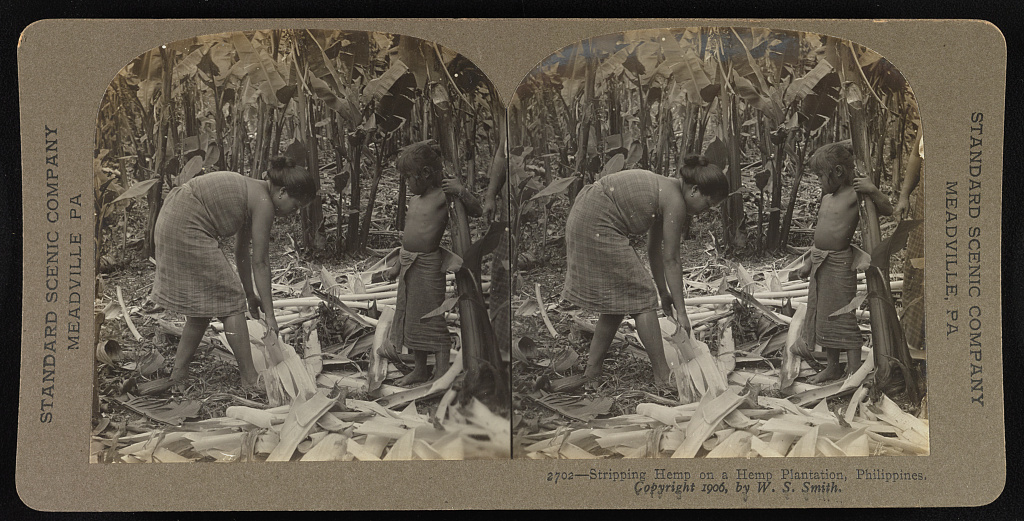
In a 1906 stereograph, a woman strips fiber from a leaf sheath while a child watches. The pale strips around their feet show how much plant matter had to be scraped away.
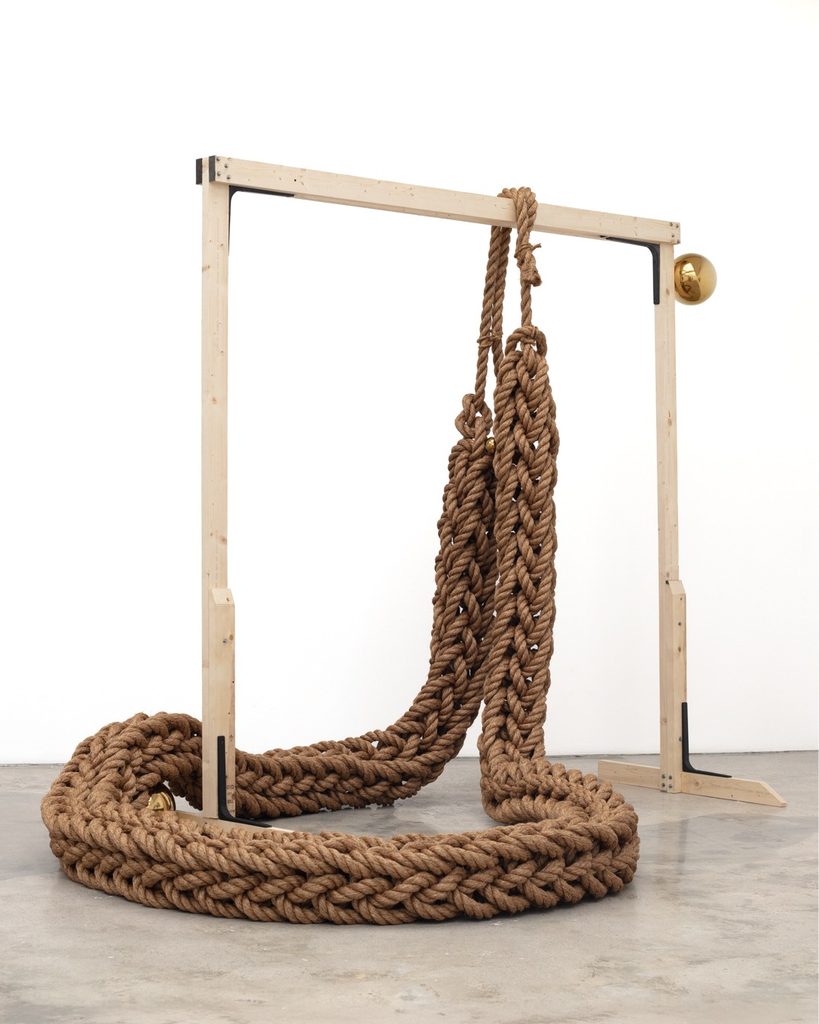
Fountain may be a formal reference to David Medalla’s Cloud Canyons, often described as a ‘bubble fountain’. Although no water is visible in Eustaquio’s work, the fibre she uses comes from abacá, a relative of the banana that needs steady rain to grow.
An eighteenth-century account describes ropemakers soaking the fiber in salt water and drying it in the sun so it could withstand twisting.
In 1619, Captain Sebastián de Pineda reported that villages near Cavite had to furnish ropemakers for the Spanish shipyard. By the nineteenth century, Bicol farming families were growing abacá for the overseas cordage trade. Eustaquio’s choice of rope gives the fountain the material history of an archipelago.
A DANCE IN ZAMBOANGA
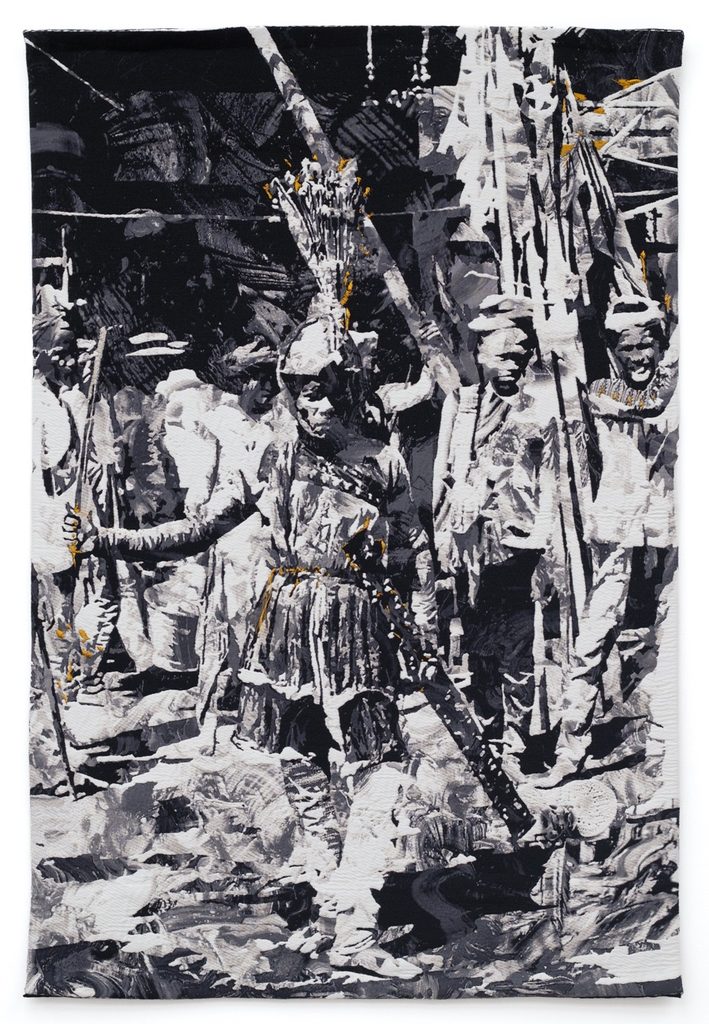
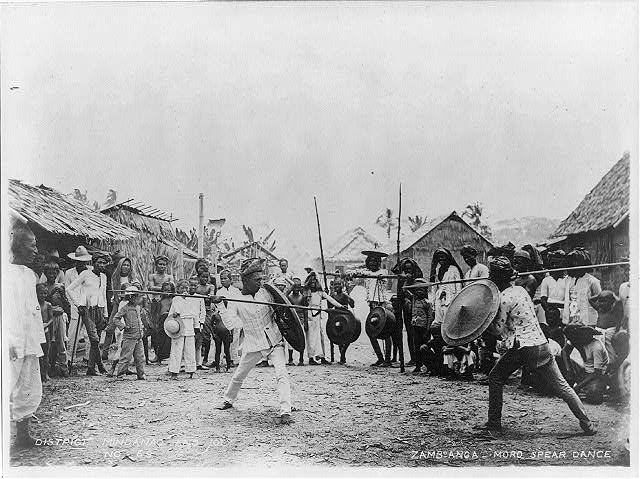
In Zamboanga (Moro’s dance), Eustaquio uses gold thread to highlight a dancer’s belt and outstretched hand. A photograph of another performance in Zamboanga around 1900 shifts attention from the dancer’s gesture to the space around the dancers. Two men face each other between houses. The spectators stand back to give them room, and the edge of the crowd marks the edge of the dance floor.
MAIL SHIRT AND TAUSUG BALLAD
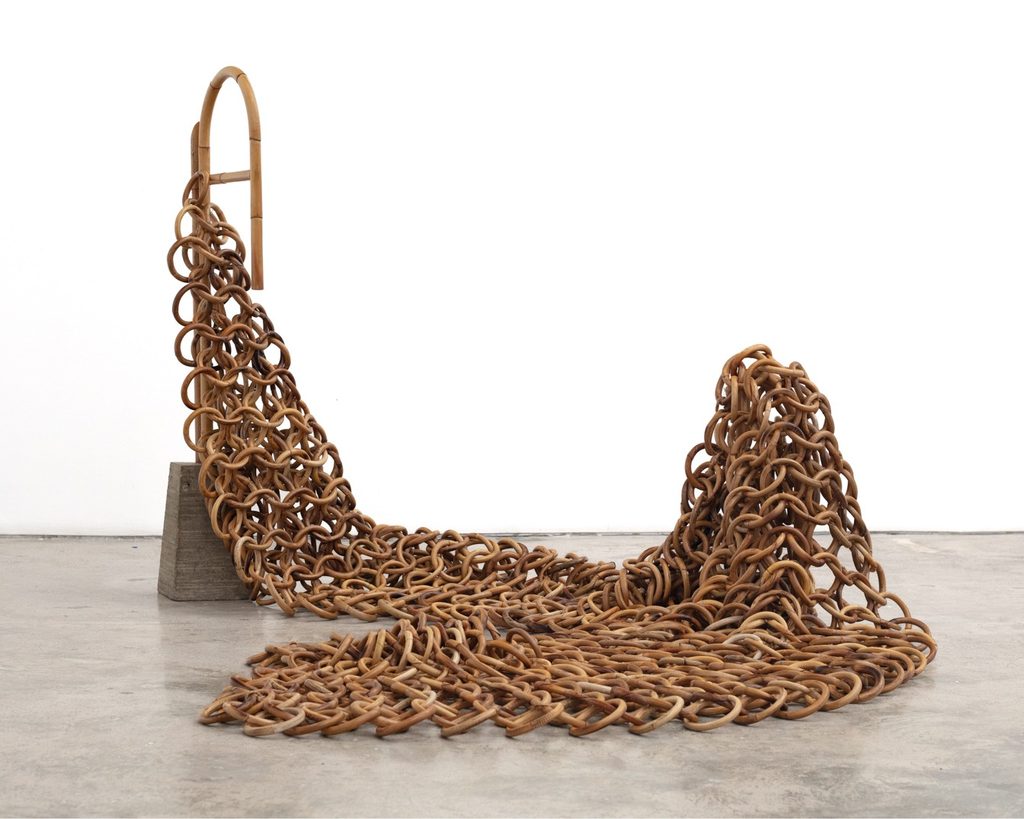
A photograph in Frederic H. Sawyer’s The Inhabitants of the Philippines (1900) shows a shirt of mail hanging against a plank wall.
A rack of swivel guns partly obscures the shirt, but its width at the shoulders still gives a sense of the body it was made to fit. The caption identifies both the armor and the guns as “Moro.” A surviving shirt from Jolo at the Met Museum in New York, made around 1875, combines buffalo horn, copper alloy, and silver.
In Juramentados i, Eustaquio’s large rattan rings make it easy to see how mail moves. Each row hangs from the one above it, and the rings pivot where they meet, allowing the mesh to fold.
The title Juramentados i recalls a Spanish colonial term for Muslims who took an oath to fight to the death. In a Tausug ballad sung by Indah Annura, two lovers, Abdulla and Putli’ Isara, undertake parang sabil, pledging to fight in defense of their faith.
Before the fighting begins, Abdulla unfolds the fine cloth he bought for Putli’ Isara, his fiancée. The Spanish term tells us what the lovers swore to do. Through Abdulla’s gift, Annura gives us a glimpse of the life they had hoped to share.
THE MAN HOLDING THE PARASOL
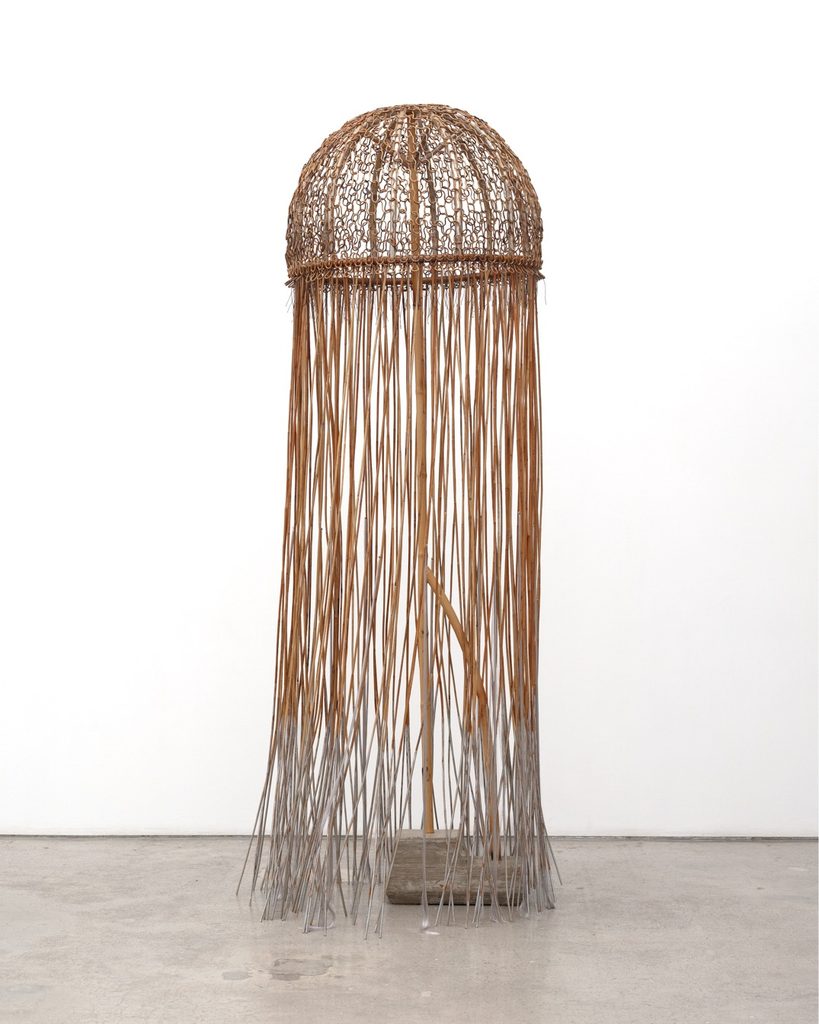
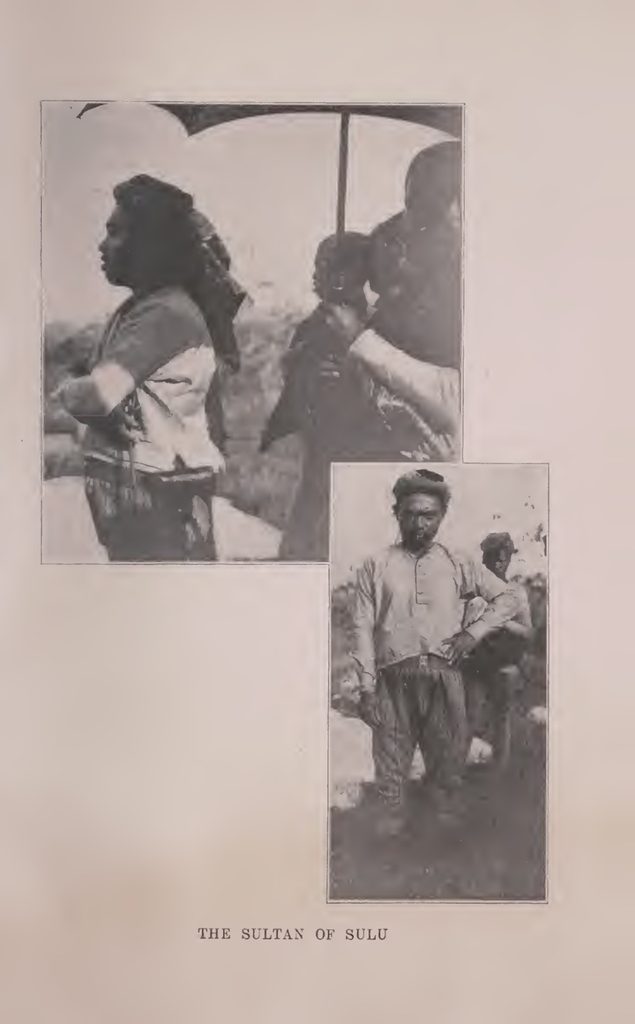
The fringe on Eustaquio’s freestanding parasol, Entourage, hangs low enough to hide the person carrying it. A photograph in Hamilton M. Wright’s 1909 handbook shows the sultan of Sulu beneath an umbrella. The caption identifies the sultan.
Eustaquio’s title draws your eye to the right edge of the frame, where an attendant grips the shaft to keep the sultan in the shade.
Earlier sultans of Sulu also claimed the right to regulate voyages between the islands.
Eleonora Poggio, Ariel Lopez, and Birgit Tremml-Werner trace one such claim to a circular the sultan issued after Sulu’s 1836 treaty with Spain. He required Sama and Iranun crews bound for Zamboanga to declare what cargo they carried and how many people were aboard. Datu Molok Mandarasa translated the order into Spanish from a text written in Jawi script.
RIGHTS TO THE PEARL BEDS
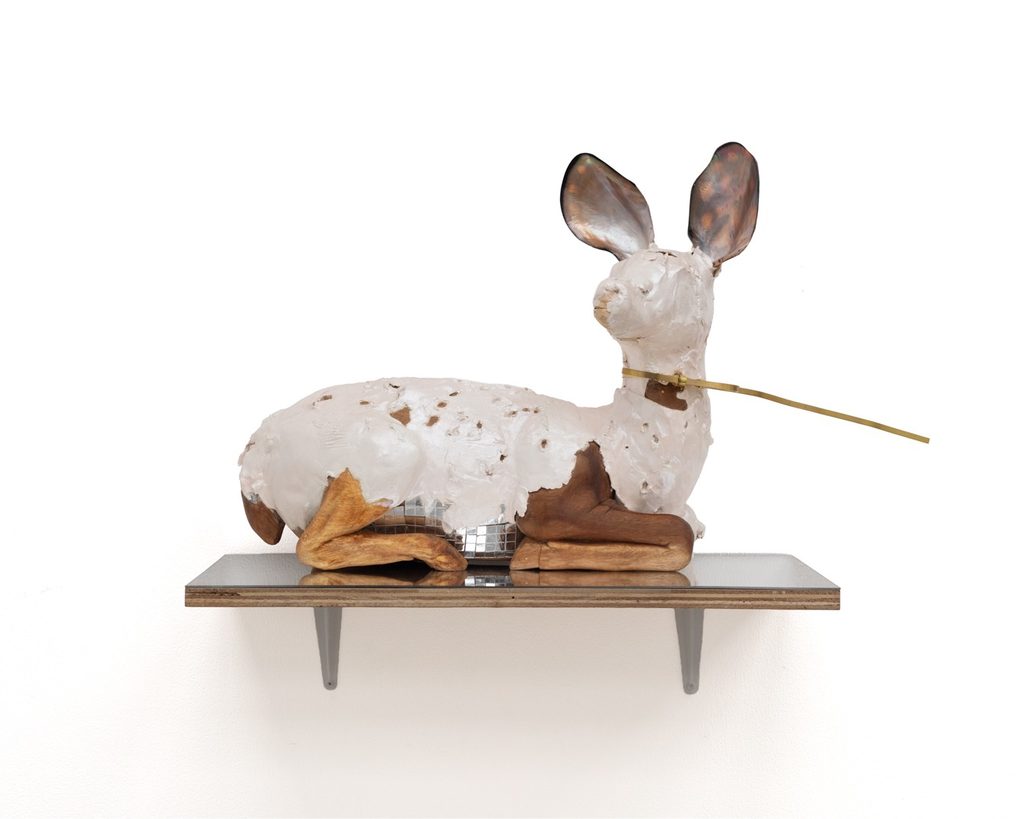
Pink shades into copper in the shell ears of Pearl of Laguna de Bay. The reclining animal looks as though it has just heard its name.
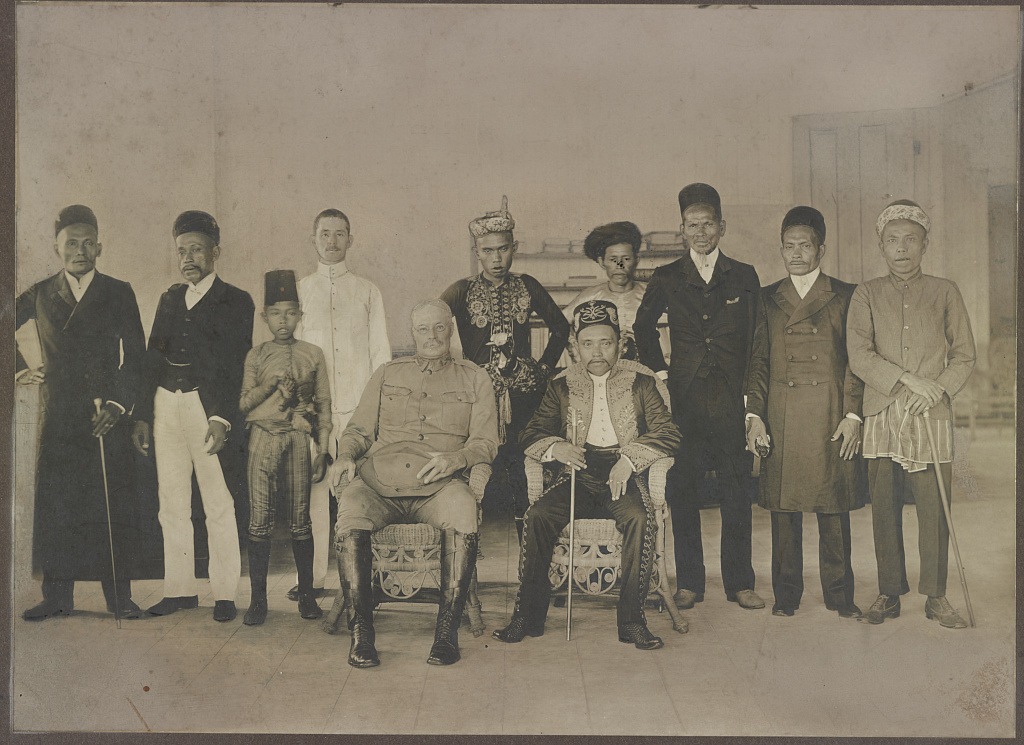
In the 1905 group portrait paired with the sculpture, Sultan Jamalul Kiram II and Governor Hugh Scott appear alongside Charles Schück, an interpreter with a stake in the pearl fisheries around Jolo. In 1899 the sultan had granted Schück and his brother exclusive rights to fish there with diving equipment.
In 1904, a year before the photograph was taken, American authorities opened the fisheries to outsiders and claimed the right to collect the license fees.
WHAT THE GALLERY LABELS LEAVE OUT
The gallery essay could use some of the attention Eustaquio gives to particulars.
Art writer Josephine V. Roque calls the barter of Sulu pearls for metalware “prehistoric,” though the historical trade that informs the title happened in the eighteenth century. Roque also describes the canopy of Entourage as looped wire, while the checklist specifies flame-bent rattan.
The more consequential omission concerns the t’nalak in Clouds and Alligators, a tapestry in which woven wool resembles broad sweeps of paint.
To make t’nalak, T’boli weavers at Lake Sebu bind sections of the abacá warp so that those threads resist the dye. Some weavers describe receiving their designs in dreams from Fu Dalu, the spirit of abacá. The checklist names the brand of drawing paper used elsewhere in the show. Who wove this cloth?
Roque asks who got the better deal in the exchange at Jolo—the trader who took home the pearl or the person who received the knife.
But whose pearl was it to trade? In an appeal to Governor Scott, published in translation in 1908, Sultan Jamalul Kiram II explained that families inherited the oyster beds their ancestors had discovered. Pearls weighing six chuchuk or more went to the sultan. Smaller pearls belonged to the families, and even the sultan had to pay if he wanted one. Families ate the oysters and made dishes from the shells. A pearl from those beds might travel all the way to London, or the family might drill it and string it on a necklace for a child.
A SHEFFIELD KNIFE IN JOLO
But what became of the knife once the pearl left Jolo?
In James Francis Warren’s account of a late eighteenth-century exchange, an English merchant traded a steel knife forged by a Sheffield master smith for a pearl recovered by a Sama diver. The pearl went to London, where a jeweler might set it in a ring or necklace.
The knife stayed in Sulu, where Tausug and Sama boatbuilders valued a light, dependable blade for carving timber. Raiders carried such knives, too, on expeditions to seize captives, some of whom were forced to work in the fisheries that supplied Jolo’s export trade.
I think of that blade when I look at Soft Industry, from Eustaquio’s Fountain series. Three stainless-steel garden balls sit among lengths of woven abacá. The metal a boatbuilder prized for its edge has taken on the shape and luster of the pearl it could buy.
The show runs through December 19, 2026.
All reviews by this author are independent and non-commissioned.
Geronimo Cristóbal
Geronimo Cristóbal is a lecturer in Art History at Ateneo de Manila University, and a PhD candidate in the History of Art and Archaeology at Cornell University. He serves as an international correspondent for the Philippines Graphic. He can be reached at gc448@cornell.edu.