

Get to know the history behind its iconography from the Venetian Lagoon to Laguna
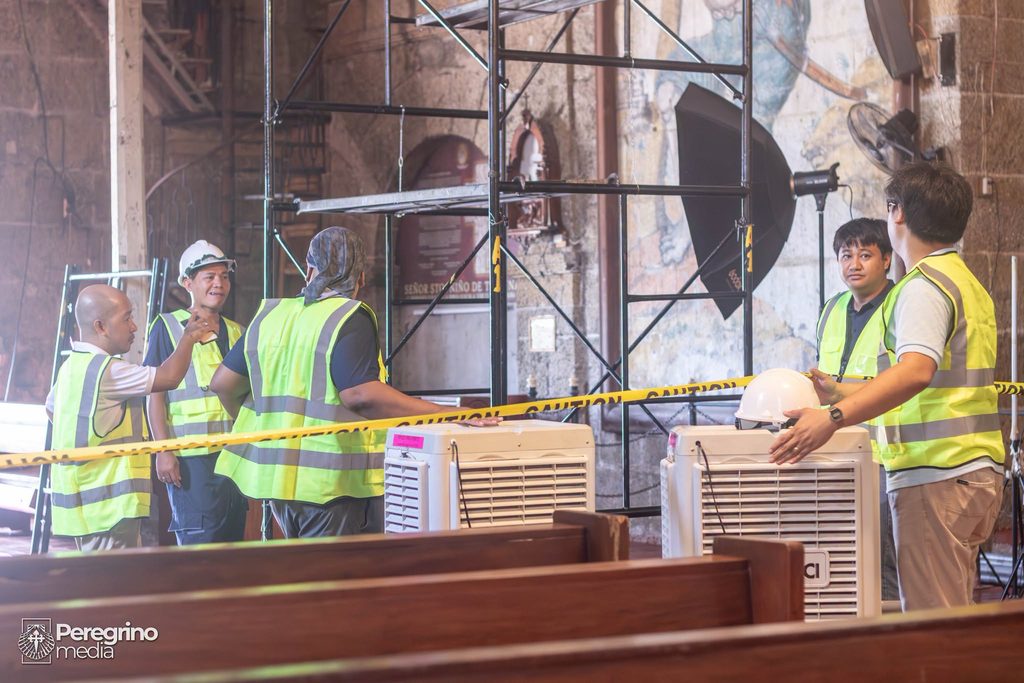
The National Historical Commission of the Philippines (NHCP) has begun the long-awaited conservation on two monumental paintings conventionally designated San Cristobal I and San Cristobal II at the parish church of Santiago Apóstol in Paete, Laguna.
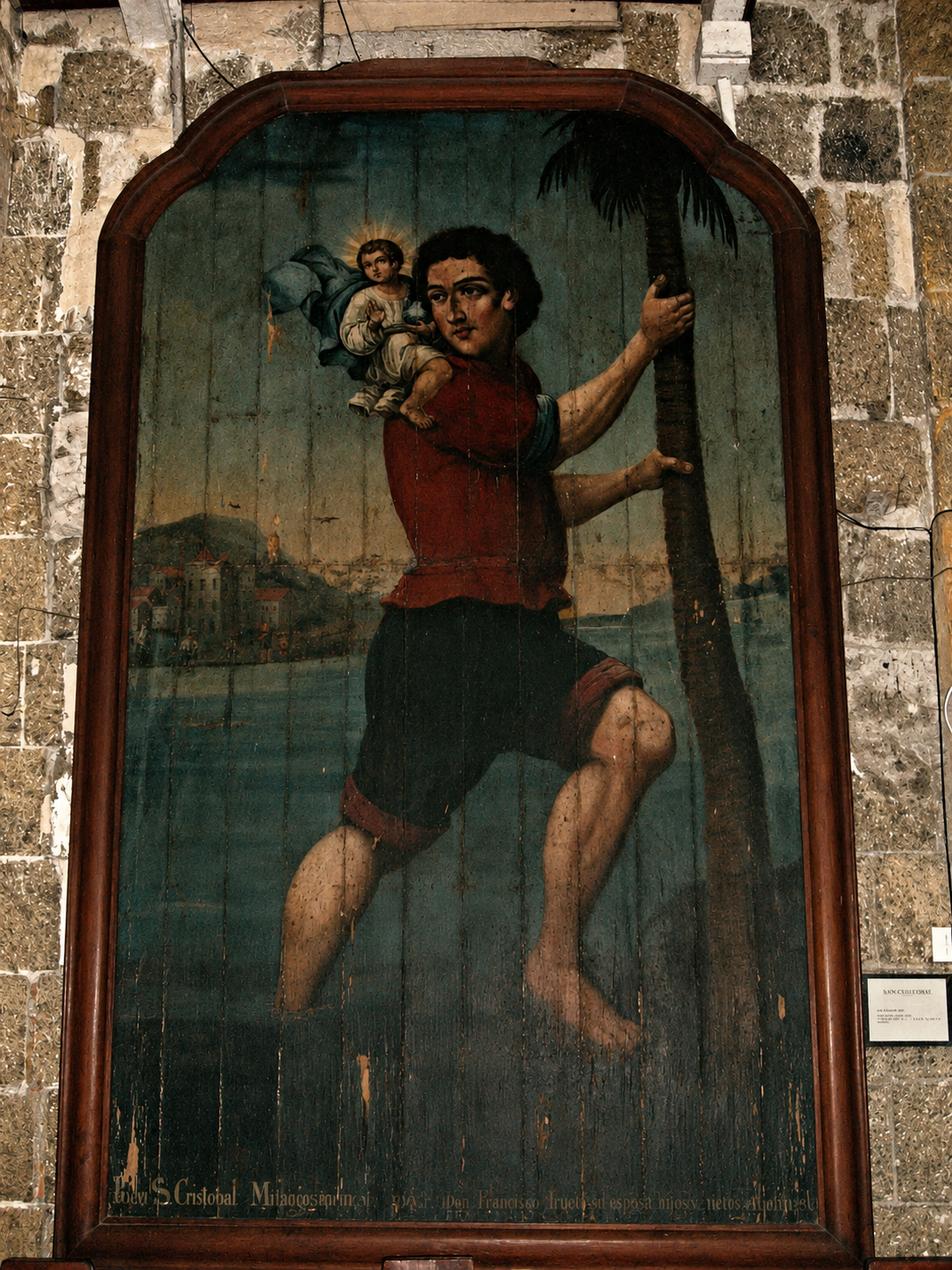
Conservation work started in August 2026 and will continue over the coming months. The better-documented work is a large oil painting on twelve vertical wooden planks joined to form a single panel painted by José Luciano Dans.
Drawing on parish documentation and records in the Archives of the Archdiocese of Manila, NHCP Chairman Regalado Trota Jose notes that the parish acquired the painting in October 1852 for 922 pesos.
The conservation addresses termite damage, deterioration of the wooden support, previous interventions, a substantial puncture and associated losses in the lower-left section, and the cumulative effects of age.
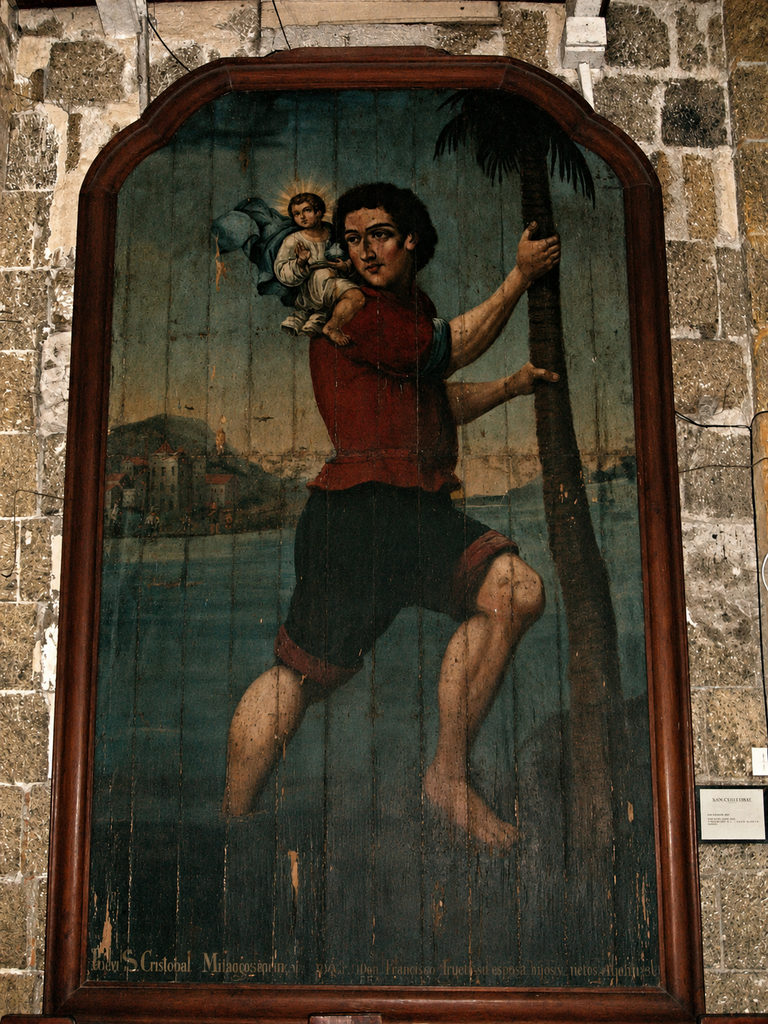
The panel shows Saint Christopher carrying the Christ Child through a broad lake. The saint occupies most of the composition, with one leg advancing through the water and his raised arm gripping a coconut palm. The Child sits on his shoulder and faces the viewer. The figures have carefully articulated limbs, while the lake, shoreline, buildings, and mountains recede through linear perspective.
Local commentary has identified the body of water as Laguna de Bay while the distant settlement and mountain have sometimes been identified as Paete and Mount Banahaw.
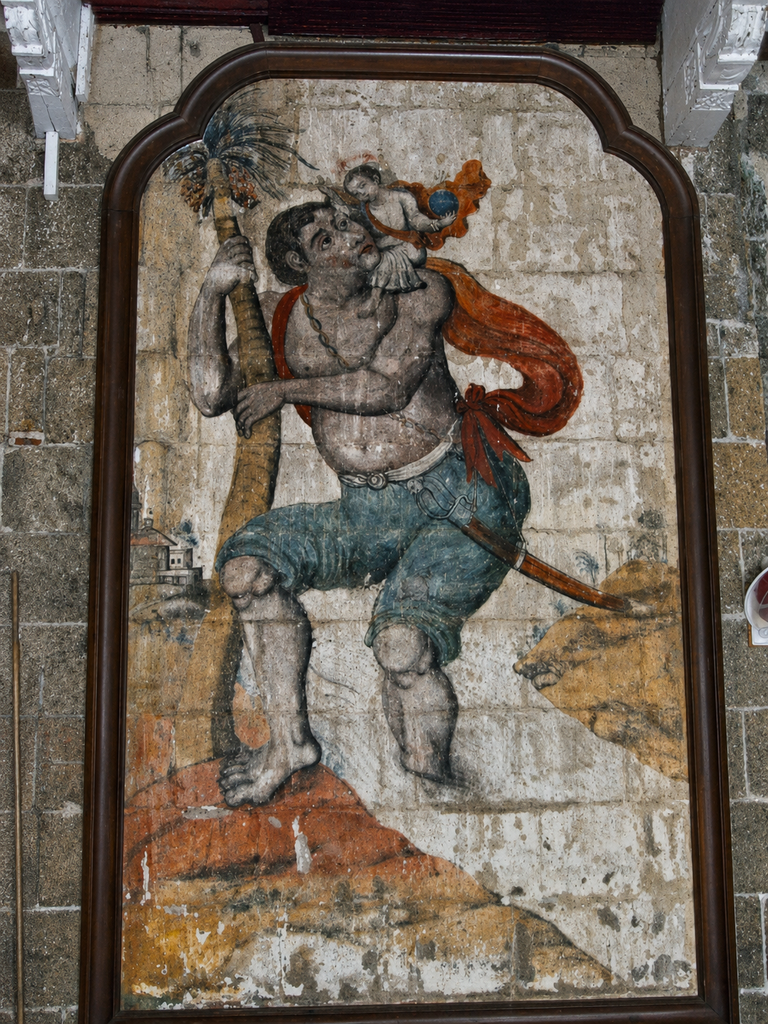
In Simbahan: Church Art in Colonial Philippines, 1565–1898, Ricardo Jose records that the church’s other San Cristobal was formerly concealed behind the panel attributed to Dans.
This earlier image is painted directly on the adobe wall, with the horizontal mortar joints between the blocks visible through the painted surface. Its wooden frame is a modern addition.
The saint in the mural grasps a coconut tree and carries a bolo at his waist. A nipa house appears on the distant hill. His physiognomy, clothing, and weapon correspond to Philippine types, while the Christ Child retains the robe, mantle, and globe associated with Western Catholic iconography.
The two paintings present different arrangements of the same subject. The wall painting focuses the crossing within a narrower river setting, while the 1852 panel expands it into a broad lacustrine (lakeside) landscape. Both preserve the principal components of Saint Christopher’s iconography: the giant bearer, the Christ Child, the passage through water, and the living staff. The Paete San Cristobal murals are representative of the process described in Philippine art history as cambio, the adaptation of inherited religious imagery to local conditions.
ICONOGRAPHY OF SAINT CHRISTOPHER
The familiar Western account of Saint Christopher received its most influential medieval formulation in Jacobus de Voragine’s thirteenth-century Legenda aurea, or Golden Legend.
Christopher, described as a man of exceptional size, serves God by carrying travelers across a dangerous river. When a child asks to be carried, his weight increases during the crossing until Christopher feels that he bears the entire world. The child then reveals himself as Christ and instructs Christopher to plant his staff in the ground, where it produces leaves and fruit as confirmation of the miracle.
This story established an iconographic type that became widely recognizable across medieval and early modern Catholic Europe. Christopher appears as a giant moving through water with the Christ Child on one shoulder and a tree trunk serving as his staff. Fish, boats, hermits, and travelers often occupy the river and its banks, while the surrounding landscape gives the miracle a visible and geographically legible setting.
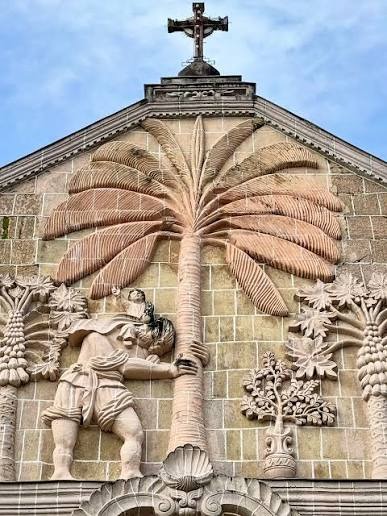
Monumental images of the saint frequently appear near church entrances and other prominent architectural locations such as in Miagao church on Panay Island. As Dominique Rigaux explains in her study of Saint Christopher imagery in the Alpine regions, visibility formed part of the image’s devotional function. Medieval inscriptions and devotional texts record the belief that anyone who saw Saint Christopher would be protected from sudden or unprepared death for the rest of the day.
TITIAN AND THE SAINT
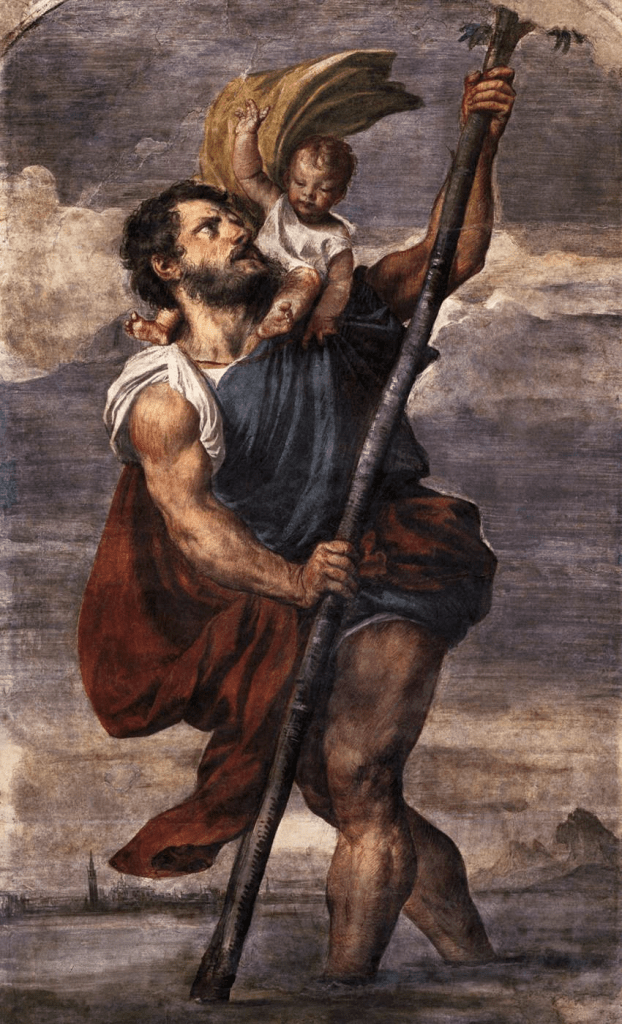
The Venetian master Titian painted Saint Christopher around 1523–24 for the apartments of Doge Andrea Gritti in the Palazzo Ducale. The fresco measures approximately the size of a very tall double doorway, and stands above the staircase leading to the doge’s private rooms. Commissioned during the opening years of Gritti’s reign, it formed part of a wider program of civic and votive imagery. Its position along a route of passage gave it devotional, ceremonial, and protective functions, including warding off potential assassinations.
The composition clearly places Christopher within the Venetian lagoon. His muscular body fills the narrow vertical field, with his feet entering the water below and his head and raised arm approaching the curved frame.
The Christ Child sits across his shoulders beneath a billowing golden mantle. Christopher grips a long tree trunk with leafy branches that form a second vertical axis. The distant waters and architectural profile of Venice occupy a narrow strip beneath the giant, presenting the saint as protector of a city structured by canals and lagoon routes.
Technical research by art historian Jill Dunkerton and her colleagues shows that Titian completed the fresco in three principal giornate, or sections of wet plaster prepared for individual days of work. He incised the preparatory design directly into the fresh surface, and the painted contours alternately follow and depart from these lines. This rapid construction reinforces the monumentality of the figure and the sense of movement through the lagoon.
PAETE PAINTINGS
The Paete paintings adapt the established iconography of Saint Christopher, along with their loaded historical and mythological meanings, to a nineteenth-century Philippine parish. Their immediate sources remain unidentified, though religious prints circulating through Franciscan networks that span Europe and Asia may have provided models for the giant saint, the Christ Child on his shoulder, and the flowering staff.
In a town whose economy depended heavily on coconut cultivation, the staff may also have carried a local agricultural meaning.
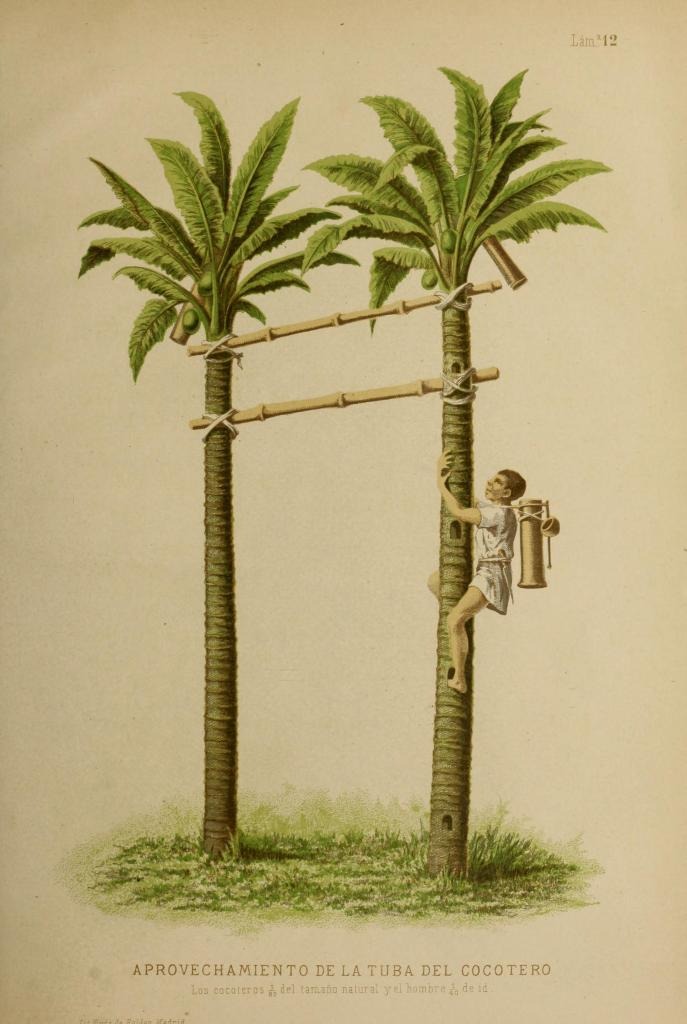
In the panel attributed to José Luciano Dans, the staff becomes a coconut palm whose ringed trunk rises from the water toward a crown of fronds. This substitution preserves the idea of miraculous renewal while locating it within a tropical working landscape. Ramón Jordana y Morera’s 1885 Bosquejo geográfico é histórico-natural del archipiélago filipino [Geographical and Natural History Sketch of the Philippine Archipelago] documents the specialized labor associated with the tree in the plate “Aprovechamiento de la tuba del cocotero.”
It shows a worker carrying a bamboo collecting vessel and moving between two palms along horizontal bamboo poles, balancing on one and using the other as a handrail. Published three decades after Dans’s painting, the image records the systems of cultivation and extraction surrounding the coconut palm in the nineteenth-century Philippines. Christopher’s grasp of the trunk thus places the sacred figure within a landscape shaped by tropical vegetation and agricultural labor.
Water occupies much of the lower half of the composition and separates Christopher from the settlement on the distant shore. With no nearby riverbank visible, the saint appears to stand within the lake itself. The use of linear perspective leads the eye from his monumental body toward the distant buildings and mountains.
Titian places Christopher’s crossing within the Venetian lagoon while the Paete panel situates the saint in a Tagalog lakeshore. In both works, the hagiographic narrative becomes linked to the waters surrounding the community for which the image was made.
The Paete paintings occupied prominent locations within a church shaped by the town’s Franciscan history. Titian’s fresco stood near the private apartments of Doge Andrea Gritti and carried an apotropaic (wards off evil) function, meaning that it was intended to ward off danger and protect Venice’s political leader. The Paete images addressed a parish congregation and extended the saint’s protective presence to the wider community. Their two localized versions of Saint Christopher may also reflect the evolving social composition of nineteenth-century Paete.
ORION COMPARISON
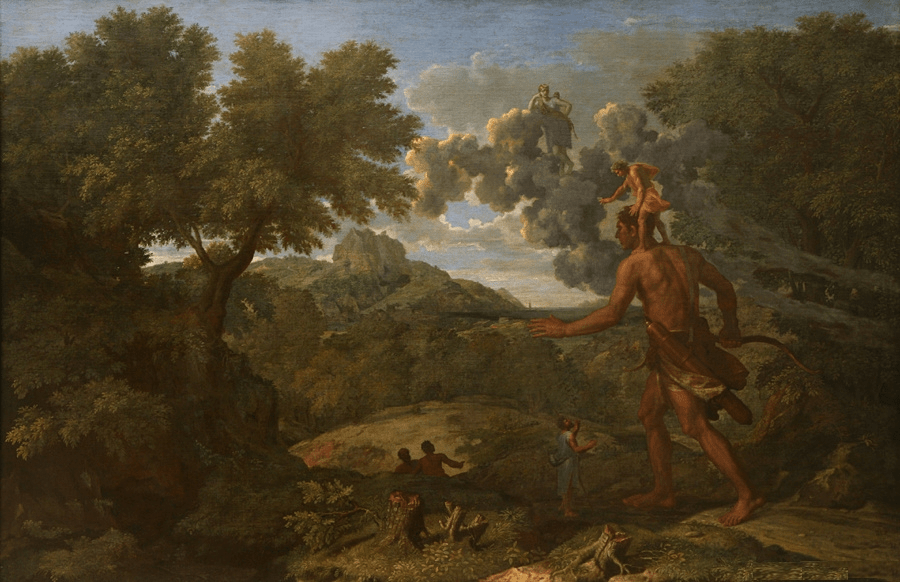
The French Baroque painter Nicolas Poussin’s Blind Orion Searching for the Rising Sun (1658) offers a related example of the giant body organizing landscape. Orion advances through hills, water, woodland, and clouds with the smaller figure Cedalion on his shoulders.
His immense scale establishes the measure of the surrounding terrain, while his movement directs the viewer toward the distant horizon. The landscape becomes legible through the giant’s stride, outstretched arm, and relation to the sky.
The art historian E. H. Gombrich connected Poussin’s treatment of Orion to the mythographical writings of Natalis Comes which associate the figure with the coming of clouds and rain. The art theorist and semiotician Lucia Corrain later described the dark cloud above Orion as a formal double of his body, repeating its mass and direction across the sky.
While Orion belongs to classical mythology and Saint Christopher belongs to Christian hagiography, both figures appear as immense bearers carrying smaller companions across land or water.
Poussin’s painting represents atmospheric changes through the movement of mythological creatures, providing a useful visual comparison for the monumental Saint Christopher images in Venice and Paete.
VENICE AND PAETE
A loose translation of Rizal’s words, Benedict Anderson uses the phrase “spectre of comparisons” to describe how distant places can become meaningful when viewed alongside one another.
Venice and Paete may look uncanny to compare, but they are linked by a long history of St. Christopher’s iconography.
While each work belongs to its own historical setting and devotional context, it is still fascinating to think how some images endure and are truly catholic (with a small c).
In all these works, the giant figure organizes the surrounding landscape: Titian’s Saint Christopher strides through the Venetian lagoon, Poussin’s Orion moves across an imagined landscape of hills, water, and clouds and Dans’s Saint Christopher rises above a lake, a shoreline settlement, and tropical vegetation.
It’s not hard to imagine why devotees from Venice and Paete held fast to this image. Both communities were shaped by their proximity to water and with the frequent floods and corruption that have wrecked our infrastructure, it is a highly symbolic gesture that our historians are restoring the country’s best known image of Saint Christopher, two paintings that connected safe passage and protection with the landscape experienced by the people who viewed them.
Geronimo Cristóbal
Geronimo Cristóbal is a lecturer in Art History at Ateneo de Manila University, and a PhD candidate in the History of Art and Archaeology at Cornell University. He serves as an international correspondent for the Philippines Graphic. He can be reached at gc448@cornell.edu.

 has begun the long-awaited conservation on two monumental paintings conventionally designated San Cristobal I and San Cristobal II at the parish church of Santiago Apóstol in Paete, Laguna.)