
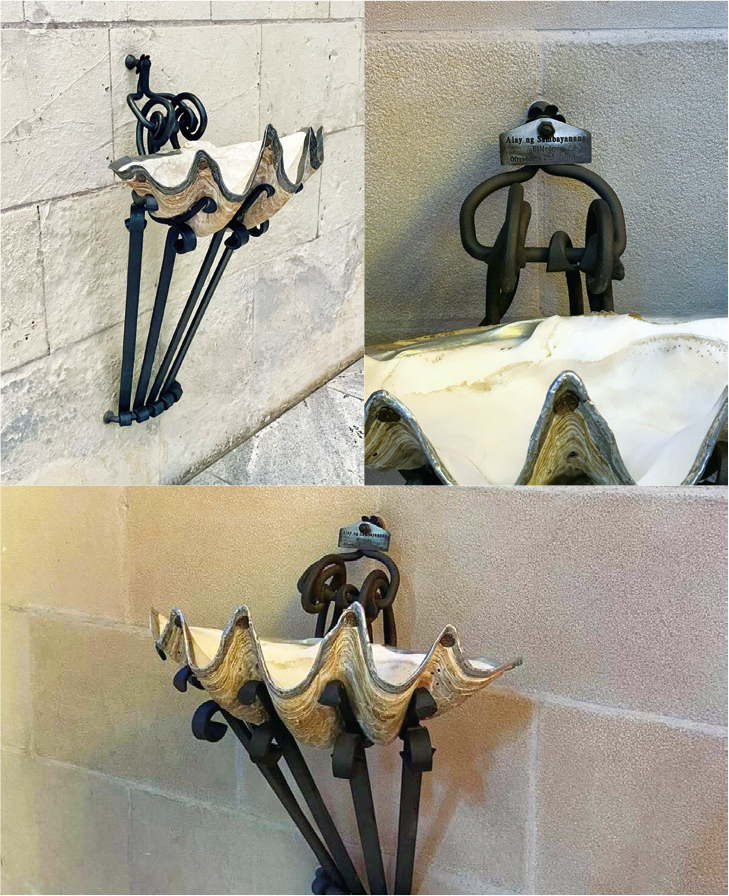
When I visited the Sagrada Família, I noticed six giant clam-shell holy-water stoups from the Philippines installed near the rear of Architect Antoni Gaudi’s basilica.
Each shell is accompanied by a plaque inscribed in Filipino and Spanish reading: “Alay ng Sambayanang Filipino/Ofrenda del pueblo Filipino.”
According to numerous reports by the Philippine Embassy, these shells were presented as a national gift to Spain in 2010. Contemporary records suggest, however, that Philippine shells had already been installed before 1927.
The use of giant clam shells for holy water stoups perfectly aligns with the original design intentions of Antonio Gaudi (1852-1926), who directed the construction of the basilica from 1883 until his death in 1926. Archival accounts indicate that Gaudí specified large marine shells to be sourced from the Philippines to serve as holy-water fonts and designed their supports accordingly. The first shells were installed while Gaudí was still alive.
Because of this fact, it can be surmised that these liturgical objects entered the basilica in stages: first through the architect’s original orders for marine-shell stoups and later through additional pieces presented as diplomatic gifts.
Gaudí’s choice of Philippine shells belongs to a larger architectural vocabulary in which bone, shell, water, and mineral forms shaped his vision of sacred space, from Casa Batlló and Park Güell to the branching columns of the Sagrada Família.
The Philippine shells at the Sagrada Família also continue an older Catholic use of shells in the archipelago. Since at least the 17th century, mother-of-pearl and mussel shells in the Spanish Philippines have served as baptismal vessels. Their engraved surfaces joined Christian imagery with local techniques of incision and pigment darkening, drawing on precolonial shell-working traditions.
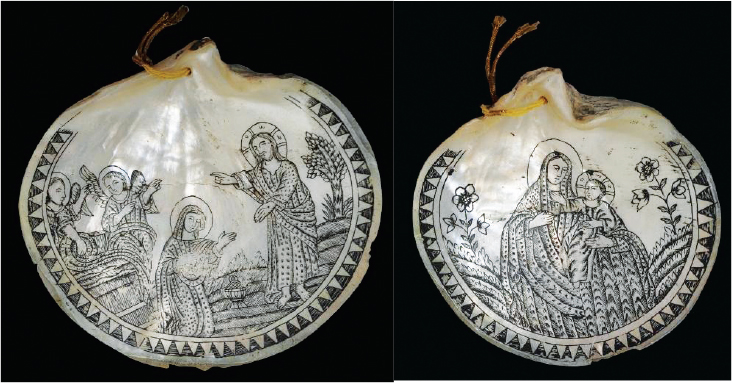
As liturgical vessels, they linked marine material to water, purification, and rebirth.
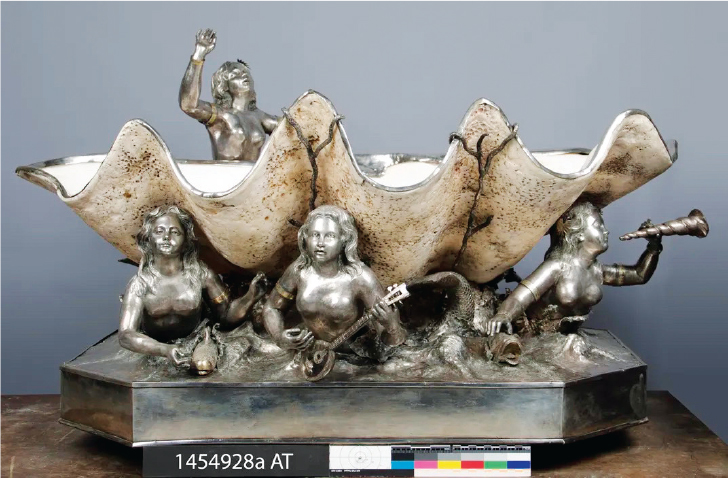
At the close of the Gilded Age, under American colonial rule, Philippine clam shells also became objects of imperial display. The Zamora Table Service, made in Manila around 1903 by Fernando Zamora, likely with his brother Tomás, for the 1904 Louisiana Purchase Exposition, centered on a monumental taclobo mounted as a punch bowl on a silver-plated base adorned with fish and mermaids. Like Gaudí’s stoups, it transformed the giant clam shell into a work of ritualized display, this time within the spectacle of empire.
DIFFERENT MATERIAL
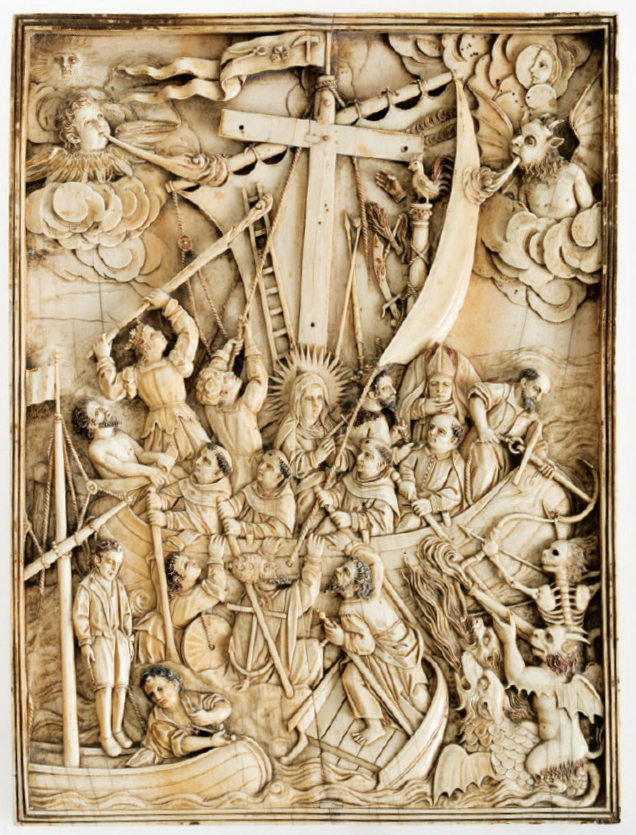
Ivory was another major material of Catholic religious imagery in the Philippines. Unlike shell, it was not locally sourced: elephant tusks reached China and Manila through long-distance trade linking Africa, India, and Southeast Asia.
In and around Manila’s Chinese enclave, especially the Parián, Chinese carvers transformed imported ivory into Christian images for local devotion and export.
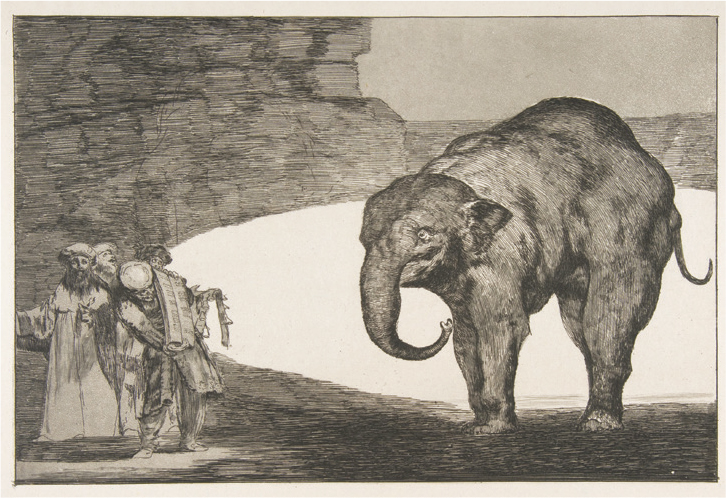
Manila’s material association with ivory became more manifest in 1773, when an elephant from the Coromandel Coast was sent through Manila by Governor Simón de Anda y Salazar to King Charles III of Spain. The animal caused a sensation in Madrid and provided the model—or at least the remembered source—for the elephant Francisco de Goya later drew and engraved in 1816.
The Santa Margarita shipwreck provides important evidence for the scale of ivory craft production in Manila. The galleon left Cavite in July 1600 and sank in 1601 off Rota in the northern Mariana Islands, along the route to Mexico. More than 300 ivory sculptures and fragments were excavated from the wreck, providing a dated body of Hispano-Filipino ivories and showing the scale of Manila’s export production by 1600. Their recovery gives scholars a dated group of Hispano-Filipino ivories and shows that comparable works often assigned to later periods may have been produced earlier.
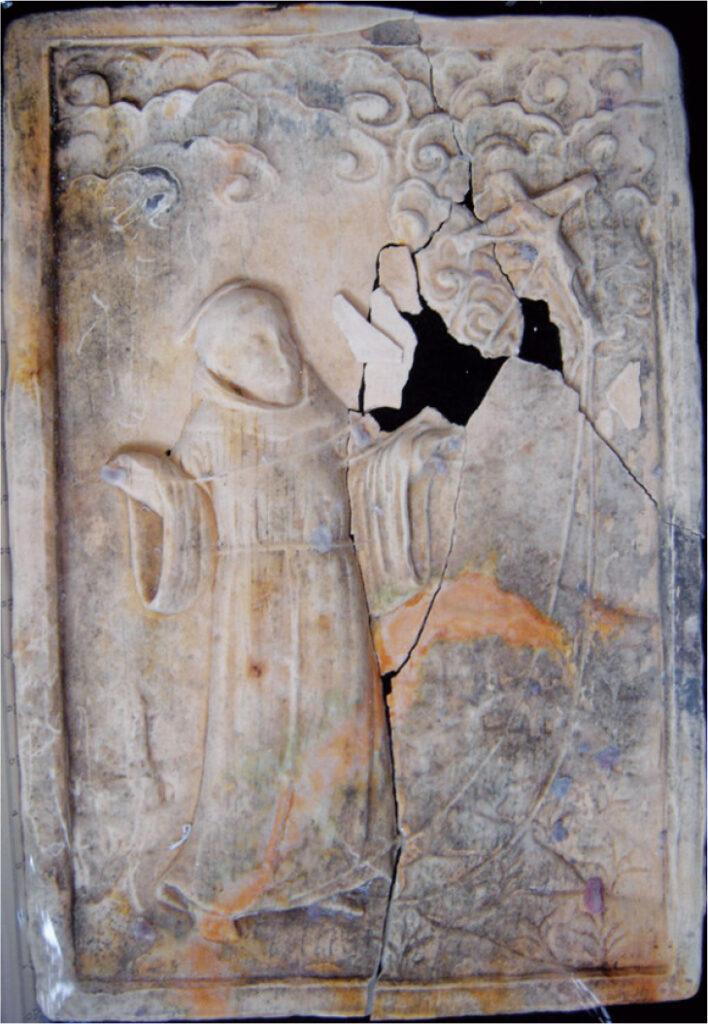
British art historian Marjorie Trusted observes that their small scale was suitable for private devotion and as souvenirs.
The repeated subjects and compositions among the Santa Margarita ivories suggest organized workshop production and strong demand for popular sacred images. Catholic iconography encouraged stable, recognizable forms that could be mastered and transmitted across generations.
Trusted explains that religious images helped convert new Christians and sustain devotion. Larger ivory figures entered aristocratic collections in Spain and Europe or were treasured in Iberian chapels and churches, valued for their sacred subjects, rare material, and intricate carving.
A 1590 letter by Domingo de Salazar, Manila’s first bishop, praised the sangleyes for reproducing Spanish models, especially ivory statuettes of the Child Jesus. He noted that churches were already being furnished with their images and suggested that Manila’s craftsmen could reduce dependence on imports from Flanders.
ESSENCE AND RARITY
From at least the early 19th century, Manileños recognized the affinity between rare materials such as shell, silver, and ivory, and sought to combine them in their most precious possessions.
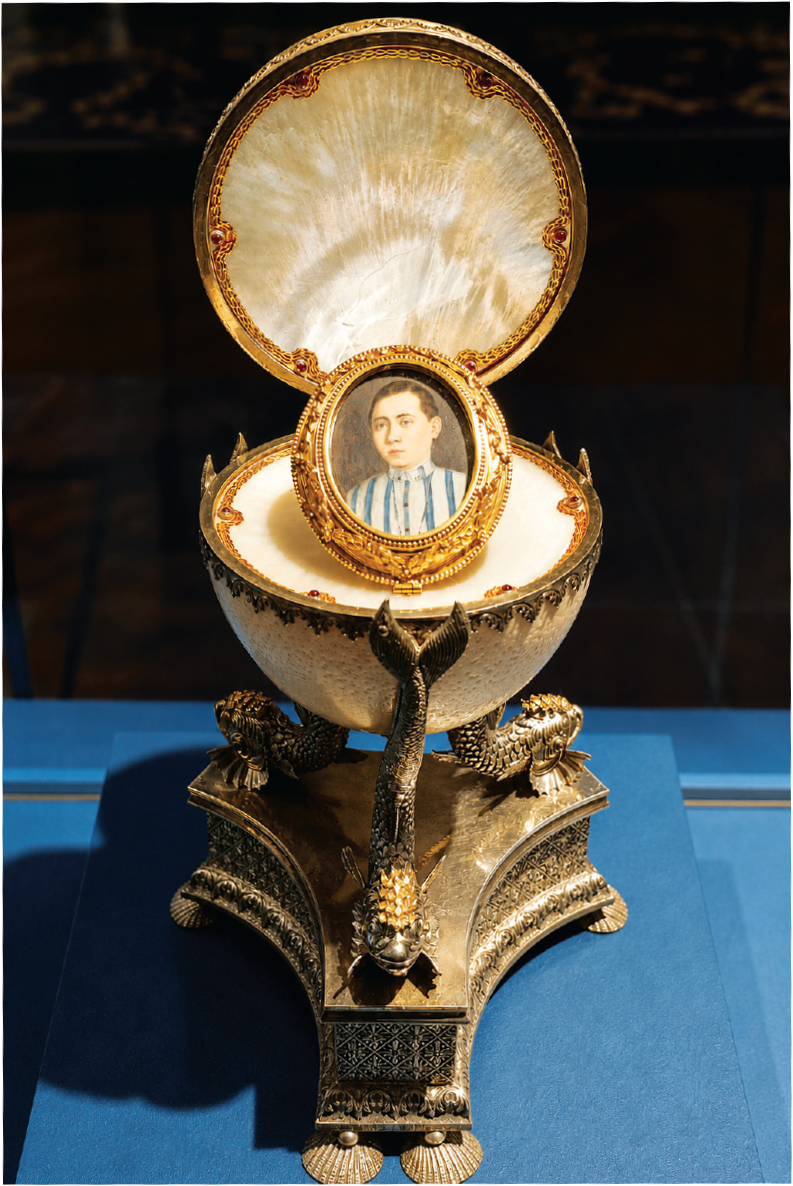
Damian Domingo’s 1826 Portrait of a Gentleman makes this convergence especially clear. The thin ivory plate provides a smooth, pale, slightly translucent ground for delicate likenesses. It was later set into an oval gold frame and mounted inside a hinged ostrich-egg container lined or faced with mother-of-pearl. The luminous shell surface is secured by small gold-toned clasps and surrounded by ornate metal fittings.
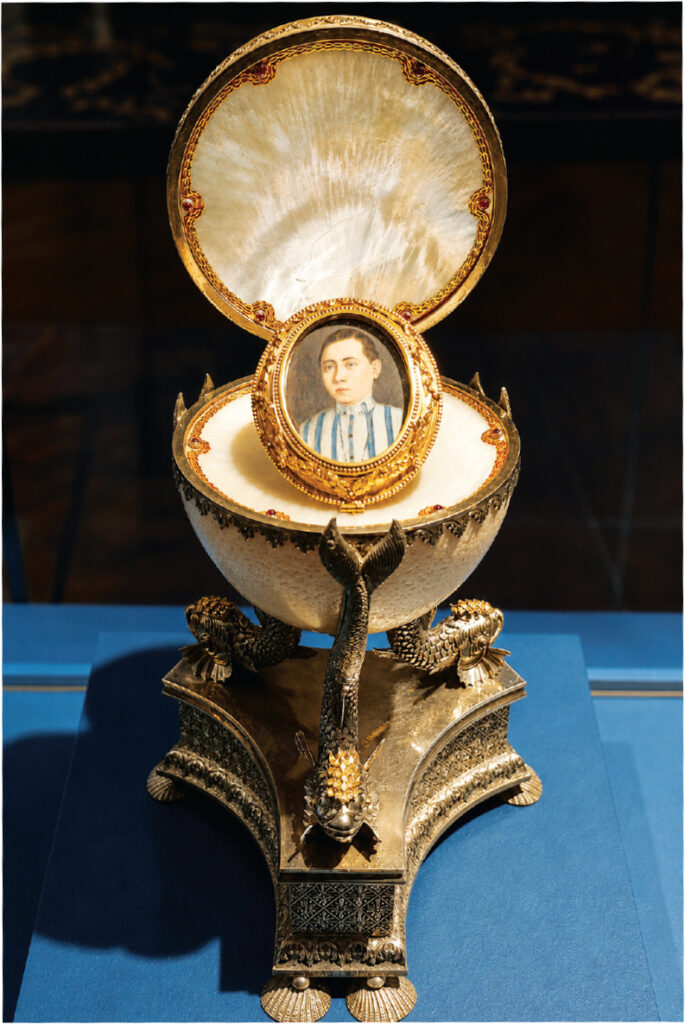
Below, the object rests on an elaborate silver base with repoussé ornament, shell-shaped feet, and projecting carp figures at the front. The object belongs to the same world of high-level Manila metalwork later seen in the Zamora Table Service: rare organic materials were mounted, protected, and elevated through silver.
The artists and collectors of Domingo’s generation expressed their admiration for craft through the care with which they used materials to preserve the likenesses of loved ones. Their legacy remains visible in scholarship today, where shell, ivory, and silverwork are closely identified with Manila and Philippine makers.
In a world where artistic value is often obscured by hype, these objects offer a clearer lesson: rare materials gained meaning through their relation to one another and through the skill required to bring them together. Taking our cue from the Philippine shell’s place in Gaudí’s vision of marine purification for his magnum opus, we can see that these luxury materials did more than decorate the image. They made the ivory portrait more meaningful, deepening its intimacy as a cherished possession.
Geronimo Cristóbal
Geronimo Cristóbal is a lecturer in Art History at Ateneo de Manila University, and a PhD candidate in the History of Art and Archaeology at Cornell University. He serves as an international correspondent for the Philippines Graphic. He can be reached at gc448@cornell.edu.