
When this magazine was being planned I told the organizers of it that I would join in only if assured that the PHILIPPINE GRAPHIC would regularly publish fiction and verse. Every week for sure; in every issue without fail.
To tell the truth, that condition I imposed was sheer bravado. I had this nervous feeling that there might not be enough material to ensure the GRAPHIC a weekly literary section. The fear was that we might have to make do with just an occasional story or poem—or, worse, that to keep our beautiful letters more or less regular we would be reduced to using inferior material, desperately edited.
The standard excuse on magazine row for not carrying literature is that there just ain’t enough good writing being done in English in the Philippines to keep a literary editor supplied; and that such editors balk at toiling on contributions that practically have to be rewritten from start to finish to become printable at all. As a result, the lit ed has become journalism’s Mohican, a species not endangered but nearly, almost extinct. And with him goes a whole sky and galaxy of Philippine letters.
But I didn’t feel like letting him go. I was determined to bring him back. A debt of gratitude compelled me to resurrect him. Not myself only but the entire host of Filipino writers in English (the great Villa not excluded) owed their recognition to the lit ed who patiently supervised their novitiates and cued their epiphanies. Where would my witless tribe be but for the offstage ministrations of an Ike Icasiano, a Serafin Lanot, an A.E. Litiatco? They and the nameless others of their kidney godfathered a culture, godmothered a literature: the most far-out in English, antipodes and ultima Thule, exotic as outpost but waiting to be discovered as a suburb of the Thames and the Mississippi. Not to mention the “magic realism” of La Hispanidad.
My debt to the lit ed, I felt I had discharged during the 20 years when I was myself a lit ed, on the Free Press Magazine, discovering young new talent, all the way from Ben Bautista and Cirilo Bautista, through Nina Rosca and Erwin Castillo, to Alfred Yuson and Federico Espino Licsi. And toiling over the manuscripts of Ibrahim Jubaira and E. Alvarez Enriquez.
Even in those days—the 1950s and ’60s—the lit ed was already evanescent and the Free Press was about the only weekly still reserving space for creative prose. How different from the time of my beginnings, when there were outlets galore for writers: in prewar days every newspaper had its Sunday or midweek supplement, which had fiction and verse for chief feature; and there were moreover the weeklies and monthlies that would have felt meager if not graced with at least one short story per issue. How lucky were the young writers then; and how unlucky the novices of today who have nowhere to make a splash.
And that explains Rule No. 1 of the GRAPHIC: fiction and verse in every issue. But after years and years of no literary outlets, wouldn’t the writing tribe be dead by now?
What a heavenly surprise therefore were the manuscripts that started pouring in the moment that word got around about this new magazine accepting fiction and verse. And they haven’t stopped pouring in. It seems the muses never left here: the publishers might ban them but they simply went on nursing one generation after another of apollonians—whom the GRAPHIC would now save from being mute Miltons. And the seven short months of its maiden year have sufficed to turn up several talents very worth discovering.
For astounding is not just the quantity of material but the quality of it—and the youngness of authors. There may be a withering in general of English in the Philippines but one would never guess it from these contributions, which average quite a steep level of skill and style.
As evidenced by our three prize stories for 1990.
How rich the harvest was, let an anecdote attest. The contest judges were Ateneo Professor Cynthia Lumbera, veteran fictionist Gregorio Brillantes, and myself. I proposed that each of us pick three stories ranked according to order of preference; stories that occurred on more than just one list would then qualify for the final judging. But when making my pick I found so many stories vying for my nod that I ended up with a list of, not three, but six choices—and what a job cutting that list down to six!
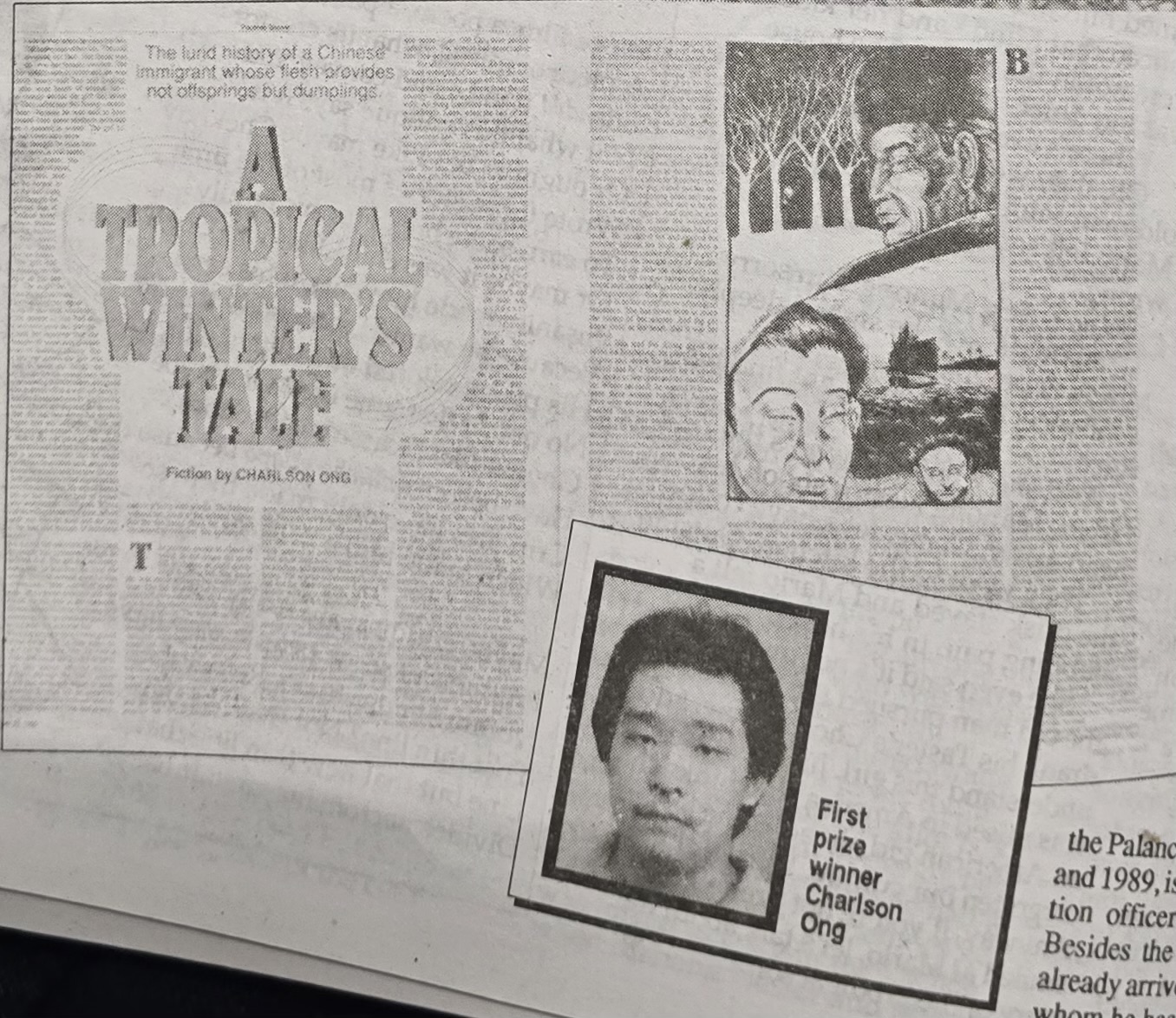
My six choices: “A Tropical Winter’s Tale” by Charlson Ong (GRAPHIC, October 10, 1990); “The Seer” by Felix Fojas (November 5, 1990); “Week of the Whales” by Leoncio Deriada (November 12, 1990); “Lola” by Danton Remoto (December 3, 1990); “Men Are Cheats” by Renee Lopez Dacquel (October 8, 1990); and “The Last Story” by Clovis Nazareno (October 15, 1990).
All six have one quality in common: narrative power. They’re the kind of story that, once begun, you can’t put down. They’re cunningly crafted, expertly plotted, unlike the arty plotless musings that were once in vogue among neophytes. Thank God the short story is back as story and can again be rated as interesting and readable and spellbinding.
In the final judging the three judges were unanimous on the Charlson Ong story for the first prize and on the Leoncio Deriada story for second prize. For a while Professor Cynthia Lumbera wavered over her third-prize choice, attracted as she was to “Lola” by Danton Remoto, but finally she decided to pick the Clovis Nazareno story too, thus making all three wins unanimous.
Charlson Ong, whose “A Tropical Winter’s Tale” exposes rather horrendously the Chinese scene in Manila, was born in 1960 and schooled at Xavier and UP. He has won in the Palanca Awards and the CCP playwriting contest; was second prize winner in the 1988 Asiaweek short story competition. His Men of the East and Other Stories rated a review in Time Magazine. A freelance journalist, he also writes for TV.
A touch of the mystical accentuates the humdrum round of village life in “Week of the Whales,” whose author, Leoncio P. Deriada, was born in Iloilo, grew up in Davao City, is now assistant professor of comparative literature at UP Visayas. His master’s thesis was on “Cinema as Literature.” He writes in English, Tagalog, Cebuano, Hiligaynon and Kiniray-a; has won nine Palanca prizes, three CCP playwriting awards, and three Focus Magazine prizes; and was second-prize winner in the 1981 Asiaweek short story competition. HIs fiction collection, The Road to Mawab, was published by New Day in 1984.
A delightful read and a witty romp is “The Last Story” by Clovis Nazareno, who exults that his prize comes in the nick of time: his wife is about to give birth. Born in 1960 in Loon, Bohol, Nazareno has been a fellow of various writers’ workshop (UP, Siliman, San Carlos U), won the Palanca third prize for poetry in 1988 and 1989, is at present the public information officer of his native municipality. Besides the about-to-be-born (or has it already arrived?), he has already one son, whom he has named Argosy.
Written by Nick Joaquin. Published by the Philippine Graphic on March 25, 1991.
Graphic Archive
The Graphic Archive contains the articles and literature published in the Philippines Graphic since it was first established in 1927.