

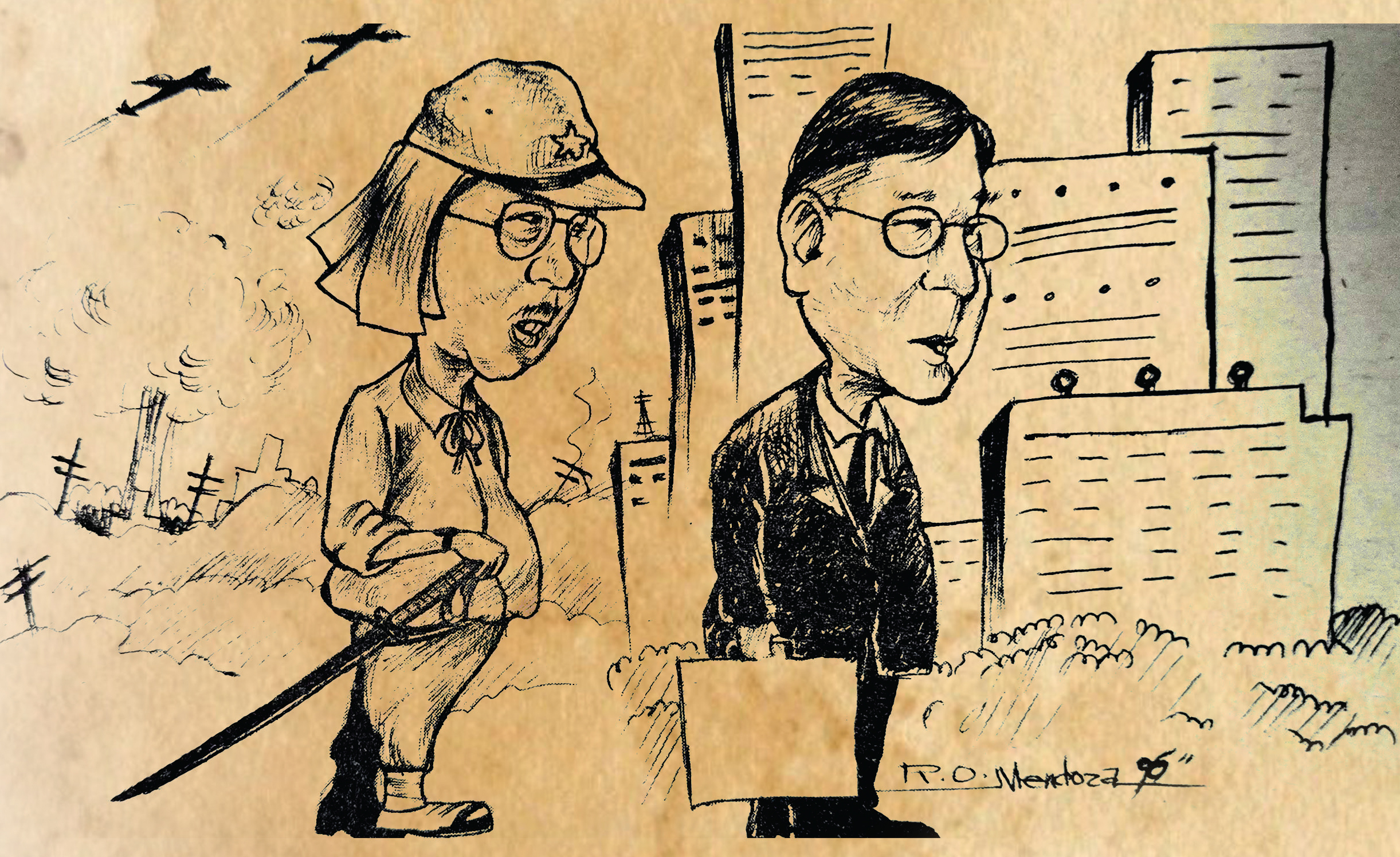
It is fashionable these days—both in and outside Japan—to argue that Japan is in the process of “re-Asianization.”
This view is part of the larger argument that all of Asia, including Japan, is asserting a distinct Asian identity in economic affairs, security arrangements and social and cultural values.
The evidence to support this view is cited as the rapid growth of economic development—and the self confidence gained by Asians as a result—and the scaled down U.S. military presence in Asia.
Singapore’s trumpeting of Asian values, Japan’s highlighting of the success of its economic model and Malaysian and Korean nationalism are often mentioned as other examples.
While this “re-Asianization” has been taking place for years, Japan has had a very ambivalent role in the process.
Indeed, a re-Asianization of Japan is an oxymoron.
For most of its modern history, Japan has not been part of Asia, and since the end of World War II, the basis of its security relationship with Asia has been overshadowed by U.S. Cold War logic.
What is happening in Japan is not its re-Asianization but Japan’s “reassociation” with Asia in the economic, security and socio-cultural spheres.
This process began when Japan’s increasing economic power led it to nurture relations with Asia.
Ironically, the first step was Japan’s war reparations to certain Asian countries, followed by diplomatic
normalization and subsequently the extension of Japanese business activities to Asia.
The 1973 oil crisis then led Japan to develop the concept of “comprehensive security” which recognized Japan’s critical need to secure foreign energy resources and focused on ensuring free passage at sea. Yet this expansion of security interests was possibly only in conjunction with the United States armed forces.
The 1991 collapse of the Soviet Union was of foremost importance to Japan’s security interests, yet (not surprisingly) resulted in no more than an emphasis on the critical importance of the Japan-United States security relationship—not just for Japan, but for all of Pacific Asia.
Accordingly, the Japan-United States Security Treaty—the region’s longest-functioning security mechanism—was revitalized to ensure Pacific Asia’s security. Arguments against the treaty, however, are heard in both countries.
In the United States, there have been growing calls for a post-Cold War peace dividend from groups that say Americans should not waste resources when its allies are unwilling to bear the cost of the alliance.
In Japan, calls for the termination of the treaty, once restricted to left-wing forces and extreme right-wing nationalists, have been heard since 1991 from the center-right.
In the 1950s and 1960s Japan’s economic ties with Asia were insignificant in comparison to its economic ties with the United States. But the dramatic rise of Pacific Asia’s economies in the 1980s and 1990s placed Japan’s economic relationship with Asia on a par with its relationship with the United States.
The relative pattern of Japan’s trade, investment and official concessional flows with these countries has roughly coincided with their developmental momentum: first Thailand and Malaysia, then Indonesia and the Philippines, and now China, Vietnam and Burma**.
In the 1990s, the acceleration of globalization and liberalization of economic activities was especially pronounced in Pacific Asia, which depends critically on free access to export markets and energy supplies and so is a clear beneficiary of the international free trade regime.
However, intra-regional diversity in terms of development and income level has encouraged many Pacific Asian nations to rely primarily on the General Agreement on Tariffs and Trade (GATT) and subsequently the World Trade Organization (WTO) on trade matters.
Only very recently have the Asia Pacific Economic Cooperation (APEC) and forum and other more regionally oriented economic institutions become prominent.
However, the United States sees much of Pacific Asia as a bastion of regulation and protection. This perception, coupled with the region’s perennial trade surplus with the United States, has led Washington to embark on a politically-driven unilateral crusade to liberalize Pacific Asian markets.
Ultimately, the answer to the question of whether Japan is a part of Asia lies in how the Japanese located World War II in their national consciousness.
The Japanese version of history is roughly as follows: From the very beginning of Japan’s encounter with the West, the Japanese found themselves up against a military, economic and civilizational onslaught. To cope with or overcome possible colonization by the West, Japan modernized its army, industrial base and government, achieving two major military victories against China and Russia. The country became the first modern non-Western economy before World War I and one of the first modern non-Western governments to introduce a form of parliamentary democracy in the late 19th century.
While Japan’s war against its Asian neighbors is widely recognized as wrong, Asians also were victimized by Westerners as Asia became an arena for imperialist competition between two powers.
Thus a clear-cut evaluation of Japan’s role in the war is difficult.
Japan, therefore, has not been able to come to terms with Asia as understood by Asians in the framework of Allied powers of the Second World War.
As a result Japan’s psychological relationship with Asia has not been fully harmonious. For this reason, psychologically speaking, juxtaposing Japan with Asia is more comfortable for many Japanese than placing it within Asia. (Inter Press Service.)
(The author is senior vice-rector at the United Nations University in Tokyo and author of “Japan’s Foreign Policy in an Era of Global Change” and “Japan: The Governing of an Economic Superpower.”)
Written by Takashi Inoguchi. This was first published in Philippine Graphic on April 15, 1996.
(** Modern-day Myanmar)

Graphic Archive
The Graphic Archive contains the articles and literature published in the Philippines Graphic since it was first established in 1927.