

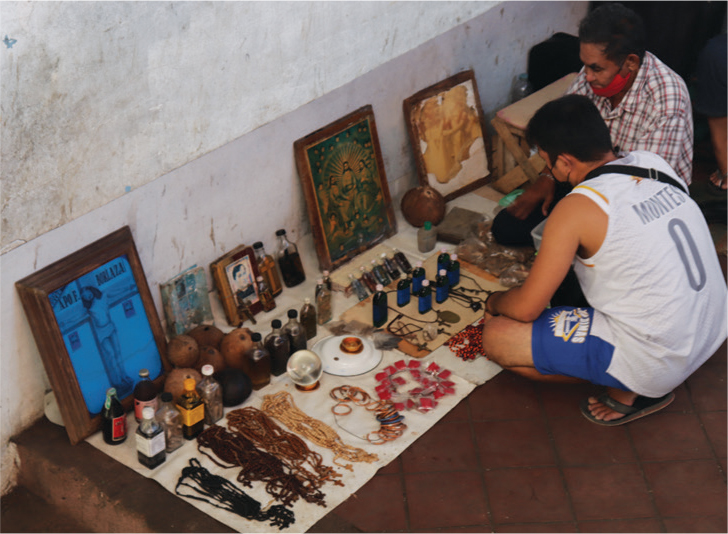
Even before the arrival of the Spaniards in 1521, Filipinos believed strongly in the existence and power of the supernatural.
A datu, or the local tribe leader, normally sought the advice of the respected and powerful babaylans—shamans, or commonly priestesses, who can connect with the spirit world, heal people, and perform supernatural feats.
Folktales shaped our oral traditions. In rural communities and indigenous tribes, the grip of folk culture and faith is strong, emanating from the songs and stories told in gatherings, or in festivals that unite the entire town.
Perhaps it was also for these reasons that religion—Christianity, Islam, and others—had such a strong influence. And no wonder, as well, that faith healing and folk healers— or the albularyo (or in the story, herbolario)—are still prevalent, despite continuous advancements in medicine. The approaches may clash, but they continue to coexist in many communities.
This was the same situation that encouraged Lourdes C. Aballe to write “Did He Really Operate on Him?” for the Graphic more than 65 years ago on September 28, 1960.
FAITH HEALING IN 1960
“Up to now, I can’t quite explain how this quack doctor did it,” began Aballe. “My high school teachers in biology and general science had always told us not to believe in quackery, exorcism, superstitions of old folks. Still I really would want them to explain this amazing occurrence which I witnessed.”
At the center of the article was a man named Ernesto Torres, who was a working student at the Mindanao Colleges (now the University of Mindanao) in Davao City, and a friend to the article’s author Aballe, as Torres often frequented their house where, nearby in a cove not so far from the house, he would go fishing with Aballe’s brother.
“Tired of fishing, he would stand on a dead tree stump and practice delivering speeches,” she wrote in the article. “Old folks warned him not to make much noise there; the place was hallowed to some supernatural beings, [as] they said. But Ernesto only laughed them off, and he shouted his orations louder.”
But things took a different turn when Torres felt an “increasing stomachache and splitting headache.” He was confined in Davao General Hospital (now called the Southern Philippines Medical Center) for two weeks, where his condition showed no signs of improving.
“Hospital physicians had given [up on him], so we desperately thought: Why not take him to a herbolario? Father went to see an herb[al] doctor named Patricio Digamo who lived in a barrio a few kilometers from Santa Cruz, our town.”
When told of Ernesto’s condition, Digamo instructed them to bring Torres at his house at 8 o’clock in the evening for the operation, alongside a list of items: one white chicken, a ganta of rice, cigarettes, a bottle of pomade, a dozen eggs, and a bottle of rum.
“At eight, he raised his hands [in] silence, then he murmured some Latin- like words. Suddenly Digamo fell on the floor unconscious, and we all got excited. But his assistants explained that the herbolario was exchanging spirits with his invisible friend. This spirit would do the operation, they said.”
During the operation, the herbolario made an incision, scooped out “a live, wriggling, thumb-sized cucumber looking thing about three inches long,” and then scooped a “spoonful of mud.”
“Digamo told Father and Mother that Ernesto had caused the anger of a nuno, [or an] old spirit, who inhabited the fishing cove, with the noise of his loud orations. After that, the herbolario and Ernesto went to the fishing cover, and Mother and I followed with the white chicken,” Aballe wrote.
FOLK HEALING PERSISTS
Written 65 years ago, the account is difficult to independently verify today. It remains common for the gravely ill to seek alternative medicine, especially when the hope of getting treated in a hospital is slowly fading. To this day, many people still believe in the power of folk healing.
For many years, the news magazine show Kapuso Mo, Jessica Soho, which airs on GMA Network every Sunday, frequently featured such cases.
Faith healers are varied in their style and execution, or the degree of absurdity of the feats they claim they are capable of doing.
LEGITIMIZE ALBULARYOS?
In 2015, the BusinessMirror reported of a program launched by the Department of Science and Technology “that would mainstream traditional healers or albularyo in the medical field.” Claudeth Mocon-Ciriaco wrote that the DOST “partnered with the Philippine Institute for Traditional and Alternative Healthcare [or PITAHC] for a P100-million, five-year survey and research to be able to give certification to the albularyo in 2016.”
One of the revelations from the partial results of the survey was that the onslaught of Western medicine had turned the practice of albularyo into a “dying profession.”
As pandemic struck wide and strong in the Philippines, the Senate discussed in 2021 about the need to regulate albularyos and other traditional medicine providers.
According to Annabelle De Guzman, who was then PITAHC’s director general, this would protect the public from “fly-by-night and unregistered practitioners.”
In that same year, a research from Centro Escolar University’s School of Medicine focused on folk medicine in the country revealed some truths about the behavior of those who seek the help of alternative medicine.
Published in the International Journal of Medical Students, the study found that “the acquisition of such products is attributed to satisfaction from prior experience, distrust in the current healthcare system, family tradition, and intention to supplement existing medical treatment.”
Dr. Rodrigo Ong, the former chief of PITAHC’s Research and Development, said in a 2023 press briefing that they have, at that point in time, identified almost a hundred thousand traditional and alternative healthcare practitioners in the country, which includes albularyo, manghihilot, and acupuncturists. Around 1,400 were duly registered—none of which were albularyos.
UNDYING FAITH
Despite the concerns of albularyos becoming a dying profession, with our country’s culture and roots so deeply tied in the belief of faith and spirits, folk healing won’t be going away any time soon.
More than six decades later, little has changed since Aballe wrote her Graphic article. There are still those who believe in the power of folk healers, or those who cannot explain their scientifically impossible feats— especially the albularyos who are said to have “treated” someone whom doctors have supposedly given up on.
As science and technology have advanced, death is no longer something we are powerless to fight. At one point in time, migraines used to be treated by drilling a hole at the patient’s skull; now, one only has to take a trip to the local drugstore for some medicine.
Some medicines, like lagundi (the five-leaved chaste tree), have been used for hundreds of years as a herbal folk medicine for common colds, wounds, headaches, among others. Now it is legitimized, being recommended in modern medicine—even landing in the 75 medicines that are part of the PhilHealth GAMOT Program.
But with the combination of financial difficulties and the lack of access to treatment (or even proper hospitals in many towns across the country), the idea of miraculous and “guaranteed” healing for an affordable price, supported by testimonials of one’s kin or acquaintances, would undoubtedly be attractive in the eyes of someone who only wants to help their sick loved ones get better.
Published in the February 2026 Special Issue of the Philippines Graphic.
Von Zyron Alimorong
Von Zyron Alimorong is a writer and social media point person for the Philippines Graphic. He is based in Makati. His works often dissect human nature, infusing narratives with introspection and existentialist thought. He studied Literature at the University of Santo Tomas and served as a Literary writer for The Flame. He is also the rhythm guitarist for the band COALESCENCE.