
As we count the months, weeks, days, and hours to the centennial year of the Philippines Graphic in 2027, we will walk down memory lane. With every issue, we will present to our readers snatches of the distant past—captured in reprints of Graphic stories, editorials, columns, illustrations, and photos published during the first five decades of the magazine. It is our way of showing to our readers how unresolved issues and concerns travel across time and plant themselves squarely in our present and future. Hence, the need to learn. In the words of George Orwell: “Who controls the past controls the future. Who controls the present controls the past.”—Ed.
The earliest known public museum in history is the Ennigaldi-Nanna Museum in the ancient city-state of Ur around 530 BCE, established more than 2,500 years ago. It was named eponymously from the princess of the Neo-Babylonian empire and dedicated to the curation of Mesopotamian artifacts.
Two millennia later came Rome’s Musei Capitolini or the Capitoline Museums, which were founded by Pope Sixtus IV in 1471 in the Capitoline Hill. A group of museums showcasing the art and history of Ancient Rome, it is generally considered to be the oldest existing museum in the world.
Roughly four hundred years later, the Philippines would also establish its first one in 1869: the University of Santo Tomas (UST) Museum.
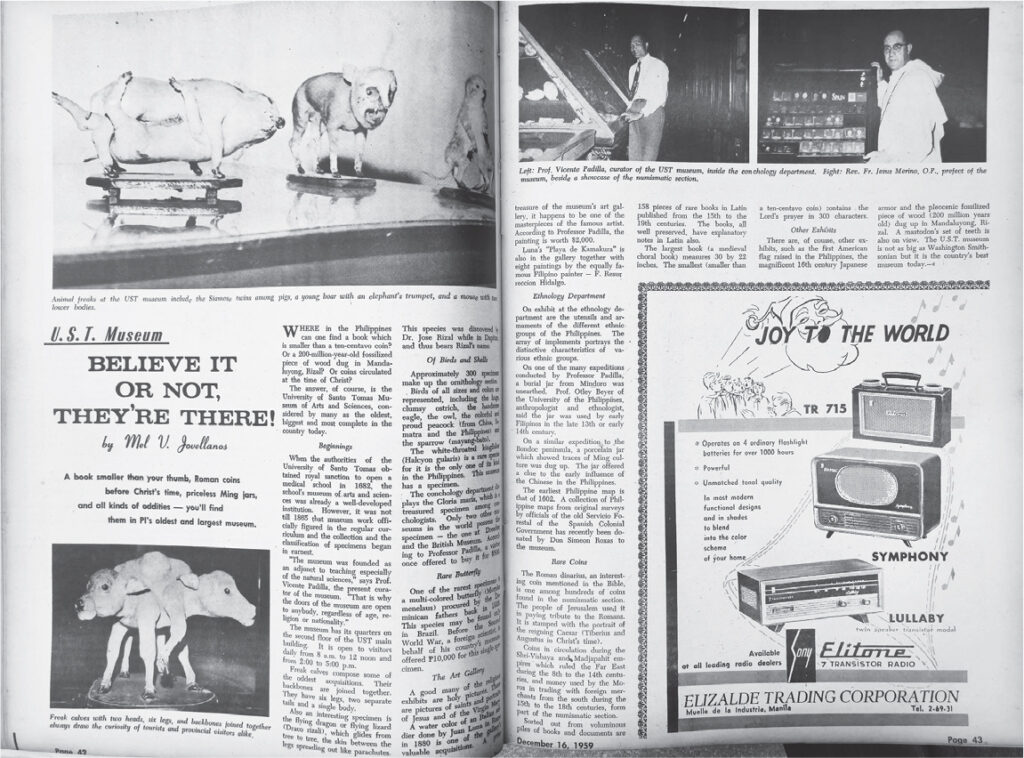
The Graphic came out with an article in December 1959 on what was then called the UST Museum of Arts and Science, considered to be the oldest in the Philippines.
In “U.S.T. Museum: Believe it or not, they’re there!” Mel V. Jovellanos toured the readers through the halls of the pontifical university’s own archival center.
“The museum was founded as an adjunct to teaching, especially of the natural sciences,” Prof. Vicente Padilla, the curator of the museum, told the Graphic in 1959. “That is why the doors of the museum are open to anybody, regardless of age, religion or nationality.”
To say that the museum’s collection by that year was “wide-ranging” would be putting it mildly: From 300 bird specimens which inhabit the ornithology section, a display of interesting shells in the conchology department (which housed one out of only three specimens of Gloria Maris (Conus gloriamaris) in the world), to butterflies, the ethnic artifacts of the ethnology department, very old coins dating back to Jesus’ time, and an art gallery housing the works of Juan Luna and F. Resurreccion Hidalgo, the UST Museum of Arts and Sciences sure lived up to its name.
The UST Museum of Arts and Sciences is “considered by many as the oldest, biggest and most complete in the country,” wrote Jovellanos in 1959. Of course, the throne of being the biggest and most complete museum has been crowned to a different one. The National Museum of the
Philippines alone has an entire complex in Manila dedicated to housing its three enormous repositories: Fine Arts, Anthropology, and Natural History.
MANY OF ITS KIND
Nowadays, museums are plentiful in the Philippines, coming in all shapes and sizes. What the UST Museum once presented as a uniquely wild and interesting space to house history, arts, and sciences, is now what is commonly expected out of museums, especially the large and famous ones like the National Museum in Manila, or Ayala Museum in Makati City.
But the one in España Boulevard in the City of Manila remains the oldest in the country, so it is privileged with an advantage that no other in the Philippines will ever attain: the benefit of having existed for a long, long time.
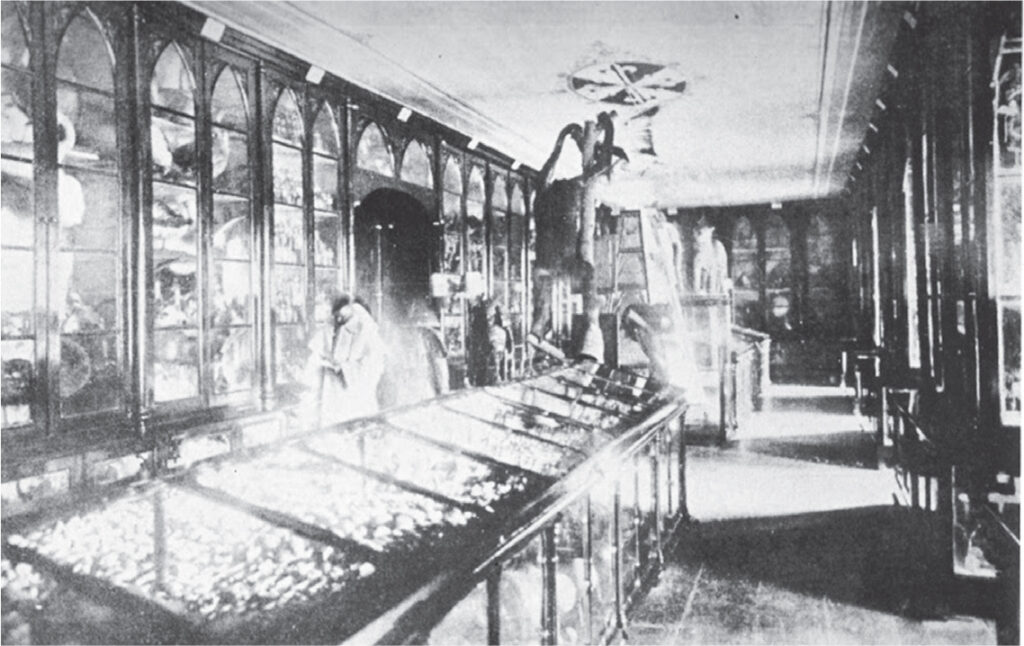
The variety of oddities in the UST museum which Jovellanos observed in 1959 presents an interesting case, because essentially, not a lot has changed about the museum in the 66 years that had passed since Graphic wrote about the matter.
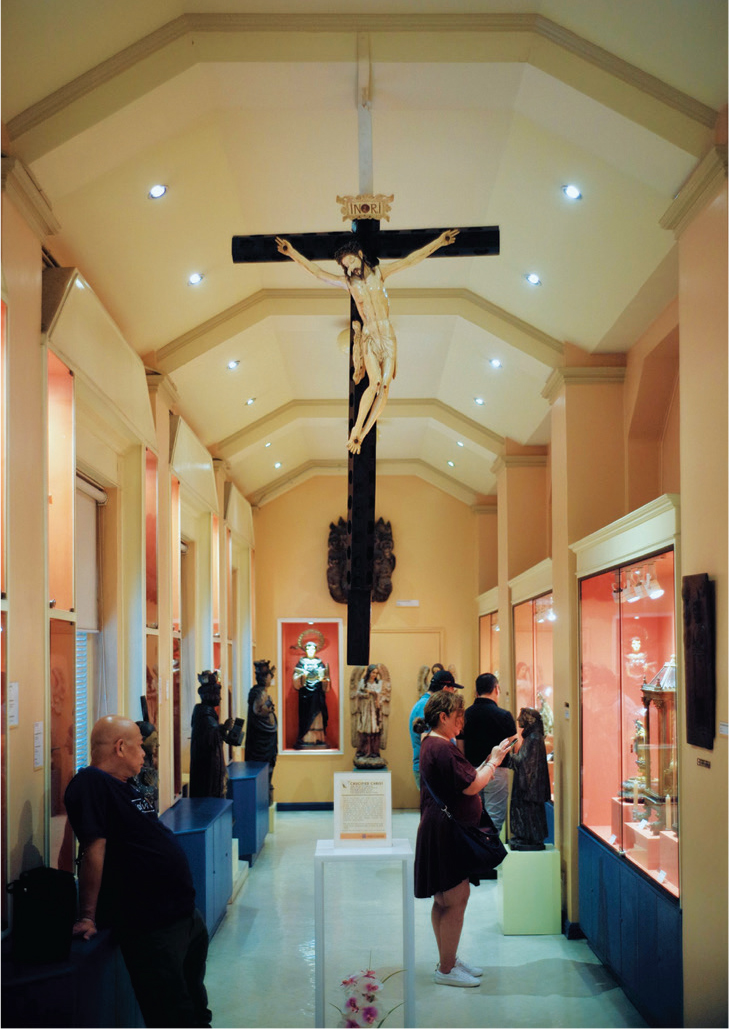
One hall remains reserved for religious artifacts, where the centuries-old and the world’s second-largest ivory figure of Christ hangs from the ceiling; paintings by Luna and Hidalgo still decorate the walls alongside other works like that of Fernando Amorsolo’s Bayanihan; and rare coins are still on display in the museum’s mezzanine. It does not mean that the museum remained as it was since its establishment.
Every now and then, the museum would host a special collection like the exhibit Nusantara: Indonesian Objets d’Art in September 2023, which featured around 150 arti-facts from Indonesia.
In the time that has passed, the museum has expanded its collection. So one might think that museums are places of permanence, where time freezes, capturing the soul of an era…
PRESERVING THE IMPERMANENT
But museums—or even the mere act of conservation and preserving pieces of history—does not freeze time; they slow down the passage just enough for the next couple of generations to experience and be mesmerized by them, just long enough for knowledge to be passed down. Museum preservation stalls the death of the inanimate, so that the time no longer here will continue to be remembered.
It is no different from a photo album—physical or otherwise; it stands as a reminder that a certain reality happened.
Museums are homes for anything orphaned by its own time, taken away from its supposed impermanence—its death put on hold—for our forgetful species to remember it to life once more.
Some might not realize it, but the public’s knowledge of history relies on a collection of representatives of a time outside their own. Think of them as ambassadors of their own kind; a select few chosen by both science and fate to tell their side of the story.
One does not need the entire deposit of Roman denarius to know how much one was worth or how they were used, or that they ever existed. We show one authentic coin to thousands of visitors to imprint an image in their memory where, hopefully, the knowledge of it is passed on across generations.
What we know of ourselves now is a product of what we know about what we once were. It is for this reason that it was inevitable for our species, who is cursed with the illness of forgetting, to erect museums.
For a species whose sense of worth is weighed upon what continues to be remembered, perhaps the concept of museums is as inevitable as our death. As a manner of mankind’s self- preservation, it has to find a way not to forget itself.
Published in the February 2026 issue of the Philippines Graphic.

Von Zyron Alimorong
Von Zyron Alimorong is a writer and social media point person for the Philippines Graphic. He is based in Makati. His works often dissect human nature, infusing narratives with introspection and existentialist thought. He studied Literature at the University of Santo Tomas and served as a Literary writer for The Flame. He is also the rhythm guitarist for the band COALESCENCE.